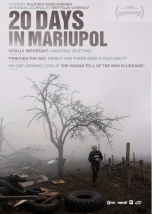
A team of Ukrainian journalists from The Associated Press trapped in the besieged city of Mariupol struggle to continue their work documenting atrocities of the Russian invasion. As the only international reporters who remain in the city, they capture what later become defining images of the war: dying children, mass graves, the bombing of a maternity hospital, and more. Drawing on director Mstyslav Chernov's daily news dispatches and personal footage of his own country at war, the film is a vivid, harrowing account of civilians caught in the siege, as well as a window into what it's like to report from a conflict zone, and the impact of such journalism around the globe.
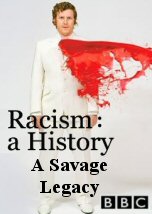
Examines the impact of racism in the 20th century. By 1900 European colonial expansion had reached deep into the heart of Africa. Under the rule of King Leopold II, the Belgian Congo was turned into a vast rubber plantation. Men, women and children who failed to gather their latex quotas would have their limbs dismembered. The country became the scene of one of the century's greatest racial genocides, as an estimated 10 million Africans perished under colonial rule.
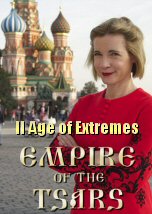
Lucy Worsley continues her journey through Russia in the footsteps of the Romanovs, the most powerful royal dynasty in modern European history. In this episode she examines the extraordinary reign of Catherine the Great, and the traumatic conflict with napoleonic France that provides the setting for the novel War and Peace. At the magnificent palace of Peterhof near St Petersburg, Lucy charts the meteoric rise of Catherine the Great, who seized the Russian throne from her husband Peter III in 1762 and became the most powerful woman in the world. Catherine was a woman of huge passions - for art, for her adopted country (she was German by birth) and for her many lovers. Catherine expanded her empire through military victories overseas, while at home she encouraged education and introduced smallpox inoculation to Russia. But Catherine struggled to introduce deeper reforms, and the institution of serfdom remained largely unchanged. Lucy explains how this injustice fuelled a violent rebellion. Nevertheless, Catherine left Russia more powerful on the world stage than ever. But all she had achieved looked set to be undone when Napoleon invaded Russia in 1812. Lucy relives the pivotal battle of Borodino, when the Russian army finally confronted the French forces; the traumatic destruction of Moscow; and, under Catherine's grandson Alexander, the eventual victory over the French that provided the Romanov dynasty with its most glorious hour.
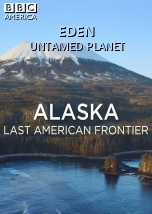
In Southeast Alaska, there's an ice-bound Eden that harbors possibly the richest temperate rainforests of all. Where the coastal mountains meet the Pacific, lays the Alexander Archipelago, a remote island chain running for almost 300 miles along the Alaskan Panhandle. This frozen frontier is one of the last great wildernesses of North America. And a stronghold for the country's highest diversity of megafauna, feasting on the abundance of fleeting summers to make it through relentless winters.
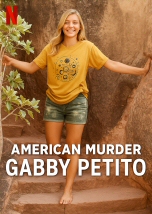
A young couple embarks on a cross-country journey to document their dream van-life adventure—until everything goes dark. Through social media posts, police bodycam footage, and never-before-seen interviews, this gripping true-crime documentary unravels the heartbreaking disappearance that captivated the world. As the clues begin to surface, so does a chilling portrait of control, isolation, and the desperate search for truth. What really happened in the quiet wilderness—and why did it take the entire internet to help find the answer? We offer all three episodes of this gripping series together—watch the full story unfold in one unmissable experience.
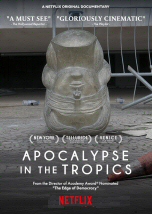
Click CC for subtitles. Oscar-nominated director Petra Costa presents a gripping investigation into the rise of evangelical power in Brazil, revealing how religious leaders have gained unprecedented political influence. With extraordinary access to President Lula, former President Bolsonaro, and Silas Malafaia, the country’s most powerful televangelist, the film uncovers a dramatic power struggle where apocalyptic faith becomes a political force. What emerges is a haunting portrait of a nation at a crossroads, where spiritual warfare is not just metaphor — it’s policy.






Drawing on director Mstyslav Chernov's daily news dispatches and personal footage of his own country at war, the film is a vivid, harrowing account of civilians caught in the siege, as well as a window into what it's like to report from a conflict zone, and the impact of such journalism around the globe.