








Last Watched

"HLA"  Sort by

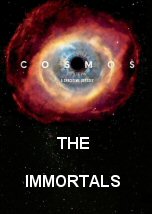
The Immortals

   2014    Science
This episode covers the nature of how life may have developed on Earth and the possibility of life on other planets. Tyson begins by explaining how the human development of writing systems enabled the transfer of information through generations, describing how Princess Enheduanna ca. 2280 BCE would be one of the first to sign her name to her works, and how Gilgamesh collected stories, including that of Utnapishtim documenting a great flood comparable to the story of Noah's Ark. Tyson explains how DNA similarly records information to propagate life, and postulates theories of how DNA originated on Earth, including evolution from a shallow tide pool, or from the ejecta of meteor collisions from other planets. In the latter case, Tyson explains how comparing the composition of the Nakhla meteorite in 1911 to results collected by the Viking program demonstrated that material from Mars could transit to Earth, and the ability of some microbes to survive the harsh conditions of space. With the motions of solar systems through the galaxy over billions of years, life could conceivably propagate from planet to planet in the same manner. Tyson then moves on to consider if life on other planets could exist. He explains how Project Diana performed in the 1960s showed that radio waves are able to travel in space, and that all of humanity's broadcast signals continue to radiate into space from our planet. Tyson notes that projects have since looked for similar signals potentially emanating from other solar systems. Tyson then explains that the development and lifespan of extraterrestrial civilizations must be considered for such detection to be realized. He notes that civilizations can be wiped out by cosmic events like supernovae, natural disasters such as the Toba disaster, or even self-destruct through war or other means, making probability estimates difficult. Tyson describes how elliptical galaxies, in which some of the oldest red dwarf stars exist, would offer the best chance of finding established civilizations. Tyson concludes that human intelligence properly applied should allow our species to avoid such disasters and enable us to migrate beyond the Earth before the Sun's eventual transformation into a red giant.
Series: Cosmos: A Spacetime Odyssey
Woodland

   2023    Nature
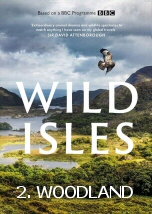
Sir David Attenborough explores the incredible diversity of Britain’s woodlands, taking us on a seasonal journey through our forests, and revealing a host of spectacular animals and the hidden dramas that rule their lives.
In an ancient pine tree in the Cairngorms, two eagle chicks are on the verge of fledging their gargantuan nest. In winter in the Forest of Dean, the reintroduction of wild boar has given the robin a lifeline. As they root through the thick snow, the boar unearth the worms with their snouts, which the robins otherwise couldn't find.
Back in Scotland, a male capercaillie displays to gathering females. These birds are on the edge. With only around 500 left, they are some of the rarest and most threatened in the British Isles. In a beech woodland outside London, the deciduous trees burst to life in spring, and huge colonies of wood ants awaken and go looking for food. Also looking for sustenance is a female roe deer. With no large predators left in our woods, the deer are free to browse on new growth to the extent that they can damage the woodland itself.
In Sussex is an ancient-looking landscape, but one that has only been recreated in the past 20 years. This is the wood pasture of Knepp, created by using old grazing methods that generate a mix of scrub, open areas and ancient trees. In the Scottish Highlands, red squirrels battle it out for access to ripe pine cones at the top of a tree. It’s an acrobatic and energetic encounter, with more than a little cunning required to win the day. As the summer finally fades, we encounter a honey buzzard nest, where two chicks feast on wasp grubs, squabble between themselves and grow up before our eyes.
Autumn brings the fallow deer rut. The woods resonate with their calls, and bucks fight for supremacy. The season also brings colour, both in the leaves but also in the fungi that fruit at this time of year. The mushrooms are just a tiny part of their story, however, and we travel underground to see how the wood-wide web connects the whole forest together.
Series: Wild Isles
Prehistoric Planet

Prehistoric Planet

2022  Science
The Making of the Mob

The Making of the Mob

2016  History
Rotten

Rotten

2018  Nature
Minimalism

Minimalism

2015  Culture
Empire of the Tsars

Empire of the Tsars

2017  History
Blood of the Vikings

Blood of the Vikings

2001  History
Top Gear

Top Gear

2012  Technology