


Last Watched

"Eating"  Sort by

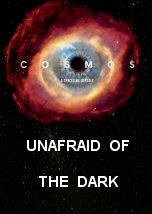
Unafraid of the Dark

   2014    Science
Tyson describes the discovery of cosmic rays by Victor Hess through high-altitude balloon trips. Swiss Astronomer Fritz Zwicky, in studying supernovae, postulated that these cosmic rays originated from these events instead of electromagnetic radiation. Also tells how Vera Rubin observed that the rotation of stars at the edges of observable galaxies did not follow expected rotational behavior leading to consider the existence of dark matter. This further led to the discovery of dark energy to account for the increasing rate of expansion of the universe. Tyson then describes the interstellar travel of the two Voyager probes. Tyson tells the Carl Sagan's role in the Voyager program, including creating the Voyager Golden Record to encapsulate humanity and Earth's position in the universe. Tyson concludes the series by emphasizing Sagan's message on the human condition in the vastness of the cosmos, and to encourage viewers to continue to explore and discover what else the universe has to offer.
Series: Cosmos: A Spacetime Odyssey
Weather

   2021    Nature
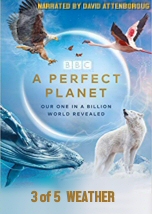
Weather controls the distribution of freshwater on Earth. David Attenborough narrates how this uneven distribution has given rise to an incredible diversity of species and habits, from the driest desert to the lushest tropical rainforest. Featuring a colony of ants banding together into a raft every time its home in the Amazon floods, a rain frog that manages to eke out an existence in one of the world's driest habitats on Earth, and the last wild camels that survive the Gobi Desert's bitter winters by eating snow that blows in from Siberia.
Series: A Perfect Planet

What are We Really Made of

   2011    Science
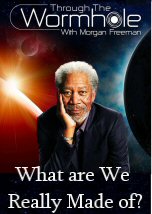
What is the universe made of? If you answered stars, planets, gas and dust, you'd be dead wrong. Thirty years ago, scientists first realized that some unknown dark substance was affecting the way galaxies moved. Today, they think there must be five times our understanding of the universe and the nature of reality itself has drastically changed over the last 100 years - and it's on the verge of another seismic shift. In a 17-mile-long tunnel buried 570 feet beneath the Franco-Swiss border, the world's largest and most powerful atom smasher, the Large Hadron Collider, is powering up. Its goal is nothing less than recreating the first instants of creation, when the universe was unimaginably hot and long-extinct forms of matter sizzled and cooled into stars, planets, and ultimately, us. These incredibly small and exotic particles hold the keys to the greatest mysteries of the universe. What we find could validate our long-held theories about how the world works and what we are made of -- or, all of our notions about the essence of what is real will fall apart.
Series: Through the Wormhole

What is the Right Diet for You 1of3

   2015    Medicine
Horizon investigates the idea that the best way to lose weight successfully is a personalised approach, diets tailored to our individual biology and psychology. In a groundbreaking experiment, Dr Chris van Tulleken and Tanya Byron join a team of experts to put 75 overweight volunteers on diets designed to tackle the specific reasons why they eat too much. The volunteers are put through a series of tests at a residential clinic to understand how their genes, hormones and psychology influence their eating behaviour. They are then put on the diets the experts believe are best suited to them. Can science succeed where other diets have failed?
Series: What is the Right Diet for You

Why are Thin People not Fat

   2009    Medicine
The world is affected by an obesity epidemic, but why is it that not everyone is succumbing? Medical science has been obsessed with this subject and is coming up with some unexpected answers. As it turns out, it is not all about exercise and diet. At the centre of this programme is a controversial overeating experiment that aims to identify exactly what it is about some people that makes it hard for them to bulk up.

Wild Isles: Freshwater

   2023    Nature
This episode takes you on an enchanting journey through the vital waterways of Britain and Ireland. From the serene reed-beds of Somerset to the bustling ecosystems of Scotland's lochs, the film unveils the intricate dance of life sustained by freshwater. Marvel at the agility of dragonflies and the aerial prowess of hobbies, witness the arduous journey of Atlantic salmon as they return to their birthplaces to spawn, and observe the fascinating life cycle of the mayfly. Discover the impact of reintroduced beavers in Scotland, creating new wetlands that buzz with life. The episode doesn't shy away from showcasing the challenges these ecosystems face, from climate change to pollution, emphasizing the delicate balance that sustains these vibrant freshwater habitats.
‘Freshwater’ is a mesmerizing ode to the streams, rivers, and lakes that are the lifeblood of the Britain and Ireland isles, supporting a diverse array of life in one of the planet's most beautiful settings.
Series: Wild Isles