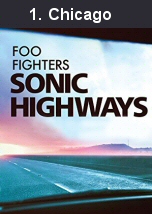
Washington, D.C. is in many ways a city of extremes. Starland Vocal Band, Marvin Gaye, Duke Ellington, Nils Lofgren, Chuck Brown, Henry Rollins, Fugazi and Trouble Funk all hail from D.C. In the early '70s, the music style go-go originated here, and has remained a local craze ever since. Dave Grohl sits down with Trouble Funk's Big Tony Fisher to talk about go-go, and explores its origins with Chuck Brown, the genre's undisputed godfather. He also chats with Don Zientara, owner of Inner Ear Studios, which the Virginia-raised Grohl says 'produced the entire soundtrack of my youth,' as well as with members of the harDCore band Bad Brains and Ian MacKaye of Teen Idles, Minor Threat and Fugazi, who all recorded at Inner Ear over the decades. The song 'The Feast and the Famine' is recorded during this episode.
Dr Hannah Fry explores a paradox at the heart of modern maths, discovered by Bertrand Russell, which undermines the very foundations of logic that all of maths is built on. These flaws suggest that maths isn't a true part of the universe but might just be a human language - fallible and imprecise. However, Hannah argues that Einstein's theoretical equations, such as E=mc2 and his theory of general relativity, are so good at predicting the universe that they must be reflecting some basic structure in it. This idea is supported by Kurt Godel, who proved that there are parts of maths that we have to take on faith. Hannah then explores what maths can reveal about the fundamental building blocks of the universe - the subatomic, quantum world. The maths tells us that particles can exist in two states at once, and yet quantum physics is at the core of photosynthesis and therefore fundamental to most of life on earth - more evidence of discovering mathematical rules in nature. But if we accept that maths is part of the structure of the universe, there are two main problems: firstly, the two main theories that predict and describe the universe - quantum physics and general relativity - are actually incompatible; and secondly, most of the maths behind them suggests the likelihood of something even stranger - multiple universes. We may just have to accept that the world really is weirder than we thought, and Hannah concludes that while we have invented the language of maths, the structure behind it all is something we discover. And beyond that, it is the debate about the origins of maths that has had the most profound consequences: it has truly transformed the human experience, giving us powerful new number systems and an understanding that now underpins the modern world.
The saga of a handful of conquerors who built an empire in Central America and invented the methods of one of the very first multinationals. In 19th century Central America, a few entrepreneurial cowboys built an empire that enslaved populations and corrupted governments for over 100 years. The United Fruit Company thrived on unregulated capitalism; this film tells its story and that of its pioneers who feared neither God nor Man, and managed to get away with murder. Until the 1970s, that multinational set up a monopoly by combining violence, repression, corruption, environmental destruction and a formidable marketing machine. It turned an unknown fruit into an instrument of fortune and domination, and created a business model still largely used by today’s tech giants. Using a rich trove of archival footage and documents, including letters to and from lobbyists, telegrams, vintage ads and movie clips, and gorgeous, hand-tinted stills, 'When Banana Ruled' is a story of intrigue that touches on economics, international politics, the history of business and reveals how an array of forces conquered the world through a simple fruit.
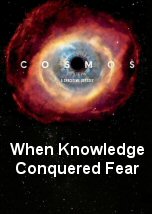
The episode begins with Tyson describing how pattern recognition manifested in early civilization as using astronomy and astrology to predict the passing of the seasons, including how the passage of a comet was often taken as an omen. Tyson continues to explain that the origin of comets only became known in the 20th century due to the work of Jan Oort and his hypothesis of the Oort cloud. Tyson then continues to relate the collaboration between Edmond Halley and Isaac Newton in the last part of the 17th century in Cambridge. The collaboration would result in the publication of Philosophiæ Naturalis Principia Mathematica, the first major work to describe the laws of physics in mathematical terms, despite objections and claims of plagiarism from Robert Hooke and financial difficulties of the Royal Society of London. Tyson explains how this work challenged the prevailing notion that God had planned out the heavens, but would end up influencing many factors of modern life, including space flight. Tyson further describes Halley's contributions including determining Earth's distance to the sun, the motion of stars and predicting the orbit of then-unnamed Halley's Comet using Newton's laws. Tyson contrasts these scientific approaches to understanding the galaxy compared to what earlier civilizations had done, and considers this advancement as mankind's first steps into exploring the universe. The episode ends with an animation of the Milky Way and Andromeda galaxies' merging based on the principles of Newton's laws.
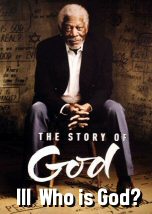
In the third episode of the series, Morgan Freeman examines different faiths' concepts of God, discovering how monotheism began in Egypt and Israel and allowing a neuroscientist to examine his own brain.
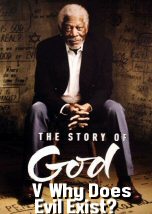
In the fifth episode of the series, Morgan Freeman sets to examine the nature of evil, visiting a serial killer in prison and witnessing an exorcism in India. He also explores ancient beliefs, including Zoroastrianism.










He also chats with Don Zientara, owner of Inner Ear Studios, which the Virginia-raised Grohl says 'produced the entire soundtrack of my youth,' as well as with members of the harDCore band Bad Brains and Ian MacKaye of Teen Idles, Minor Threat and Fugazi, who all recorded at Inner Ear over the decades. The song 'The Feast and the Famine' is recorded during this episode.