




Last Watched

"Nim"  Sort by

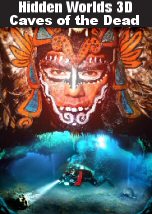
Hidden Worlds 3D Caves of the Dead

   2013    History    3D    HD
In the days of the Mayas, cenotes – deep, natural pits on the Yucatan peninsula - provided the only means of obtaining drinking water. But in the mythology of this advanced civilisation, these waterholes and caves were also the entrance to Xibalba – the underworld. All deceased were obliged to pass through Xibalba and wait there until they were called into heaven. It was a place in which one made sacrifices to the gods – objects of daily life, as well as bloody, human sacrifices. To this day, the relics of these acts are still in place preserved underwater for more than a thousand years. The entrance to the underworld begins at a dirty waterhole in the middle of the Mexican jungle overgrown and barely recognisable. But immediately after entry, a hall of breath-taking dimensions and beauty is revealed. As if they were sculptures, stalactites and stalagmites lend the underwater cave an almost sacred ambience. By now, one has succumbed to the fascination emanated by the world’s largest underwater cave system. We accompany four professional research divers to Yucatan – a team of specialists, able to squeeze their bodies through crevices and holes, barely larger than their bodies and who master dives that would push even the most experienced divers to their limits. With them, we penetrate worlds only a few people have ever ventured into. We encounter the remains of human victims, prehistoric fireplaces and primeval animal skeletons and undertake a dive, which takes us from the primeval forest to the open sea. We then enter Xibalba – the place of myths and the dead. In the days of the Mayas - a voyage of no return. Today, this is one of the greatest challenges one can face as a diver – the hidden world of the underwater caves of Yucatan – all filmed in 3D.
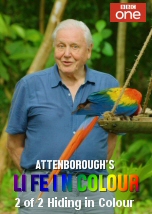
Hiding in Colour

   2021    Nature
David Attenborough reveals the extraordinary ways that some animals use colour to hide and disappear into the background. New science reveals how the Bengal tiger in central India uses its orange-black stripes to hide from its colour-blind prey. In Kenya’s Masai Mara, the zebra’s black-and-white pattern confuses predators with an extraordinary effect called motion dazzle. And on the island of Cuba, a small snail uses colourful stripes in a surprising way to hide from its enemies.
Other animals use colour to trick and to deceive. On Australia’s Great Barrier Reef, a blue-striped blenny uses colours to mimic other fish and launch a sudden attack. In the grasslands of Zambia, the chick of a pin-tailed whydah mimics the patterns of its nest mates to ensure that it is not detected as an imposter. And specialist cameras reveal how a tiny crab spider uses bright ultraviolet colours to lure in its victims.
Series: Attenborough Life in Colour

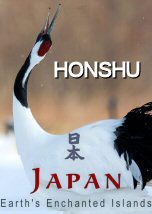
Honshu

   2017    Nature
Japan's landscapes range from snowy mountains to subtropical warmth. They are full of wildlife - and animals' and people's lives often cross as they adapt to these extremes. The central island of Honshu is home to over 100 million people, and its biggest city, Tokyo, is one of the largest urban metropolises on earth. But it has a wild heart - most of Honshu is mountainous. This wilderness is home to an astonishing range of wildlife - black bears, monkeys, exquisite fireflies and even cow demons. But all across this island, from the mountains to the edge of the sea, people and nature are drawn together in the most unexpected ways.
Series: Japan Earth Enchanted Islands

Human Planet: The Jungles

   2011    Culture
The rainforest is home to more species of plants and animals than any other habitat on the planet. But for humans, life there is not as easy as it looks. Life in the trees requires great skill, ingenuity and sheer bravery. The Matis of Brazil carve 4-metre-long blow-pipes to hunt monkeys - in near total silence. Deep in the Congo forests, Tete defies death by scaling a giant tree using nothing more than a liana vine, and he must then negotiate an angry swarm of bees - all to collect honey for his family. Three children from Venezuela's Piaroa tribe venture deep into the jungle to hunt tarantulas - to toast for lunch! In West Papua the Korowai tribe show-off their engineering skills by building a high-rise home 35 metres up in the tree tops. Most memorable of all, in Brazil we join a unique monitoring flight in search an un-contacted tribe...
Series: Human Planet

Human Planet: The Oceans

   2011    Culture
Human Planet is a majestic portrait of humankind and the power of nature in extraordinary symbiosis, struggle and strife. For the first time, the camera has turned on ourselves. In doing so, we see how amazing human beings can be and how we adapt to any habitat, anywhere. Human Planet is epic in ambition, extreme in content, intimate in effect. It explores how we have devised ways of surviving in every corner of Earth – from the remotest deserts to the busiest urban metropolis. Each episode focuses on an iconic environment and reveals how we have adapted to the challenges of the landscape and the endless diversity of animals and plants we live with. Discover how our remarkable intelligence, tool use, and close-knit social lives have enabled us to cope with just about anything nature can throw at us". As an air-breathing animal, the human is not built to survive in water. But people have found ways to live an almost aquatic life so they can exploit the sea's riches. From a 'shark-whisperer' in the Pacific to Brazilian fishermen collaborating with dolphins to catch mullet, this journey into the blue reveals astonishing tales of ingenuity and bravery. Daredevil Galician barnacle-collectors defy death on the rocks for a catch worth 200 pounds per kilo. In Indonesia an epic whale-hunt, using traditional hand-made boats and harpoons, brings in a sperm whale. The Bajau 'sea gypsies' of the Sulu Sea spend so much time on water they get 'land sick' when they set foot on the land! We dive 40 metres down to the dangerous world of the Pa-aling fishermen, where dozens of young men, breathing air through a tangled web of pipes attached to a diesel engine, capture thousands of fish in a vast net. We see how surfing has its origins in the ancient beliefs of the ocean-loving Polynesians, and we join a Borneo free-diving spear-fisherman on a breath-taking journey 20 metres down in search of supper.
Series: Human Planet

Humans

   2021    Nature
A new force threatens our perfect planet. In the past, five mass extinction events were caused by cataclysmic volcanic eruptions. It was not the lava or ash that wiped out life, but an invisible gas released by volcanoes: carbon dioxide. Almost every part of modern life depends on energy created by burning fossil fuels, and this produces CO2 in huge amounts. Humans are changing our planet so rapidly, it’s affecting earth’s life support systems: our weather, our oceans and the living world. The greatest change to be made is in how we create energy, and the planet is brimming with natural power that can help us do just that. It’s these forces of nature - the wind, the sun, waves and geothermal energy - that hold the key to our future.
Through compelling animal-led stories and expert interviews, we discover how CO2 is destabilising our planet. We meet rescued orphaned elephants in Kenya, victims of ever worsening droughts, and join ocean patrols off the coast of Gabon fighting to save endangered sharks. In the Amazon, we witness wildlife teams saving animals in the shrinking forests, and in San Diego we enter a cryogenic zoo preserving the DNA of endangered species before they become extinct.
Series: A Perfect Planet
Trainwreck

Trainwreck

2025  Culture
Planet Dinosaur

Planet Dinosaur

2011  Science
The Sky at Night

The Sky at Night

2023  Science
Prehistoric Planet II

Prehistoric Planet II

2023  Science
Earth from Space

Earth from Space

2019  Nature
The Story of China

The Story of China

2016  History