








Last Watched

"Al-Khalili"  Sort by

Nothing

   2011    Science
The second part, Nothing, explores science at the very limits of human perception, where we now understand the deepest mysteries of the universe lie. Professor Jim Al-Khalili sets out to answer one very simple question - what is nothing? His journey ends with perhaps the most profound insight about reality that humanity has ever made. Everything came from nothing. The quantum world of the super small shaped the vast universe we inhabit today, and Jim can prove it.
Series: Everything and Nothing

Secrets of the Brain

   2025    Medicine    HD
Physicist Jim Al-Khalili embarks on an extraordinary quest through 600 million years of evolution to reveal how the human brain — the most complex structure known in the universe — came to exist. With more than 100 billion neurons and 100 trillion connections, it surpasses even the stars of the Milky Way. Through breathtaking science and striking visuals, this documentary uncovers how nature transformed simple nerve cells into the ultimate thinking machine.
From the first survival instincts of primates to the dawn of social intelligence, Jim explores how cooperation, relationships and empathy reshaped the brain and made us who we are. Working alongside his wife and leading researchers, he dives into fossil evidence, brain scans and the rise of artificial intelligence to answer one profound question: what makes the biological brain so unique — and can anything ever match it?

Spark

   2014    Science
Professor Jim Al-Khalili tells the electrifying story of our quest to master nature's most mysterious force - electricity. Until fairly recently, electricity was seen as a magical power, but it is now the lifeblood of the modern world and underpins every aspect of our technological advancements.Without electricity, we would be lost. This series tells of dazzling leaps of imagination and extraordinary experiments - a story of maverick geniuses who used electricity to light our cities, to communicate across the seas and through the air, to create modern industry and to give us the digital revolution. Episode one tells the story of the very first 'natural philosophers' who started to unlock the mysteries of electricity. They studied its curious link to life, built strange and powerful instruments to create it and even tamed lightning itself. It was these men who truly laid the foundations of the modern world. Electricity was without doubt a fantastical wonder. This is the story about what happened when the first real concerted effort was made to understand electricity; how we learned to create and store it, before finally creating something that enabled us to make it at will - the battery.
Series: Shock and Awe: The Story of Electricity

The Empire of Reason

   2017    History
Al-Khalili travels to northern Syria to discover how, a thousand years ago, the great astronomer and mathematician Al-Biruni estimated the size of the earth to within a few hundred miles of the correct figure. He discovers how medieval Islamic scholars helped turn the magical and occult practice of alchemy into modern chemistry. In Cairo, he tells the story of the extraordinary physicist Ibn al-Haytham, who helped establish the modern science of optics and proved one of the most fundamental principles in physics - that light travels in straight lines. Prof Al-Khalili argues that these scholars are among the first people to insist that all scientific theories are backed up by careful experimental observation, bringing a rigour to science that didn't really exist before.
Series: Science and Islam

The Joy of AI

   2018    Technology
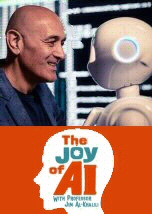
Professor Jim Al-Khalili looks at how we have created machines that can simulate, augment, and even outperform the human mind - and why we shouldn't let this spook us. He reveals the story of the pursuit of AI, the emergence of machine learning and the recent breakthroughs brought about by artificial neural networks. He shows how AI is not only changing our world but also challenging our very ideas of intelligence and consciousness.
Along the way, we'll investigate spam filters, meet a cutting-edge chatbot, look at why a few altered pixels makes a computer think it's looking at a trombone rather than a dog and talk to Demis Hassabis, who heads DeepMind and whose stated mission is to 'solve intelligence, and then use that to solve everything else'. Stephen Hawking remarked 'AI could be the biggest event in the history of our civilisation. Or the worst'. Jim argues that AI is a potent new tool that should enhance our lives, not replace us.

The Language of Science

   2017    History
Physicist Jim Al-Khalili travels through Syria, Iran, Tunisia and Spain to tell the story of the great leap in scientific knowledge that took place in the Islamic world between the 8th and 14th centuries. Its legacy is tangible, with terms like algebra, algorithm and alkali all being Arabic in origin and at the very heart of modern science - there would be no modern mathematics or physics without algebra, no computers without algorithms and no chemistry without alkalis. For Baghdad-born Al-Khalili, this is also a personal journey, and on his travels he uncovers a diverse and outward-looking culture, fascinated by learning and obsessed with science. From the great mathematician Al-Khwarizmi, who did much to establish the mathematical tradition we now know as algebra, to Ibn Sina, a pioneer of early medicine whose Canon of Medicine was still in use as recently as the 19th century, Al-Khalili pieces together a remarkable story of the often-overlooked achievements of the early medieval Islamic scientists.
Series: Science and Islam