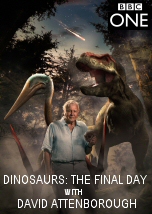
Sir David Attenborough presents this landmark documentary which brings to life, in unprecedented detail, the lost world of the very last days of the dinosaurs. Searching in the hills of North Dakota, palaeontologist Robert DePalma makes an incredible discovery in a prehistoric graveyard known as Tanis - fossilised creatures, astonishingly well preserved like the bodies found at Pompeii. Whilst DePalma hunts for the evidence that can shed light on the final days of the dinosaurs, state-of-the-art VFX transports Sir David back in time to the Late Cretaceous to witness the creatures who lived at Tanis at the end of the Age of Dinosaurs. Meanwhile, cutting edge scanning techniques reveal fossilised secrets that could change our understanding of the dinosaurs' extinction once and for all.
Huge asteroids have smashed into the earth, and turned it into an enveloped fire, uninhabitable to almost all life on the surface. The world will get hit again. It's just a matter of when. So, what should we do as a species? Should we just, like the dinosaurs, look up and die? The reasons the dinosaurs are extinct is they didn't have a space program. We do. We have the capability to perhaps escape the Earth. Astronaut Chris Hadfield believes the only chance for human survival is to escape from Earth and build a space colony, but there are real barriers.
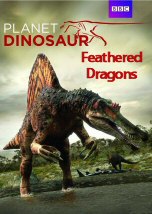
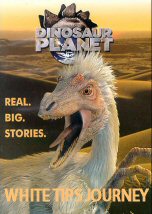
In a late Jurassic forest in what is now China, an Epidexipteryx escapes from a juvenile Sinraptor by climbing a tree. It finds a beetle grub in the tree bark, being shown to use its elongated fingers in a similar way to a modern day aye-aye. However, its prey is stolen by another, larger Epidexipteryx, and after a brief bout of posturing, the smaller individual goes to find more food. It drops a second grub to the forest floor, where the other Epidexipteryx retrieves it, only to be killed by the juvenile Sinraptor. The episode then cuts to a desert in late Cretaceous Mongolia, where a Saurornithoides is shown brooding a nest of eggs. When it leaves the nest, an Oviraptor raids it, fleeing when the troodontid returns. The Saurornithoides is suddenly attacked and eaten by a Gigantoraptor, which then heads to compete in a breeding ritual for mates. The males use their feathers for display, a brief fight between two erupting at one point, allowing the females to choose the best suitor. The episode finally cuts to an early Cretaceous forest in China, where a Xianglong is being hunted by a Microraptor, which uses its feathers to pursue the gliding lizard in the air. A Sinornithosaurus attacks it, and after a brief chase the Microraptor manages a lucky escape. The Sinornithosaurus, alongside two other members of its species is then shown hunting a Jeholosaurus and its three young. The group brings down the parent, the narrator explaining that their possibly venomous bite allowed them to tackle animals much larger than themselves. A montage is then shown of the feathered dinosaurs featured in the programme, with the narrator saying that Microraptor not only hints at how flight might have developed, but also that dinosaurs still live amongst us today, as birds.
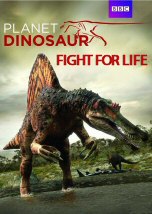
This episode focuses on the Jurassic period, a time when the first giant killers stalked the Earth and lurked in the seas; a time when the slightest advantage meant the difference between life and death. In North America the iconic allosaurus, an ambush hunter with a lethal bite, dominated. Not even the heavily-armoured stegosaurus was safe from this killer, and incredible evidence reveals a glimpse of a vicious battle between these two giants. Life in Jurassic oceans was no easier; in 2008, a fossil was dug out of a frozen island high in the Arctic. It was a colossal marine reptile, twice as big as most ocean predators, at 15 metres long and weighing about 45 tonnes. This was Predator X. Its skull alone was nearly twice the size of a tyrannosaurus rex's, and its bite force unmatched by anything in the Jurassic seas. The balance of power between predator and prey is a fine one, as prey continually evolves different ways to avoid predators. But for the most successful and enduring predators, the battle to survive has always been tipped in their favour
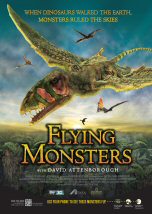
For thousands of years, humans have believed that there were once flying monsters. But did they really exist beyond our nightmares? 220 million years ago dinosaurs were beginning their domination of Earth. But another group of reptiles was about to make an extraordinary leap: pterosaurs were taking control of the skies. The story of how and why these mysterious creatures took to the air is more fantastical than any fiction. In Flying Monsters 3D, David Attenborough the worlds leading naturalist, sets out to uncover the truth about the enigmatic pterosaurs, whose wingspans of up to 40 feet were equal to that of a modern day jet plane. Attenborough works with scientists to understand the incredible story of the evolution of the pterosaurs, a story that unfolds in such stunning locations as New Mexico, the Jurassic Coast of Lyme Regis in Britain, an ancient pterosaur landing site in Southern France and a fossil pit in Germany where near perfect pterosaur specimens have been found. The central question and one of the greatest mysteries in palaeontology is: how and why did pterosaurs fly? How did lizards the size of giraffes defy gravity and soar through prehistoric skies? Driven by the information he finds as he attempts to answer these questions, Attenborough starts to unravel one of sciences more enduring mysteries, discovering that the marvel of pterosaur flight has evolutionary echoes that resonate even today. Flying Monsters 3D is a groundbreaking film that uses cutting-edge 3D technology and CGI to bring the story of giant flying monsters and their prehistoric world to life. Audiences of all ages will be in awe as they enter the world and experience, as never before, REAL Flying Monsters in 3D.
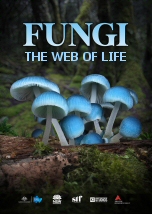
Acclaimed biologist Dr. Merlin Sheldrake seeks a rare blue mushroom in Tasmania's ancient Tarkine rainforest, revealing fungi's extraordinary abilities. Fungi may provide solutions to humanity's problems, with millions more species yet to be discovered. All life on Earth is connected by a great mystery we are only just beginning to unravel. Hidden between the world of plants and animals, another world exists… Fungi’s web of life. We’ll begin in the mysterious world of the forest floor, where fungi are the central players in nature’s story of birth, death, and rebirth to discover that life as we know it simply would not exist without them. Dr. Sheldrake will show us some the grandest and strangest organisms ever discovered, showcased through jaw-dropping time-lapse cinematography, in a landscape largely unchanged from the time of the dinosaurs. Fungi have important lessons to teach humanity about survival through cooperation. Indeed, these incredible lifeforms may hold the key to solving some of humanity’s most urgent problems. With millions more species to discover, our journey into the secret world of fungi has only just begun.










Whilst DePalma hunts for the evidence that can shed light on the final days of the dinosaurs, state-of-the-art VFX transports Sir David back in time to the Late Cretaceous to witness the creatures who lived at Tanis at the end of the Age of Dinosaurs. Meanwhile, cutting edge scanning techniques reveal fossilised secrets that could change our understanding of the dinosaurs' extinction once and for all.