In every ocean… just beyond our shores…lives an animal with characteristics we think of as ‘human’ – intelligent, social, curious, gentle, and fierce. They build cities, use tools, and collaborate with other species to hunt. They have personalities – some are bold, while others shy. These animals can change their skin colour, texture, and body shape in a blink of an eye and see in wavelengths beyond our vision. Recent studies reveal octopuses’ consciousness, sophisticated decision-making, and unique personalities. On tropical reefs, in frigid waters, from the shoreline to the deep sea and everywhere in between, the octopus have made a home. Join us as we reveal ‘Secrets of the Octopus’. In the first chapter, whether transforming their body shape and color to disappear or mimicking their deadliest enemy, Octopus use shape-shifting superpowers to survive.
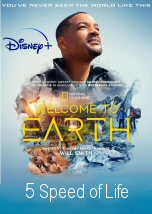
Will Smith discovers hidden worlds of fast and slow in the Earth's oldest desert. Worlds where things go so fast or so slow we don't even know they're happening. This hidden world of speed is everywhere, even 80 feet underwater. Hundreds of tiny anemones, anchored to the rocks, but film them patiently, then speed it up, and this miniature world comes to life. A lizard's tongue is one of the fastest movements in the entire animal kingdom. An orca creates a shock wave by slapping her tail and that pulse can travel through the water at more than a thousand miles an hour. to stuns the herrings she hunts.
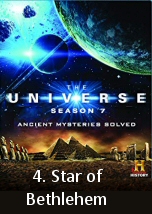
A strange light in the heavens. The star that signals the birth of Jesus. Is it faith, fable, or fact? The star of Bethlehem is hard to identify thousands of years later. Can we decode the secret of the star with the science of the universe? What was it? Where did it come from? And will it return? Discover an explanation by various astronomers and religion historians of what the star of Bethlehem really was based on available evidence.
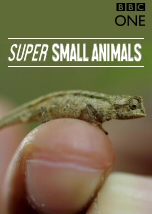
From a primate that’s no bigger than a mouse, to a chameleon that can fit on your fingertip, the natural world is full of fantastically small animals. Biologist Patrick Aryee explores the fascinating secrets behind these miniature marvels and shows that they’re not the underdogs you might think they are. Super Small Animals follows him as he meets the leading experts on these pint sized superstars, and finds out what makes them some of the most successful on the planet. First up, he reveals the huge benefits that being small can bring. There’s the little lemur whose diminutive frame helps it to exploit a unique gap in the eco-system, the tiny hummingbird that uses its size to out-maneuver the competition, and the world’s smallest seahorse that never has to leave home. He also explores why small animals are proportionally the strongest in the world, and introduces a peanut-sized beetle that can pull over a thousand times its own weight. Next he explores the challenges that animals face when they shrink in size, and the ingenious ways they overcome them. We find out how the smallest armadillo in the world manages to control its temperature in the searing desert sun, and the how the world’s smallest fish can survive in nothing more than a puddle, because it never really grows up. Patrick meets a secretive hippo that lives in the dense jungle, and looks like it’s been shrunk in the wash, and some of the world’s smallest snakes that give birth to enormous babies. He also meets a scientist that studies how really tiny spiders have a surprising trick that enables them to travel an incredible 40 miles per day, using almost no energy. Then there are the animals that refuse to be pigeon holed as small, and manage to punch way above their weight. He puts some astonishing invertebrates to the test, to see how they work together to become much bigger than the sum of their parts and meets a pint-sized predator that takes on some of the largest and most dangerous creatures on the planet, getting hands on to discover how its build helps it to be brave. Finally he uncovers the incredible lengths that deep sea anglerfish go to in order to be big and small at the same time, and has an endearing encounter with a tiny carnivore that manages to be small in just one direction. Whether their size helps them to hunt, hide or survive, all these remarkable animals prove that good things really do come in small packages.
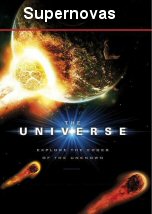
A stellar explosion, the supernova is the sensational death of a star. It can shine as bright as 100 billion Suns and radiate as much energy as the Sun would emit over 10 billion years. Jets of high-energy light and matter are propelled into space and can cause massive Gamma Ray Bursts and emit intense X-ray radiation for thousands of years. Astronomers believe that this process creates the very building blocks of planets, people and plants. Meet the world's leading Supernova hunters, and take a look at recorded supernovas throughout history.
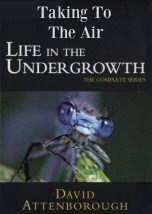
As the early June sun begins to set over a calm river in Central Hungary, masses of ghostly shapes emerge from their larval cases to take to the air for the first time. They are mayflies and in a spectacular display, thousands of them demonstrate how the very first wings were used.
From the stunning aerobatics of hoverflies in an English garden to the mass migration of purple crow butterflies in the valleys of Taiwan, this episode tells the tale of the first animals ever to take to the air. Unique footage reveals the lightning fast reactions of bluebottles and hoverflies, filmed with one of the world's fastest cameras, and Sir David Attenborough handles the world's largest (and perhaps most ferocious) insect - the Titan beetle.











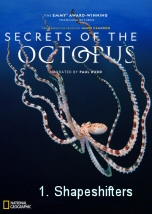



In the first chapter, whether transforming their body shape and color to disappear or mimicking their deadliest enemy, Octopus use shape-shifting superpowers to survive.