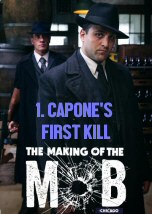
'It's really about terror and intimidation and people basically fighting for survival and often committing extraordinary violence in order to protect themselves or to stay safe. It's kind of like the weak dog in the pack. If others spot weakness, they're gonna pounce on you for a couple of reasons. You pounce on that guy, that gives you a little more status. So, I had to ask myself, are you gonna be a victim? No, I ain't gonna be a victim. Well, that really only left me one choice in my mind. That means I gotta be the victimizer. At some point, for some reason, might be legitimate, might not be, someone's gonna test you.. Even if you lose, you're gonna have to stand up for yourself. ' 'A guy comes over, and it's your day to get your package, and he tries to take your package from you that your people sent you, if you let him do it, there's gonna be 10 other dudes, oh, yeah, he let that guy take his package, I'm gonna go get his TV, right down the line until somebody's after your ass. But if you stand up that first time and they see you'll stand up for yourself, even if you lose, people will respect that. Oh, don't mess with him. There's easier prey. Why do you have to go and get that guy and get a couple lumps for it when he can go get that guy's stuff over there, don't cost you nothing. It usually only has to happen once or twice but just as importantly that you didn't go to the man for help... you're gonna be all right.'
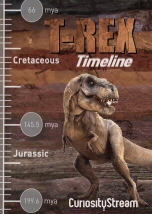
The Tyrannosaurus Rex is known as the king of the dinosaurs, but how did its reign begin? Meet Moros Intrepidus, a 180 lb., deer-sized ancestor to the T-Rex. Learn how the latest in palaeontology can now link this small dinosaur to the 19,000-pound Scotty, the largest T-Rex ever discovered. We're filling in gaps in the history of well-known dinosaurs and we're finding specimens of even the most famous dinosaur that are telling us new things about their biology, about their growth, about their size, that we didn't know before. We are nowhere at the end of learning about dinosaurs and in generations to come, we will be knowing things about the lives of these ancient creatures that would probably blow our minds.
The filmmakers challenge former Indonesian death-squad leaders to reenact their mass-killings in whichever cinematic genres they wish, including classic Hollywood crime scenarios and lavish musical numbers. Anwar Congo and his friends have been dancing their way through musical numbers, twisting arms in film noir gangster scenes, and galloping across prairies as yodeling cowboys. Their foray into filmmaking is being celebrated in the media and debated on television, even though Anwar Congo and his friends are mass murderers. Medan, Indonesia. When the government of Indonesia was overthrown by the military in 1965, Anwar and his friends were promoted from small-time gangsters who sold movie theatre tickets on the black market to death squad leaders. They helped the army kill more than one million alleged communists, ethnic Chinese, and intellectuals in less than a year. As the executioner for the most notorious death squad in his city, Anwar himself killed hundreds of people with his own hands. The Act of Killing is about killers who have won, and the sort of society they have built. Unlike ageing Nazis or Rwandan génocidaires, Anwar and his friends have not been forced by history to admit they participated in crimes against humanity. Instead, they have written their own triumphant history, becoming role models for millions of young paramilitaries. The Act of Killing is a journey into the memories and imaginations of the perpetrators, offering insight into the minds of mass killers. And The Act of Killing is a nightmarish vision of a frighteningly banal culture of impunity in which killers can joke about crimes against humanity on television chat shows, and celebrate moral disaster with the ease and grace of a soft shoe dance number.
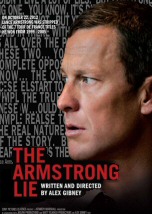
Academy Award-winning director Alex Gibney (Taxi to the Dark Side) masterfully explores the fall of the disgraced cycling champion following the 2009 Tour de France, making use of his extraordinary access to attain rare interviews with former teammates, alleged doping mastermind Dr. Michele Ferrari, and Armstrong himself. What was Lance Armstrong thinking? For years, after seizing international fame as the cancer survivor who won seven Tour de France titles, he fiercely denied accusations that he used performance-enhancing drugs. He used his power to aggressively litigate journalists and publicly humiliate former friends who claimed otherwise. His deceit finally cracked in January 2013, when he admitted guilt to Oprah Winfrey in a television interview that critics decried for only scratching the surface. Academy Award-winning director Alex Gibney approaches Armstrong with unique and extraordinary access. In 2009, Gibney was commissioned to make a film about Armstrong's return to the Tour de France, four years after the racing champion had declared retirement. That race would later stir up devastating evidence in the case against Armstrong. But Gibney came away from the experience unable to reconcile the discrepancy between doping allegations and Armstrong's emphatic denials. Then, post-Oprah, Gibney went back to Armstrong for new interviews to extract a more detailed account of his double life. In The Armstrong Lie, Gibney masterfully explores the complexities of the case, interweaving the dramatic action of the 2009 Tour de France, when Armstrong found himself unexpectedly competing against his own teammate Alberto Contador. Gibney attains rare interviews with Armstrong's former teammates and alleged doping mastermind Dr. Michele Ferrari. The film also raises troubling questions about the process of doping regulation. Recently, when asked to give advice to documentary filmmakers, Gibney responded with a motto exemplified by this film: "Embrace contradictions."
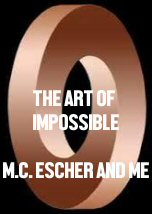
Sir Roger Penrose is more than just a fan of MC Escher's mind-bending art. During the course of a long creative collaboration, the British mathematician and the Dutch artist exchanged ideas and inspirations. Some of Escher's most iconic images have their origin in Penrose's mathematical sketches - while the artist's work has served as a starting point for the professor's own explorations of new scientific ideas". To coincide with the first ever Escher retrospective in the UK, Penrose takes us on a personal journey through Escher's greatest masterpieces - marvelling at his intuitive brilliance and the penetrating light it still sheds on complex mathematical concepts.
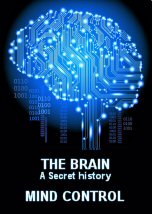
Dr Michael Mosley traces the sinister ways the experimental psychology has used to try to control our minds. He finds that the pursuit of mind control has led to some truly horrific experiments and left many casualties in its wake. Extraordinary archive captures what happened - scientists systematically change the behaviour of children; law abiding citizens give fatal electric shocks; a gay man has electrodes implanted in his head in an attempt to turn his sexuality. Michael takes a hallucinogenic drug as part of a controlled experiment to try to understand how its mind-bending properties can change the brain. This is a scientific journey goes to the very heart of what we hold most dear - our free will, and our ability to control our own destiny.



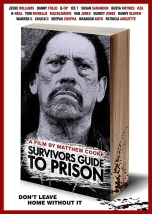





'A guy comes over, and it's your day to get your package, and he tries to take your package from you that your people sent you, if you let him do it, there's gonna be 10 other dudes, oh, yeah, he let that guy take his package, I'm gonna go get his TV, right down the line until somebody's after your ass. But if you stand up that first time and they see you'll stand up for yourself, even if you lose, people will respect that. Oh, don't mess with him. There's easier prey. Why do you have to go and get that guy and get a couple lumps for it when he can go get that guy's stuff over there, don't cost you nothing. It usually only has to happen once or twice but just as importantly that you didn't go to the man for help... you're gonna be all right.'