





Last Watched

"Life "  Sort by

Finding Life in Outer Space

   2019    Science    HD
Over billions of years, planet Earth has become home to an amazing interdependent ecosystem, containing a dizzying variety of animals and plants. But how did life here begin? And does it exist anywhere outside of our solar system? We uncover the secrets of our world by tracking the evolution of the cosmos itself, from the Big Bang onwards. Follow scientists responsible for some of the major breakthroughs in understanding the origins of life and witness how their discoveries are fundamentally changing the way we perceive the universe.
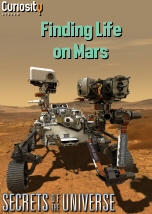

Finding Life on Mars

   2020    Science
For decades, scientists have dreamed of finding life on Mars. But despite their best efforts, no signs of life have been found. Could that be about to change? This is the story of the scientists and engineers behind Perseverance: the rover that could change our view of Mars forever.
Series: Secrets of the Universe

Finding Their Voice

   2020    Culture
Arrested and charged in 2019 with child sex trafficking, Jeffrey Epstein took his own life while behind bars in a federal prison of New York City in unclear circumstances. Many claim that Epstein had an international sex trafficking ring and he would take a lot of people down. Epstein signed a will two days before he committed suicide to move his money over to the Virgin Islands. It made it much more difficult for the victims to get restitution. Nor would the survivors see him in jail for life. But the judge was going to let some of the victims have their day in court.
Series: Jeffrey Epstein: Filthy Rich

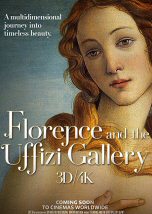
Florence and the Uffizi Gallery

       Art    3D    HD
This film is a multi-dimensional journey through the city that was once the cradle of the Italian Renaissance. Get an exclusive tour through the most beautiful and representative works of art of the period from Michelangelo and Brunelleschi, to Leonardo and Botticelli, with a detailed central chapter dedicated to the very treasure house containing their masterpieces: the Uffizi Gallery. This also includes the breathtaking 'Adoration of the Mag' by Leonardo Da Vinci, which, after several years of restoration, will be brought back to life and unveiled in this worldwide exclusive premiere on the big screen.

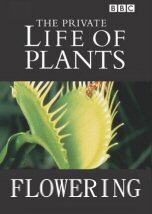
Flowering

   1995    Nature
The third episode is devoted to the ways in which plants reproduce. Pollen and a stigma are the two components needed for fertilisation. Most plants carry both these within their flowers and rely on animals to transport the pollen from one to the stigma of another. To do this, they attract their couriers with colour, scent and nectar. It isn't just birds that help pollination: some mammals and reptiles also do so. However, it is mostly insects that are recruited to carry out the task. To ensure that pollen is not wasted by being delivered to the wrong flower, some species of plant have developed exclusive relationships with their visitors, and the gentian and its attendant carpenter bees is one example. Since pollen can be expensive to produce in terms of calories, some plants, such as orchids, ration it by means of pollinia and a strategically placed landing platform. Other orchids offer no reward for pollination, but instead mislead their guests by mimicking their markings and aroma, thus enticing males to 'mate' with them (Pseudocopulation). The most extreme fertilisation method is one of imprisonment, and one plant that uses it is the dead horse arum. It is often found near gull colonies, and mimics the appearance and smell of rotting flesh. Blow-flies are attracted to it, and are forced to stay the night before being allowed to depart in the morning, laden with pollen. Finally, Attenborough introduces the world's largest inflorescence: that of the titan arum.
Series: The Private Life of Plants

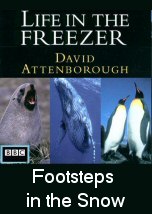
Footsteps in the Snow

   1993    History
This episode discusses the human exploration of Antarctica, in particular the mission led by Captain Robert Falcon Scott, whose team died on the way back from the South Pole. It shows the scientific work in the modern human bases in Antarctica, especially Mawson Base and its observation of Adelie Penguins (partially through tracking devices). The second half of the episode describes how the series was made. Most crucial was of course the camera work. To get access to the wildlife of the sea, for example, boats, divers, suspended capsules and remotely controlled cameras mounted on inflatables were used. Particularly dangerous to divers were Leopard Seals and other predators. The film concludes that although working in Antarctica is now much easier than during the early days of exploration, human footsteps on the continent are still exceedingly rare in part because of international treaties prohibiting industrial exploitation.
Series: Life in the Freezer