





Last Watched

"Time"  Sort by

Frozen Planet: Autumn

   2011    Nature
For the animals in the polar regions, autumn means dramatic battles and epic journeys. Time is running out - the Arctic Ocean is freezing over and the sea ice is advancing at 2.5 miles per day around Antarctica. Polar bears gather in large numbers on the Arctic coast as they wait for the return of the ice. Soon, tempers fray and violent sparring contests break out. Meanwhile 2,000 beluga whales head for one special estuary, a gigantic 'whale spa' where they will thrash their snow-white bodies against the gravel and exfoliate. Inland, the tundra undergoes a dramatic transformation from green to fiery red. Here, musk ox males slam head-first into each other with the force of a 30mph car crash as they struggle to defend their harems. Frisky young caribou males play a game of 'grandma's footsteps' as they try to steal the boss's female. Down in Antarctica, Adelie penguin chicks huddle together in creches. When a parent returns from fishing, it leads its twins on a comical steeplechase - sadly there's only enough for one, so the winner gets the meal. Two months later and the chicks are fully feathered apart from downy Mohican hairdos - they're ready to take their first swim - reluctantly though, as it seems penguins are not born with a love of water! And with good reason - a leopard seal explodes from the sea and pulls one from an ice floe, a hunting manoeuvre that has never been filmed before. As winter approaches and everyone has left, the giant emperor penguin arrives and makes an epic trek inland to breed. The mothers soon return to the sea leaving the fathers to hold the eggs and endure the coldest winter on earth.
Series: Frozen Planet
Frozen Planet: Summer

   2011    Nature
It is high summer in the Polar Regions, and the sun never sets. Vast hordes of summer visitors cram a lifetime of drama into one long, magical day; they must feed, fight and rear their young in this brief window of plenty. Summer is a tough time for the polar bear family, as their ice world melts away and the cubs take their first swimming lesson. Some bears save energy by dozing on icy sun beds, while others go egg-collecting in an Arctic tern colony, braving bombardment by sharp beaks. There are even bigger battles on the tundra; a herd of musk oxen gallop to the rescue as a calf is caught in a life and death struggle with a pair of Arctic wolves. But summer also brings surprises, as a huge colony of 400,000 king penguins cope with an unlikely problem - heat. The adults go surfing, while the woolly-coated chicks take a cooling mud bath. Nearby, a bull fur seal is prepared to fight to the death with a rival. Fur flies as the little pups struggle desperately to keep out of the way of the duelling giants. Further south, a minke whale is hunted amongst the ice floes by a family of killer whales. The dramatic chase lasts over 2 hours and has never been filmed before. The killers harry the minke whale, taking it in turns to wear it down. Eventually it succumbs to the relentless battering. Finally, comical adelie penguins waddle back to their half a million strong colony like clockwork toys. The fluffy chicks need constant feeding and protection as piratical skuas patrol the skies. When an unguarded chick is snatched, a dramatic "dogfight" ensues.
Series: Frozen Planet

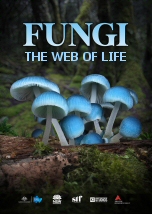
Fungi: The Web of Life

   2023    Nature    HD
Acclaimed biologist Dr. Merlin Sheldrake seeks a rare blue mushroom in Tasmania's ancient Tarkine rainforest, revealing fungi's extraordinary abilities. Fungi may provide solutions to humanity's problems, with millions more species yet to be discovered.
All life on Earth is connected by a great mystery we are only just beginning to unravel. Hidden between the world of plants and animals, another world exists… Fungi’s web of life. We’ll begin in the mysterious world of the forest floor, where fungi are the central players in nature’s story of birth, death, and rebirth to discover that life as we know it simply would not exist without them. Dr. Sheldrake will show us some the grandest and strangest organisms ever discovered, showcased through jaw-dropping time-lapse cinematography, in a landscape largely unchanged from the time of the dinosaurs.
Fungi have important lessons to teach humanity about survival through cooperation. Indeed, these incredible lifeforms may hold the key to solving some of humanity’s most urgent problems. With millions more species to discover, our journey into the secret world of fungi has only just begun.

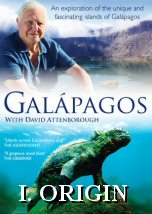
Galapagos with David Attenborough Origin

   2013    Nature    3D    HD
Sir David Attenborough returns to the Galápagos Islands and travels throughout the archipelago to explain their origins and their unique fauna in evolutionary terms. He has captured a new species of pink iguana on film for the first time. In the first episode, the islands of the Galapagos rose explosively from the ocean four million years ago. Although life would not seem viable in such a remote Pacific outpost, the first arrivals landed as the fires still burned. David Attenborough explores the islands for the animals and plants that descend from these pioneers: from the sea birds carrying the seeds that made a tentative foothold on these rocks, to equator-dwelling penguins and a dancing bird with blue feet. This is a story of treacherous journeys, life-forms that forged unlikely companionships, and surviving against all odds. It is the story of an evolutionary melting pot in which anything and everything is possible.
Series: Galapagos with David Attenborough

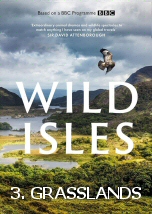
Grasslands

   2023    Nature
David Attenborough explores Britain and Ireland’s grasslands, revealing the creatures that create them and the extraordinary stories they hide. From the coastal flower meadows in the Scottish Outer Hebrides to the rich open landscapes in the mountains of southern Ireland, we enter surprising and dramatic worlds.
In southern England, we meet an extraordinary bee that lives in chalk grassland, one of our rarest habitats, laying her eggs in empty snail shells. Meanwhile, in the colourful machair of the Hebrides, ringed plovers and lapwings strive to rear their families of tiny fluffy chicks and to save them for marauding gulls.
We travel back in time to explore the vast wild grasslands once found throughout our isles, before meeting herds of semi-wild horses, where males battle fiercely for the females. Today, they are helping to turn some of this land back to wilderness. And in our precious remaining pockets of flower-rich meadow, a remarkable conservation success story plays out. Once extinct in our isles, England now has the largest known populations of large blue butterflies. Their survival relies on a game of deception with red ants, which are tricked into adopting the butterfly’s unassuming but predatory caterpillars.
Our story then journeys to the mountains. Each morning in early spring, feisty male black grouse battle for prime position on their frozen breeding grounds. Their sole mission is to impress a female. Meanwhile, on south-facing scree slopes, dozens of adders emerge from hibernation to perform a surprisingly delicate courtship routine.
The episode concludes with a mighty battle in the wild mountains of County Kerry. This is the scene of an epic and spectacular rut between the largest land mammals in Britain and Ireland, red deer.
The grasslands of Britain and Ireland are under threat. We have lost 97 per cent of our species-rich meadows in the last century, as modern agriculture replaces these precious habitats. This episode shows just how important different types of grassland are to the species which call these islands home.
Series: Wild Isles

Gravitational Waves Revealed

   2021    Science
In astronomy, we've been looking at different kinds of light and opening up the universe a little bit more of the time. But then in 2015, the roof came off. Something happened that changed everything, the ability to see waves in space and time itself. Gravitational waves help us roll back the clock to the dawn of time, discover epic cosmic collisions, on make Earth-shaking discoveries. Gravitational waves are the biggest game changer since the invention of the telescope. We have a completely new universe to view now. A new exploration of space is just beginning.
Series: How the Universe Works Series 9