









Last Watched

"Astronomy"  Sort by

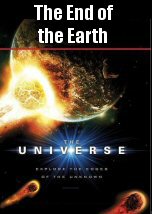
The End of the Earth

   2007    Science
Find out what is being done to prevent the end of the world from threats from outer space such as comets and asteroids. Also discussed are apocalyptic scenarios.
Series: The Universe
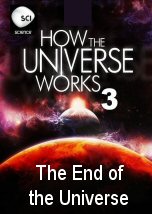
The End of the Universe

   2014    Science
How and when will the Universe end? Gravity and dark matter are poised to annihilate the Universe in a big crunch. Expansion and dark energy may tear it apart. Or, a phase transition could kill us tomorrow in a cosmic death bubble.
Series: How the Universe Works

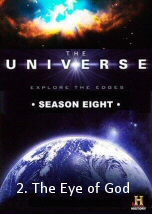
The Eye of God

   2016    Science
The film examines strange shapes of the universe, such as the 'Eye of God', the hexagon on Saturn, and the 'face' on Mars. One of Saturn's moons is a Star Wars lookalike. Could the strange patterns of the universe now solve mysteries that have haunted mankind since ancient times?
Series: The Universe Season 8

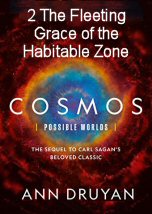
The Fleeting Grace of Habitable Zone

   2020    Science
The second episode takes a look at how humans have always been voyagers and explorers, leaving the comfort of native shores to explore. Neil DeGrasse Tyson will show us a long-term vision of humanity's future worlds.
Series: Cosmos: Possible Worlds

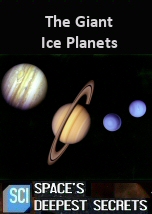
The Giant Ice Planets

   2021    Science
Uranus and Neptune, two of the largest, farthest and strangest planets in our solar system. These two planets break all the rules. Of all the big planets, Uranus and Neptune remain the biggest enigmas. Today, astronomers are finally unlocking why these supersized snowballs are so weird. Can an ancient mega-collision reveal what knocked Uranus onto its side? Can a missing twin world unlock why one of Neptune's moons orbits the wrong way? And what is the energy that drives the fastest winds in the solar system?
Series: Space Deepest Secrets Series 8

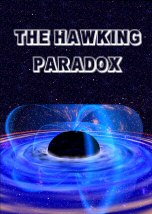
The Hawking Paradox

   2005    Science
Stephen Hawking is the most famous scientist on the planet. But behind the public face lies an argument that has been raging for almost 30 years. Has he been wrong for the last 30 years? Hawking shot to fame in the world of physics when he provided a mathematical proof for the Big Bang theory. This theory showed that the entire universe exploded from a singularity, an infinitely small point with infinite density and infinite gravity. Hawking was able to come to his proof using mathematical techniques that had been developed by Roger Penrose. These techniques were however developed to deal not with the beginning of the Universe but with black holes". Science had long predicted that if a sufficiently large star collapsed at the end of its life, all the matter left in the star would be crushed into an infinitely small point with infinite gravity and infinite density – a singularity. Hawking realised that the Universe was, in effect, a black hole in reverse. Instead of matter being crushed into a singularity, the Universe began when a singularity expanded to form everything we see around us today, from stars to planets to people. Hawking realised that to come to a complete understanding of the Universe he would have to unravel the mysteries of the black hole and its paradoxes