

Last Watched

"Rat"  Sort by

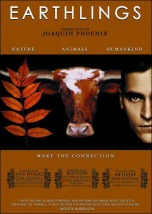
Earthlings

   2005    Nature
A feature length documentary about humanity's absolute dependence on animals (for pets, food, clothing, entertainment, and scientific research) but also illustrates our complete disrespect for these so-called 'non-human providers'. With an in-depth study into pet stores, puppy mills and animals shelters, as well as factory farms, the leather and fur trades, sports and entertainment industries, and finally the medical and scientific profession, the film uses hidden cameras and never before seen footage to chronicle the day-to-day practices of some of the largest industries in the world, all of which rely entirely on animals for profit. Powerful, informative and thought-provoking, EARTHLINGS is by far the most comprehensive documentary ever produced on the correlation between nature, animals, and human economic interests. There are many worthy animal rights films available, but this one transcends the setting.
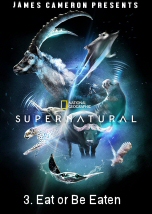
Eat or Be Eaten

   2022    Nature
Predators and prey are in an arms race for survival. Hunters and hunted deploy hidden super- skills in the battle to eat or be eaten. Masterclasses in predatory perfection are vital to passing on skills. So when they're ready to hunt for real, the next generation is fully prepared for the battle between predator and prey.
Life is a mission, survival. Animals have evolved secret weapons and hidden skills to outsmart their enemies. So in those life or death moments, it takes the most extraordinary super powers to prevail.
Series: Super/Natural

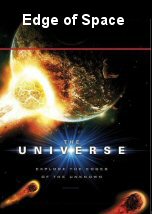
Edge of Space

   2009    Technology
Low Earth Orbit, 120 miles above sea level, is where the majority of space exploration has occurred. This 1,100 mile band around Earth is where--for a cool $20 million--any private citizen can take the vacation of his or her life on the International Space Station. Commercial prospects for LEO are huge; but dangers lurk for any individual willing to travel here--radiation, cosmic rays, and space debris numbering in the thousands threaten any spacecraft travelling in orbit. It's the new frontier, or the final frontier...and the possibilities are endless if you are willing to travel to the edge of space exploration.
Series: The Universe

Edge of the Universe

   2019    Science
Does the universe, have a limit? Does the universe have an edge? Looking out to the edge of the universe is tremendously important to understand our place in the cosmos and to understand the universe itself.
Inflation was a formative moment for our universe. By the time it stopped, the universe's basic characteristics were set. There could be regions of the greater universe where inflation didn't stop then. Occasionally a little region will stop inflating and just expand at the normal rate. We could imagine a super large-scale structure where there's different regions of the universe, domains, and each domain has different local constants and laws of physics.
Series: How the Universe Works Series 8

Eggs

   2017    Culture
The series 'The Mind of a Chef' combines travel, cooking, history, science and humor about everyone's favorite topic -- food. Each season brings with it a new host as well as fresh and exciting recipes. The 5th season is narrated by chef Ludo Lefebvre.
It’s everyone’s favourite food. From the New York City's classic egg on a roll to Faroe Island fulmar egg and curry, this episode of The Mind of a Chef finds us going through and re-falling in love with the best egg dishes from our archives. Crack it open, and let the fun begin.
Series: The Mind of a Chef

Einstein Nightmare

   2014    Science
Professor Jim Al-Khalili investigates the most accurate and yet perplexing scientific theory ever - quantum physics. At the beginning of the 20th century scientists were led into the hidden workings of matter, into the sub-atomic building blocks of the world around us. They discovered phenomena unlike any encountered before - a realm where things can be in many places at once, where chance and probability call the shots and where reality appears to only truly exist when we observe it. Albert Einstein hated the idea that nature, at its most fundamental level, is governed by chance. Jim reveals how, in the 1930s, Einstein thought he'd found a fatal flaw in quantum physics because it implies that sub-atomic particles can communicate faster than light in defiance of the theory of relativity. In the 1960s the scientist John Bell showed there was a way to test if Einstein was right and quantum mechanics was actually mistaken. Jim repeats this critical experiment - with shocking results.
Series: The Secrets of Quantum Physics