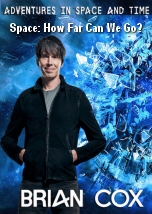
Professor Brian Cox tackles some of the most challenging and intriguing questions facing science. He looks back on a decade of discovery and towards the next space frontier. Brian believes we are at the start of a new age of space travel, where space flight is on the verge of becoming routine. In this episode, he explores the latest science and takes a new look at his old films and asks: how far can we go in our exploration of the cosmos?
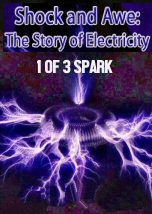
Professor Jim Al-Khalili tells the electrifying story of our quest to master nature's most mysterious force - electricity. Until fairly recently, electricity was seen as a magical power, but it is now the lifeblood of the modern world and underpins every aspect of our technological advancements.Without electricity, we would be lost. This series tells of dazzling leaps of imagination and extraordinary experiments - a story of maverick geniuses who used electricity to light our cities, to communicate across the seas and through the air, to create modern industry and to give us the digital revolution. Episode one tells the story of the very first 'natural philosophers' who started to unlock the mysteries of electricity. They studied its curious link to life, built strange and powerful instruments to create it and even tamed lightning itself. It was these men who truly laid the foundations of the modern world. Electricity was without doubt a fantastical wonder. This is the story about what happened when the first real concerted effort was made to understand electricity; how we learned to create and store it, before finally creating something that enabled us to make it at will - the battery.
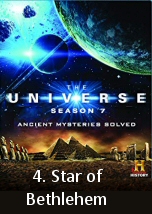
A strange light in the heavens. The star that signals the birth of Jesus. Is it faith, fable, or fact? The star of Bethlehem is hard to identify thousands of years later. Can we decode the secret of the star with the science of the universe? What was it? Where did it come from? And will it return? Discover an explanation by various astronomers and religion historians of what the star of Bethlehem really was based on available evidence.
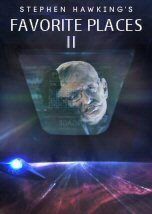
Commander Stephen Hawking takes another journey in his space ship, the SS Hawking, this time to Venus, the Sun and out to the Eagle Nebula...but things don't always go according to the flight plan...
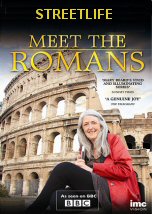
In this programme, Mary descends into the city streets to discover the dirt, crime, sex and slum conditions in the world's first high-rise city. This Rome is not the marble Rome we know, but a vast, messy metropolis with little urban planning, where most Romans lived in high-rise apartment blocks with little space, light, or even sanitation. Forced outdoors into the city streets, she reveals where they went to hang out, get drunk, have sex and get clean. She looks at the Forum as a place of gamblers, dentists and thieves, and she explores the lustiness of Roman bar life and jokes. Finally, exploring law and order from the bottom up, Mary examines how this city really worked. She meets Ancarenus Nothus, an apartment dweller who lived in fear of the rent collector; Notorious Primus, who wrote about his three great pleasures in life - baths, wine and sex; and Unlucky Doris, a seven-year-old girl killed in one of Rome's many fires.
‘Sugarcane’ is a compelling 2024 documentary that delves into the harrowing legacy of the Canadian Indian residential school system. The film investigates the discovery of unmarked graves at St. Joseph's Mission near Williams Lake, British Columbia, bringing to light the physical and sexual abuses endured by Indigenous children. Through intimate interviews with survivors and their descendants, directors Julian Brave NoiseCat and Emily Kassie reveal the enduring impact of these institutions on Indigenous communities, highlighting their resilience and ongoing quest for justice. The narrative intertwines personal stories with a broader historical context, showcasing the strength and unity of a community confronting its painful past. ‘Sugarcane’ not only exposes the atrocities committed but also celebrates the enduring spirit of Indigenous peoples as they heal and reclaim their cultural identity. This poignant film serves as a testament to their perseverance and the ongoing fight for recognition and reconciliation.











Brian believes we are at the start of a new age of space travel, where space flight is on the verge of becoming routine. In this episode, he explores the latest science and takes a new look at his old films and asks: how far can we go in our exploration of the cosmos?