Jacob Ward travels the globe to investigate Decision Science. We imagine our conscious minds make most decisions but in reality we go through much of our lives on 'Autopilot'. And marketers and social media companies rely on it. The first part offers you the owner’s manual for this autopilot. The second part, 'Weapons of Influence', explores how politicians, social media companies and corporate marketers use big data to hack decision-making system. The third part, 'Us vs. Them', shows how this autopilot biases fuel the nation's divisions and how to overcome them. The last part, 'The Wings of Angels', explores why hacking for good is an important scientific discovery; how people can hack their own minds to improve their lives and change the world for the better.
Beginning with the separation of the fuzzy thinking and pious fraud of astrology from the careful observations of astronomy, Sagan follows the development of astronomical observation. Beginning with constellations and ceremonial calendars (such as those of the Anasazi), the story moves to the debate between Earth and Sun-centered models: Ptolemy and the geocentric worldview, Copernicus' theory, the data-gathering of Tycho Brahe, and the achievements of Johannes Kepler (Kepler's laws of planetary motion and the first science-fiction novel).
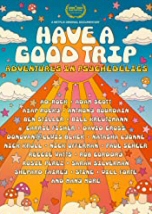
Mixing comedy with a thorough investigation of psychedelics, the film explores the pros, cons, science, history, future, pop cultural impact, and cosmic possibilities of hallucinogens. The documentary features comedic tripping stories from A-list actors, comedians, and musicians. Star-studded reenactments and trippy animations bring their surreal hallucinations to life. 'Have a Good Trip' tackles the big questions: Can psychedelics have a powerful role in treating depression, addiction, and helping us confront our own mortality? Are we all made of the same stuff? Is love really all we need? Can trees talk?
Sagan discusses comets and asteroids as planetary impactors, giving recent examples of the Tunguska event and a lunar impact described by Canterbury monks in 1178. It moves to a description of the environment of Venus, from the previous fantastic theories of people such as Immanuel Velikovsky to the information gained by the Venera landers and its implications for Earth's greenhouse effect. The Cosmos Update highlights the connection to global warming.
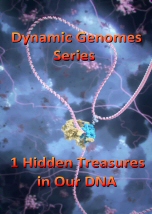
Explore the hottest area of bioscience, genomics with stunning live image, quality CGI, the forefront research, and real human stories. Previously it was thought that only 2% of our DNA is meaningful and the remaining 98% is non-coding 'junk'. But today we are beginning to know how the junk part of our DNA works to decide our personal characteristics and tendencies.
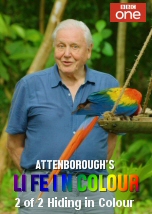
David Attenborough reveals the extraordinary ways that some animals use colour to hide and disappear into the background. New science reveals how the Bengal tiger in central India uses its orange-black stripes to hide from its colour-blind prey. In Kenya’s Masai Mara, the zebra’s black-and-white pattern confuses predators with an extraordinary effect called motion dazzle. And on the island of Cuba, a small snail uses colourful stripes in a surprising way to hide from its enemies. Other animals use colour to trick and to deceive. On Australia’s Great Barrier Reef, a blue-striped blenny uses colours to mimic other fish and launch a sudden attack. In the grasslands of Zambia, the chick of a pin-tailed whydah mimics the patterns of its nest mates to ensure that it is not detected as an imposter. And specialist cameras reveal how a tiny crab spider uses bright ultraviolet colours to lure in its victims.








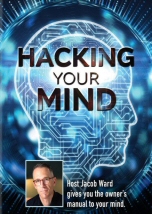






The first part offers you the owner’s manual for this autopilot. The second part, 'Weapons of Influence', explores how politicians, social media companies and corporate marketers use big data to hack decision-making system. The third part, 'Us vs. Them', shows how this autopilot biases fuel the nation's divisions and how to overcome them. The last part, 'The Wings of Angels', explores why hacking for good is an important scientific discovery; how people can hack their own minds to improve their lives and change the world for the better.