Professor Brian Cox concludes his exploration of our place in the universe by asking what next for the ape that went to space. Our future is far from certain. In Florida, Brian joins the latest efforts to protect Earth from potential catastrophic events. He joins a team of Nasa astronauts who are training for a future mission to an asteroid - should we ever discover one coming our way - under 30 feet of water in a submerged laboratory that simulates space. It is just one example of how, for our long-term survival, space exploration may well be vital. It is a view shared by Apollo 16 astronaut Charlie Duke, who tells Brian what it was like to escape the confines of the planet. It is a dream that both Nasa and now commercial companies share as they race to get humans back into deep space. But space travel, like every leap our civilisation has ever made, requires energy. Here too, scientists are hard at work attempting to safeguard our future. At the National Ignition Facility in California, Brian witnesses the world's most successful fusion experiment in action. He believes that if their mission succeeds, our civilisation will have unlocked a way to the stars that will not destroy the planet in the process. Brian concludes by returning to the top of the world in Svalbard, where he gains access to our civilisation's greatest treasure, locked away in a vault buried deep in the permafrost.
An informative and ambitious journey exploring how the evolution of scientific understanding is intimately interwoven with society's historical path. The Story Of Science tells the forces that came together to create scientific knowledge; the practical business of making instruments and machines; the great forces of history – revolutions, voyages of discovery and artistic movements – and the dogged determination of scientists and experimenters. This is the story of how scientific ideas shaped the modern world and how science made history. Michael Mosley begins the first episode with the story of one of the great upheavals in human history - how we came to understand that our planet was not at the centre of everything in the cosmos, but just one of billions of bodies in a vast and expanding universe. He reveals the critical role of medieval astrologers in changing our view of the heavens, and the surprising connections to the upheavals of the Renaissance, the growth of coffee shops and Californian oil and railway barons. Michael shows how important the practical skills of craftsmen have been to this story and finds out how Galileo made his telescope to peer at the heavens and by doing so helped change our view of the universe forever.
The story of how the secret of life has been examined through the prism of the most complex organism known - the human body. It begins with attempts to save the lives of gladiators in Ancient Rome, unfolds with the macabre work and near-perfect drawings of Leonardo in the Renaissance, through the idea of the 'life force' of electricity, to the microscopic world of the cell. It reveals how a moral crisis unleashed by work on the nuclear bomb helped trigger a great breakthrough in biology - understanding the structure and workings of DNA.
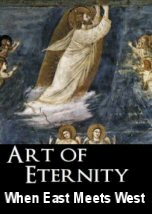
Andrew Graham-Dixon examines early Christian art and the reasons for its evolution during the Renaissance. He also reveals just how far modern artists have been influenced by the pre-perspective view of the world.
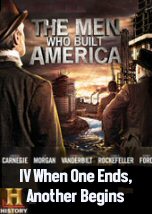
Rockefeller, Carnegie and Morgan team up to help elect William McKinley to the U.S. presidency by paying for his 1896 campaign, to avoid a possible attack on monopolies. However, fate intervenes when McKinley is suddenly assassinated, and vice president Theodore Roosevelt assumes the presidency and promptly begins dissolving monopolies and trusts in America. Meanwhile, Morgan buys out Carnegie Steel to make Carnegie the richest man in the world, and Henry Ford designs an affordable automobile with his Model T and starts his own business, Ford Motor Company, which sets a new business model for companies to follow.
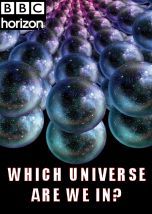
Imagine a world where infinite copies of you are playing out every storyline of your life. It sounds like a plot stolen straight from Hollywood, but far from it. This is the multiverse. Until very recently the whole idea of the multiverse was dismissed as a fantasy, but now this strangest of ideas is at the cutting edge of science. And for a growing number of scientists, the multiverse is the only way we will ever truly make sense of the world we are in. Do multiple universes exist? And if so, which one are we actually in?" Imagine a world where dinosaurs still walk the earth. A world where the Germans won World War II and you are president of the United States. Imagine a world where the laws of physics no longer apply.








But space travel, like every leap our civilisation has ever made, requires energy. Here too, scientists are hard at work attempting to safeguard our future. At the National Ignition Facility in California, Brian witnesses the world's most successful fusion experiment in action. He believes that if their mission succeeds, our civilisation will have unlocked a way to the stars that will not destroy the planet in the process. Brian concludes by returning to the top of the world in Svalbard, where he gains access to our civilisation's greatest treasure, locked away in a vault buried deep in the permafrost.