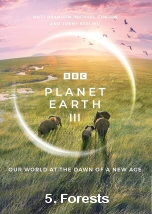
Journey to secret worlds where lives are wrapped in unexpected of ways. The fifth episode of the series takes viewers into the fascinating world of forests, revealing their hidden complexities and the intricate relationships within. Initially perceived as tranquil, forests are in fact bustling with life and intricate ecological interactions. The episode showcases various species, each with its unique lifestyle and survival strategies. Highlights include the Oriental pied hornbills in Borneo, whose extraordinary nesting rituals and partner dynamics are captivating. The Amazon rainforest is explored, introducing the peculiar treehoppers and their unique communication methods, vital for survival amidst numerous predators like ants and assassin bugs. The episode also delves into the intelligent and cooperative hunting techniques of dholes in the forests of India. The narrative takes a turn to China, focusing on the visually stunning courtship displays of Temminck's tragopans and golden pheasants. In the temperate rainforests of Western Canada, the rare spirit bear and its unique relationship with its habitat are examined. The episode concludes with an insightful look at the impact of human activity on forests and their inhabitants, particularly focusing on chimpanzees in Uganda, whose survival is increasingly intertwined with human expansion.
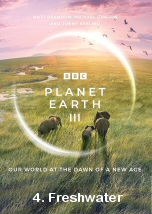
Covering one tenth of all species on the planet, Freshwater is a rich, diverse habitat filled with never-ending surprises. The fourth episode is set beneath the Yucatan Peninsula and spanning diverse locations like the rainforests of Costa Rica and the Kalahari Desert and presents a vivid exploration of how freshwater shapes life on Earth. The narrative journeys through the unique breeding rituals of gliding tree frogs in Costa Rica, the strategic hunting methods of mugger crocodiles in Sri Lanka, and the astonishing adaptations of wildlife in the Okavango Delta. It highlights the critical role of freshwater in supporting diverse ecosystems, from the teeming fish species in Lake Malawi to the perilous journey of gobies in Bioko. The episode also addresses human impact, showcasing the extensive irrigation system in Pakistan and its unintended consequences on local wildlife, like the endangered Indus river dolphin. This captivating chapter not only showcases nature's marvels but also underscores the delicate balance between human needs and wildlife conservation.
This featured film investigates the emerging threats posed by plastic pollution to life on Earth. The hyper-convenience of our modern way of living produces staggering volumes of plastic waste daily. Scientists now know that this waste breaks down into ever tinier pieces, spreading right across the globe and posing direct health risks, including through bioamplification of toxic additives moving up the food chain. We explore the drastic changes it will take to deliver a sustainable future for our planet.
Spy in the Huddle use innovative techniques to reveal the incredible secrets of your pets' behaviour in ways never seen before. As astonishing photography explores the wild side of our playful pets, find out why hamsters love to run in a wheel, how dogs pick up the rules of the pack and how kittens learn to be solitary hunters. Featuring incredible views of plunge-diving dogs, babysitting cats, acrobatic hamsters and a playful cat outwitted by his prey" - you'll never look at your favourite companions in quite the same way again. The latest science also reveals why budgies talk, how a cat scales a vertical wall with the help of a special claw, why hamsters stuff their faces with more food than they can eat and the real meaning behind a rabbit's hop. Our pets are also given a chance to explore their wild side as we join the free-roaming pet dogs of Cusco Peru, pet rabbits living in a natural warren and the wild-living inhabitants of Cat Island, Japan. A range of innovative techniques such as moving X-rays, thermal imagery, minicam-carrying dogs and revelatory slow-motion photography shows why our pets play and how their true wild nature is just a whisker away.
On the trail of tiger sharks in the Pacific, Will Smith explores the power of smell. Sharks have a sense of smell that's hundreds of times more potent and accurate than that of humans. An enormous part of their brain is dedicated to smelling, to finding their way through the vast expanse of the ocean.
Five times, the Earth has faced apocalyptic events. Cataclysms that have swept away all life forms, or almost. Each time, a handful of species has survived, establishing a new world. What did these prehistoric worlds look like? What catastrophes led to their disappearance? How did our distant ancestors manage to survive the five mass extinctions that the Earth has suffered, finally giving rise to the world we know today? Combining CGI of ancient animal and plant life, VFX and filming, 'Prehistoric Worlds' looks back at the five mass extinctions of life on Earth that allowed the advent of the human race. On the brink of a sixth mass extinction that the scientific community considers imminent – this time caused by mankind – this film gives us an interesting and powerful look at Man's existence on the scale of the history of our planet.

























The Amazon rainforest is explored, introducing the peculiar treehoppers and their unique communication methods, vital for survival amidst numerous predators like ants and assassin bugs. The episode also delves into the intelligent and cooperative hunting techniques of dholes in the forests of India. The narrative takes a turn to China, focusing on the visually stunning courtship displays of Temminck's tragopans and golden pheasants. In the temperate rainforests of Western Canada, the rare spirit bear and its unique relationship with its habitat are examined.
The episode concludes with an insightful look at the impact of human activity on forests and their inhabitants, particularly focusing on chimpanzees in Uganda, whose survival is increasingly intertwined with human expansion.