One of the main battles of the Second World War took place inside the brain of a mathematician called Alan Turing. During the war, the allies' key objective was to crack the German army's encrypted communications code. Without a doubt, the key player in the game was this interdisciplinary scientist and a long-forgotten hero. Alan Turing's breakthroughs, his story and tragic destiny, gives us a chance to look at the Second World War from a different angle.
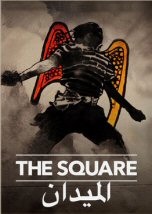
A group of Egyptian revolutionaries battle leaders and regimes, risking their lives to build a new society. The Egyptian Revolution has been an ongoing rollercoaster over the past two and a half years. Through the news, we only get a glimpse of the bloodiest battle, an election, or a million man march. At the beginning of July 2013, we witnessed the second president deposed within the space of three years. The Square is an immersive experience, transporting the viewer deeply into the intense emotional drama and personal stories behind the news. It is the inspirational story of young people claiming their rights, struggling through multiple forces: from a brutal army dictatorship willing to crush protesters with military tanks, to a corrupt Muslim Brotherhood using mosques to manipulate voters. Directed by Jehane Noujaim, the film was nominated for the Academy Award and also won three Emmy Awards.
Michael Wood’s epic series moves on to the revolutionary years after 500BC - the Age of the Buddha. Travelling by rail to the ancient cities of the Ganges plain, by army convoy through Northern Iraq, and on down the Khyber Pass, he shows how Alexander the Great’s invasion of India inspired her first empire.
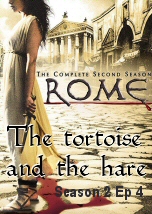
Having learned that Vorenus' children are alive, Pullo sets off to find him in Gaul where he is again a serving soldier in Mark Antony's army. He had hoped to arrive before Octavian and Antony's armies meet in battle. Too late however, he is forced to find what is left of Antony's army in the mountains. He finds Vorenus alive and well, if somewhat battle worn, and they set off to find the children. The victorious Octavian plans his return to Rome. In Western Turkey, Brutus and Cassius amass their own army, now 19 Legions strong.
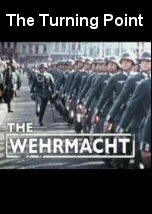
The German army launched Operation Barbarossa, the invasion of the East, with supreme confidence in its own superiority. High Command was sure that victory would come as quickly and as easily as in France. At the onset, the troops advanced rapidly and the Panzer forces under General Guderian were unbeatable. There were, however, far more casualties and more wear-and-tear on equipment than anticipated. The invading force got bogged down short of Moscow and the withdrawal from there was a severe psychological blow to the men. When an extremely severe winter set in, morale sank further. The soldiers were not equipped for such low temperatures and their guns and machinery could not cope. Hitler ordered his troops to stand firm.
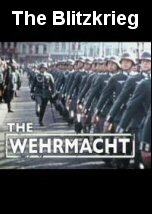
What was the Wehrmacht? A group of obedient yeasayers? A murdering band of thugs? An army of millions of abused young men? This series in 5 parts provides differentiated and conclusive answers based on the latest historical and comprehensive investigative research, bringing many new facts to light – among them documents proving for the first time ever, what many among the officers actually thought. Blitzkrieg, the lightning war, in German incorporate modern weapons and vehicles as a method to help avoid the stalemate of trench warfare and linear warfare in future conflicts. The first practical implementations of these concepts coupled with modern technology were instituted by the Wehrmacht in the opening theatres of World War II. The strategy was particularly effective to Germany in the invasions of Western Europe and initial operations in the Soviet Union. These operations were dependent on surprise penetrations, general enemy unpreparedness and an inability to react swiftly enough to German offensive operations.















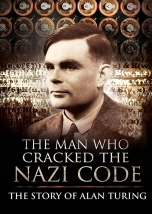






Alan Turing's breakthroughs, his story and tragic destiny, gives us a chance to look at the Second World War from a different angle.