










Last Watched

"Bird"  Sort by

Life: Fish

   2009    Nature
Fish dominate the planet's waters through their astonishing variety of shape and behaviour. The beautiful weedy sea dragon looks like a creature from a fairytale, and the male protects their eggs by carrying them on his tail for months. The sarcastic fringehead, meanwhile, appears to turn its head inside out when it fights. Slow-motion cameras show the flying fish gliding through the air like a flock of birds and capture the world's fastest swimmer, the sailfish, plucking sardines from a shoal at 70 mph. And the tiny Hawaiian goby undertakes one of nature's most daunting journeys, climbing a massive waterfall to find safe pools for breeding.
Series: Life

Life: Plants

   2009    Nature
Plants' solutions to life's challenges are as ingenious and manipulative as any animal's. Innovative time-lapse photography opens up a parallel world where plants act like fly-paper, or spring-loaded traps, to catch insects. Vines develop suckers and claws to haul themselves into the rainforest canopy. Every peculiar shape proves to have a clever purpose. The dragon's blood tree is like an upturned umbrella to capture mist and shade its roots. The seed of a Bornean tree has wings so aerodynamic they inspired the design of early gliders. The barrel-shaped desert rose is full of water. The heliconia plant even enslaves a humming bird and turns it into an addict for its nectar.
Series: Life

Listening to Kenny G

   2021    History
This featured film takes a humorous but incisive look at the best-selling instrumentalist of all time – and quite possibly one of the most famous living musicians. Listening to Kenny G investigates the artist born Kenny Gorelick – who took the pop charts by storm with his 1986 breakthrough single, 'Songbird' – exploring his talent for playing jazz so smoothly that a whole new genre, 'Smooth Jazz,' formed around him, and questioning fundamental assumptions about art and excellence.
In his own words, Kenny G speaks candidly about his musical background, his stringent work ethic, and his controversial standing in the jazz canon – along with insights from fans and critics alike.

LudoBird

   2017    Culture
How does a chef trained in the finest kitchens of France translate his haute cuisine to fast food? Ludo’s obsession with a perfectly cooked bird can be traced back to France, where he learned to roast chicken.
His love for the American classic was solidified in 1996 when he arrived in LA and ate at KFC for the first time. “It was the same sensation,” he’s said, the crunchy skin and juicy flesh, and the gap between his two worlds was bridged. In this episode we learn how a Frenchman became famous for a truly American dish.
Series: The Mind of a Chef

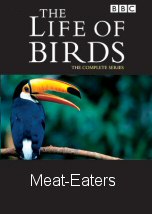
Meat-Eaters

   1998    Nature
This episode examines those birds whose sustenance comes from flesh and their methods of hunting. In New Zealand, Sir Attenborough observes Keas, parrots that do not eat meat exclusively, raiding a shearwater's burrow for a chick. However, it is the dedicated birds of prey, such as owls, buzzards, eagles, falcons and vultures, to which much of the programme is devoted. In order to spot and pursue their victims, senses of sight and hearing are very acute. Vultures are the exception, in that they eat what others have left, and once a carcass is found, so many birds descend on it that the carrion seems submerged beneath them. The Turkey Vulture is an anomaly within its group, as it also has a keen sense of smell. Eagles defend their territory vigorously, and a pair of sea eagles are shown engaging in an aerial battle. The Galápagos Hawk hunts Marine Iguanas, but can only do so when its quarry is vulnerable, during the breeding season. The African Harrier Hawk has adapted to extracting burrowing animals by virtue of an especially long, double-jointed pair of legs. By contrast, a shrike is not equipped with the requisite sharp beak and talons needed for butchery, and so dismembers its kill by impaling it on the thorns of acacias. The Lammergeier eats bones, and will drop them on to rocks from a great height in order to break them down to a digestible size. Also featured are the Eurasian Sparrowhawk, Goshawk and Peregrine Falcon.
Series: The Life of Birds

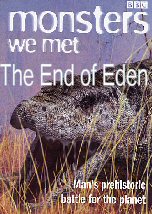
Monster we met: The End of Eden

   2006    Science
New Zealand - 850 years ago New Zealand was the last major land mass to be discovered and colonised by humans. A mere 850 years ago, Polynesian seafarers arrived in a land with no terrestrial mammals. New Zealand was a land of birds, and its avian rulers were giants: huge herbivorous moas were hunted by Haast's eagle - the largest eagle the world has ever seen. But within the space of only 100-400 years, the eagle, all the moas and over 20 other species of birds were gone. Had mankind become the monster?
Catalyst

Catalyst

2017  Science
The Story of India

The Story of India

2007  History
Welcome to Earth

Welcome to Earth

2021  Nature
Mind Field Season 2

Mind Field Season 2

2018  Technology
Sex Explained

Sex Explained

2020  Medicine