

Last Watched

A Sky Full of Ghosts

   2014    Science
Tyson begins the episode by explaining the nature of the speed of light and how much of what is seen of the observable universe is from light emanated from billions of years in the past. Tyson further explains how modern astronomy has used such analyzes via deep time to identify the Big Bang event and the age of the universe. Tyson proceeds to describe how the work of Isaac Newton, William Herschel, and James Clerk Maxwell contributed to understanding the nature of electromagnetic waves and gravitational force, and how this work led towards Albert Einstein's Theory of Relativity, that the speed of light is a fundamental constant of the universe and gravity can be seen as distortion of the fabric of space-time. Tyson describes the concept of dark stars as postulated by John Michell which are not visible but detectable by tracking other stars trapped within their gravity wells, an idea Herschel used to discover binary stars. Tyson then describes the nature of black holes, their enormous gravitational forces that can even capture light, and their discovery via X-ray sources such as Cygnus X-1. Tyson uses the Ship of Imagination to provide a postulate of the warping of spacetime and time dilation as one enters the event horizon of the black hole, and the possibility that these may lead to other points within our universe or others, or even time travel. Tyson ends on noting that Herschel's son, John would be inspired by his father to continue to document the known stars as well as contributions towards photography that play on the same nature of deep time used by astronomers.
Series: Cosmos: A Spacetime Odyssey
A Sunday Afternoon on the Island of La Grande Jatte

   2004    Art
This award-winning series, Private Life of a Masterpiece, reveals the full and fascinating stories behind famous works of art, not just how they came to be created, but also how they influenced others and came to have a life of their own in the modern world. The works of art featured here are both instantly familiar and profoundly mysterious. Revolutionary in their conception, and iconic years after their execution, they each have their own compelling stories. For behind the beautiful canvases and sculptures are tales of political revolution, wartime escapes, massive ego clashes, social scandal, financial wrangling and shocking violence. In this fascinating series key works of art are investigated and the intricate details of their lives revealed - the history, contemporary reactions, and legacies of each are illustrated.
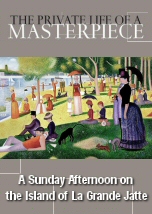
A Sunday Afternoon on the Island of La Grande Jatte is a popular masterpiece and yet an enduring enigma. It seems to show a quiet scene in a Paris park but there are hints at the demi-monde, if you know where to look. The most remarkable aspect of this vast canvas however remains Seurat's technique his revolutionary pointillism.
Series: The Private Life of a Masterpiece

A Tale of Two Atoms

   2020    Science
Inside the heart of the atom, its nucleus houses energy. This hidden treasure was forged billions of years ago in distant stellar furnaces. The secret of starlight is nothing to fool with. It can bring a civilization to life and it can burn it to the ground.
Two atoms from different parts of the universe meet on a small planet. A deadly embrace between science and state altered the fate of the world and a gripping cautionary tale of others who grew used to living in the shadow of grave danger until it killed them all except one.
Series: Cosmos: Possible Worlds

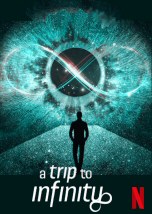
A Trip to Infinity

   2022    Science
Does Infinity exist? Can we experience the Infinite? In an animated film created by artists from 10 countries, the world's most cutting-edge scientists and thinkers go in search of the infinite and its mind-bending implications for the universe.
It doesn’t behave like we’re used to. It’s a monster that needs to be tamed. It creates and destroys mathematicians. It’s infinity! You know, the thing that goes on and on and on and never ends. Here we have theoretical physicists, mathematicians, philosophers, theoretical cosmologists talking about infinity – what it is, how it works, where we can find it, etc., and their concepts and explanations are illustrated by a variety of nifty animations in a variety of visual styles ranging from literal to metaphorical.
Directors Jonathan Halperin and Drew Takahashi solicit experts to help them tackle the most maximal topic in the history of everything from a few different angles. Y when you think about it for a second, the only possible conclusion one can arrive at is a sublime and confounding realization that, on a cosmic scale, humans are naught but grand ignoramuses.

A Ukrainian Soldier Record

   2024    History
A young filmmaker leaves behind his civilian life to enter the front lines of Ukraine’s war, documenting not only the battlefield but the emotional weight of a conflict that reshapes everything it touches. Through his camera, moments of tension, fear and humanity unfold with an immediacy that places you inside a reality few ever witness firsthand.
Beyond the combat, the film reveals the inner transformation of a man confronting duty, identity and survival, offering a raw and intimate perspective that turns a distant war into something deeply personal and impossible to ignore.

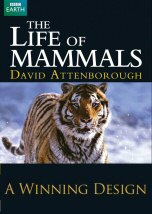
A Winning Design

   2002    Nature
A Winning Design clarifies what makes a mammal different from reptiles and birds. No, it isn't egg-laying: both the platypus and the echidna are egg-laying mammals; it's their ability to adapt. And it's this adaptability that becomes the crux of the remainder of the series. From the tiniest bat to the massive blue whale, all mammals share the ability to nurture their young on milk and regulate their own temperatures.
Series: The Life of Mammals
Leaving Neverland

Leaving Neverland

2019  Culture
Mammals

Mammals

2024  Nature
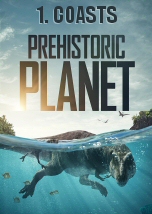
Prehistoric Planet

Prehistoric Planet

2022  Science
Space Race

Space Race

2005  Technology
The Hunt

The Hunt

2015  Nature