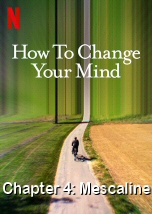
The last episode explores Mescaline, the psychoactive molecule in San Pedro and peyote cacti, a sacred medicine that Native Americans have had to fight for the right to use. At the Indigenous practices there's always an elder, someone who knows the territory very well, who's presiding. There's usually a group, a community is involved, There's always an intention, a purpose to what you're doing, and you're treating it as sacred, in order to achieve altered states of consciousness, which contribute to worship in various ways, or celebration or healing. But maybe all this is not so new to Western culture after all. In the old Greek histories of Eleusis, people who were initiated there got the drink, the kykeon, and then they had the illumination. The precise recipe is a mystery, but we know that the kykeon was a psychoactive brew that was used at the Eleusinian mysteries, a sacred annual ritual of enlightenment practiced by some of the world's greatest minds including Socrates, Plato, and Aristotle. So why did this ritual come to an end more than 1,000 years ago? Was the possibility of illumination or achieving a higher consciousness considered threatening to the powers that be? Have the drug wars been merely an extension of that fear? Psychedelics has a major part in how we can heal as a community, how we can heal as a city, and how we can heal as a country. The current renaissance of psychedelics could not come at a better time as the world confronts a crisis in mental health. But psychedelics have much to offer. The psychedelic experience changes the mind in ways that will help scientists better understand how it works. All these altered states allow us to probe what is the greatest mystery in all of nature. The emergence from mere matter of something as miraculous as consciousness. But an even bigger question is whether psychedelics might help us address the environmental crisis of how we think about our place in nature. One of the greatest gifts of psychedelics is how they reanimate the natural world, allowing us to perceive the subject, the spirit of all species, not just our own. And to feel a deeper sense of interconnectedness with nature.
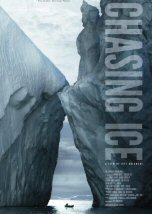
Acclaimed National Geographic photographer James Balog was once a skeptic about climate change. But through his Extreme Ice Survey, he discovers undeniable evidence of our changing planet. In Chasing Ice, Balog deploys revolutionary time-lapse cameras to capture a multi-year record of the world's changing glaciers". His hauntingly beautiful videos compress years into seconds and capture ancient mountains of ice in motion as they disappear at a breathtaking rate. Traveling with a team of young adventurers across the brutal Arctic, Balog risks his career and his well-being in pursuit of the biggest story facing humanity. As the debate polarizes America, and the intensity of natural disasters ramps up globally, Chasing Ice depicts a heroic photojournalist on a mission to deliver fragile hope to our carbon-powered planet. Directed by Jeff Orlowski
From the small town of Lynchburg, Tennessee, where every drop of Jack Daniel's is made, to the outback of Australia, from Beverly Hills to the streets of Havana, Cuba, 'Chasing Whiskey' documents a cultural exploration into why a world of people identifies with a distinctly American brand. Through it all, Jack Daniel's serves as the compass on a journey that offers a glimpse into humanity, shared values and differing views, dreams and delusions
Foo Fighters commemorate their 20th anniversary by documenting the eight-city recording odyssey that produced their latest, and eighth, studio album. Foo Fighters founder Dave Grohl directs the series, which taps into the musical heritage and cultural fabric of eight cities: Chicago, Austin, Nashville, Los Angeles, Seattle, New Orleans, Washington D.C. and New York. The band based themselves at a legendary recording studio integral to the unique history and character of each location. One song was recorded in each city, and every track features local legends. Even the lyrics were developed in an experimental, unprecedented way: Grohl held off on writing them until the last day of each session, letting himself be inspired by the experiences, interviews and personalities that became part of the process. Foo Fighters Sonic Highways is, in Grohl’s words, “a love letter to the history of American music.” Each episode delves into the identity of each city -- showing how each region shaped these musicians in their formative years and, in turn, how they impacted the cultural fabric of their hometowns. Every artist who appears in the show, regardless of genre or locale, started as an average kid with universal dreams of making music and making it big. Grohl made his feature film directorial debut in 2013 with the universally acclaimed Grammy-winning Sound City, a celebration of the human element in the creation and recording of music. Foo Fighters have won 11 Grammy Awards, including four for Best Rock Album, more than any other band. Premiering on the eve of Foo Fighters’ 20th anniversary, Foo Fighters Sonic Highways aims to “give back” to the next generation of young musicians. As guitarist and singer Buddy Guy, an interviewee from the Chicago blues scene, explains, “Everything comes from what’s come before.” In the first episode, Dave Grohl and friends discuss the rise of the famous Chicago music scene from the roots blues of Muddy Waters and Buddy Guy to the Rock and roll of Cheap Trick.
Curiosity over the man calling himself a messiah makes Waco the center of a media circus. FBI negotiation and rescue teams clash over the use of force. The negotiating team established contact with Koresh inside the compound. Communication over the next 51 days included telephone exchanges with various FBI negotiators. Koresh himself had been seriously injured by a gunshot. As the standoff continued, he and his closest male associates negotiated delays, so that he could possibly write religious documents, which he said he needed to complete before his surrender. Koresh's conversations with the negotiators were dense and they also included biblical imagery. The FBI negotiators treated the situation as a hostage crisis.
America says eight out of ten industrial espionage cases now involve China. Governments around the world are uncovering secret operations to expand China's influence - the work of a little-known branch of the Chinese Communist Party called the United Front Work Department. President Xi has called it his 'magic weapon'. Jane Corbin investigates this powerful but shadowy organisation. Has influence become interference as China bids to become the most powerful nation on earth?


























But maybe all this is not so new to Western culture after all. In the old Greek histories of Eleusis, people who were initiated there got the drink, the kykeon, and then they had the illumination. The precise recipe is a mystery, but we know that the kykeon was a psychoactive brew that was used at the Eleusinian mysteries, a sacred annual ritual of enlightenment practiced by some of the world's greatest minds including Socrates, Plato, and Aristotle. So why did this ritual come to an end more than 1,000 years ago? Was the possibility of illumination or achieving a higher consciousness considered threatening to the powers that be? Have the drug wars been merely an extension of that fear?
Psychedelics has a major part in how we can heal as a community, how we can heal as a city, and how we can heal as a country. The current renaissance of psychedelics could not come at a better time as the world confronts a crisis in mental health. But psychedelics have much to offer. The psychedelic experience changes the mind in ways that will help scientists better understand how it works. All these altered states allow us to probe what is the greatest mystery in all of nature. The emergence from mere matter of something as miraculous as consciousness. But an even bigger question is whether psychedelics might help us address the environmental crisis of how we think about our place in nature. One of the greatest gifts of psychedelics is how they reanimate the natural world, allowing us to perceive the subject, the spirit of all species, not just our own. And to feel a deeper sense of interconnectedness with nature.