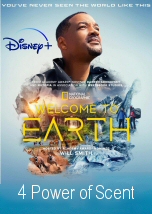
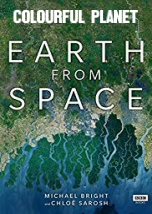
From space, Earth is a kaleidoscope. Turquoise plankton blooms trigger a feeding frenzy, China turns yellow with rapeseed flowers, and mysterious green lights appear in the ocean. Satellites give us a new perspective on its greatest and most beautiful spectacles allowing us to make new discoveries We can watch landscapes change through the seasons and marvel in the scale of their transformations. Satellite cameras capture a kaleidoscope of extraordinary colours surprising and constantly changing, created by natural phenomena, by animals and by people. These colours are revealing new insight into the health of our fragile planet, transforming our understanding of our colourful home.
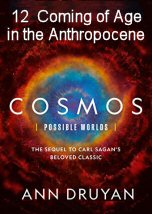
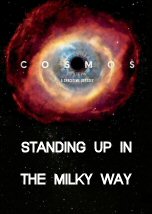
At 11 o'clock on New Year's Eve of the Cosmic Calendar, Homo erectus stood up for the first time, freeing its hands and earning the species its name. They began to move around, to explore, daring to risk everything to get to unknown places. Our Neanderthal relatives lived much as we did and did many of the things we consider to be 'human.' More restless than their cousins the Neanderthals and Denisovans, our Homo sapiens ancestors crossed seas and unforgiving landscapes, changing the land, ocean and atmosphere, leading to mass extinction. The scientific community gave our age a new name, 'Anthropocene.' Since the first civilizations we've wondered if there's something about human nature that contains the seeds of our destruction. Syukuro Manabe was born in rural Japan and took an intense interest in Earth's average global temperature. In the 1960's, he would assemble the evidence he needed to predict the increase of Earth's temperature due to greenhouse gases until it becomes an uninhabitable and toxic environment, leading to our extinction. 'This doesn't have to be,' says Neil deGrasse Tyson, 'it's not too late. There's another hallway, another future we can still have; we'll find a way.'
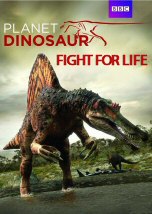
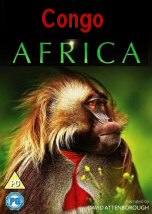
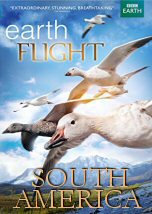
The very heart of Africa is covered in dense tropical rainforest. The animals that live here find the most ingenious ways to carve out their space in a claustrophobic landscape. Danger lurks in every shadow, but some animals thrive here, from honey-stealing chimps to birds with a lineage as old as the dinosaurs, thundering elephants and kick-boxing frogs. Here in the Congo, no matter how tough the competition, you must stand up and fight for yourself and your patch.
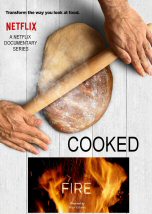
As he tries his hand at baking, brewing and braising, acclaimed food writer Michael Pollan explores how cooking transforms food and shapes our world. In the first espisode, with help from Aboriginal hunters and a barbecue pit master, Pollan shows how fire shaped human gastronomy, and weighs our duty to the animals we eat.
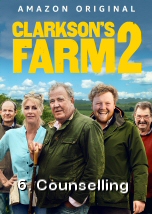
Everyone's still reeling from the council's decision and its implications: the money Jeremy's spent on cows for the restaurant, the locals who won't find work there now and the farmers' co-operative that's now defunct. Charlie sets out to find a legal team to help Jeremy appeal the decision, as Jeremy and Kaleb get to work on tagging the new calves and attempting to navigate a government helpline where you're supposed to register them. There are other useful distractions from the council in the shape of Diddly Squat's Hedge Laying Competition and a mouse that brings the whole farm to a standstill. The legal team that Charlie has assembled pay a visit. They outline their strategy for the appeal, but also the costs that come with it.
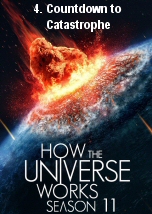
November 4, 2029. We face a countdown to catastrophe. A giant asteroid hurtles towards Earth at 40,000 mph. It's heading straight for the eastern seaboard of the United States. The space rock could wipe out an entire city and cause widespread devastation. Can Earth survive? Now, experts confront the story of this fictional asteroid event to determine what could happen, and how it might be stopped.


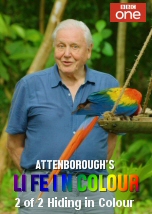








Satellite cameras capture a kaleidoscope of extraordinary colours surprising and constantly changing, created by natural phenomena, by animals and by people. These colours are revealing new insight into the health of our fragile planet, transforming our understanding of our colourful home.