

Last Watched

"Time"  Sort by

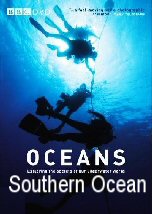
The Southern Ocean

   2009    Nature
The Southern Ocean, which circles the globe without being blocked by land, is home to the Antarctic Circumpolar Current (ACC), the longest of the world's ocean currents. Also known as the "channel", it connects the Indian, Atlantic and Pacific Ocean basins and exerts a powerful influence over the Earth's climate. The ACC carries 150 times more water around Antarctica than the flow of all the world's rivers combined.
Series: Oceans
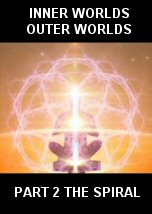
The Spiral

   2012    Science
The Pythagorian philosopher Plato hinted enigmatically that there was a golden key that unified all of the mysteries of the universe. It is this golden key that we will return to time and again throughout our exploration. The golden key is the intelligence of the logos, the source of the primordial om. One could say that it is the mind of God. With our limited senses we are observing only the outer manifestation of the hidden mechanics of self similarity. The source of this divine symmetry is the greatest mystery of our existence.
Series: Inner Worlds Outer Worlds

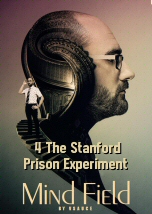
The Stanford Prison Experiment

   2019    Culture
It all begins as a study on the psychology of prison life led by Stanford psychology professor Dr. Philip Zimbardo. 24 volunteers - 12 guards and 12 prisoners - have agreed to spend the next two weeks recreating life in a correctional facility. Normal people can become monsters, given the right situation, that's the standard narrative of the Stanford Prison Experiment, one of the most famous psychological experiments of all time.
But what if the cause of its participants' cruel behavior wasn't what we've always been told?
Series: Mind Field

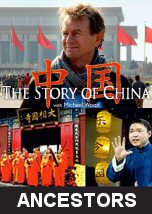
The Story of China Ancestors

   2016    History
Michael Wood embarks on a great historical adventure, exploring the stories, people and landscapes that have helped create China's distinctive character and genius over four thousand years. Is the history of the world's newest superpower, from its ancient past to the present day.
Starting in Wuxi, Michael joins the Qin family reunion, when 300 relatives gather to worship their ancestors on Tomb Sweeping Day. 'Like the nation, the family has been through so much,' one says. 'Now everyone wants to know - what are our roots?'
Looking for the origins of the Chinese state, he visits the excavations at Erlitou and sees an exquisite turquoise dragon sceptre from 2000 BC. China's first writing is found on 'oracle bones' dug up from the Shang royal tombs at Anyang in the 1920s. At the Beijing Planetarium, Michael travels back in time as astronomers plot the planetary conjunction that the ancients believed foretold the overthrow of the Shang Dynasty. Next, the Age of Philosophers and Confucius, whose book Analects has had greater influence worldwide than even the Bible, according to some. In Xi'an, we hear how the First Emperor united China and created the authoritarian Qin state that gave us the word China. Finally, Michael returns to the temple fair in Henan for a dramatic night ceremony to give thanks to the ancestors. China, Michael concludes, is rising again, not just because of its economic strength, but because of the incredible solidarity of the Han Chinese view of their own civilisation, their sense of family and, of course, the presence of the ancestors.
Series: The Story of China

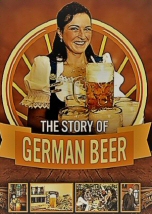
The Story of German Beer

   2021    Technology
Beer, as popular today as ever. Beer, an ever present in changing times. German beer, protected for 500 years, it's a mark of quality and an export success the world over. This documentary looks at the history of beer starting with the Sumerians, who invented it 5.000 years ago, to the Middle Ages and to the new trend of the future: craft beer. Prost!

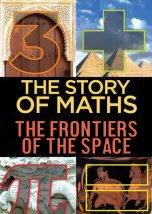
The Story of Maths The Frontiers of Space

   2008    Science
In the third episode we will see Europe by the 17th century taking over from the Middle East as the powerhouse of mathematical ideas. Great strides had been made in understanding the geometry of objects fixed in time and space. The race was on to discover the mathematics to describe objects in motion. This programme explores the work of Rene Descartes, Pierre Fermat, Isaac Newton, Leonard Euler and Carl Friedrich Gauss. Du Sautoy proceeds to describes René Descartes realisation that it was possible to describe curved lines as equations and thus link algebra and geometry. He talks with Henk J. M. Bos about Descartes. He shows how one of Pierre de Fermat’s theorems is now the basis for the codes that protect credit card transactions on the internet. He describes Isaac Newton’s development of math and physics crucial to understanding the behaviour of moving objects in engineering. He covers the Leibniz and Newton calculus controversy and the Bernoulli family. He further covers Leonhard Euler, the father of topology, and Gauss' invention of a new way of handling equations, modular arithmetic. The further contribution of Gauss to our understanding of how prime numbers are distributed is covered thus providing the platform for Bernhard Riemann's theories on prime numbers. In addition Riemann worked on the properties of objects, which he saw as manifolds that could exist in multi-dimensional space.
Series: The Story of Maths
Mammals

Mammals

2024  Nature
Leaving Neverland

Leaving Neverland

2019  Culture
How to Change Your Mind

How to Change Your Mind

2022  Medicine
How Earth Made Us

How Earth Made Us

2010  Science
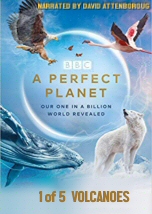
A Perfect Planet

A Perfect Planet

2021  Nature
Secrets of the Universe

Secrets of the Universe

2022  Technology
The Sky at Night

The Sky at Night

2025  Science
Life of a Universe

Life of a Universe

2017  Science