In the third episode, a Velociraptor hunts pterosaurs on a cliffside by a waterfall. A battle-scarred Tyrannosaurus nurses his wounds and encounters a newcomer. With its feathered body and duck bill, the eight-ton Deinocheirus wades through an Asian wetland in search of relief from pesky biting flies. A female Quetzalcoatlus builds and guards her nest. A mother Masiakasaurus and her family hunt crabs. Elasmosaurs enter an estuary in search of fish.
This episode explores the palaeogeography of Earth over millions of years, and its impact on the development of life on the planet. Tyson starts by explaining that the lignin-rich trees evolved in the Carboniferous era about 300 million ago, then explains on the nature of plate tectonics that would shape the landmasses of the world and the asteroid impact that initiated the Cretaceous–Paleogene extinction event, leaving small mammals as the dominate species on earth. Earth's landmasses are expected to change in the future and postulates what may be the next great extinction event.
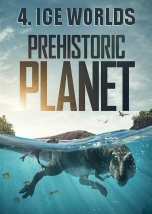
In the fourth episode, Dromaeosaurs stalk a hadrosaur herd as they cross a freezing river. Male Ornithomimus raid rival nests to bolster their own. Olorotitan raise their offspring on fertile volcanic fields but contend with biting mosquitoes. Troodontids hunt mammals flushed out by a forest fire. A juvenile Antarctopelta scours the forest for a new winter den. Within the snow-covered forest, a tense standoff develops between ancient rivals, Pachyrhinosaurus and Nanuqsaurus.
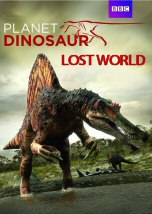
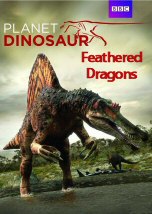
Planet Dinosaur is sure to please budding paleontologists and older dinosaur fans alike. Narrated by John Hurt, more than 50 different prehistoric species featured in this series and they and their environments were created entirely as computer-generated images. The first episode is 95 million years ago, Late Cretaceous in North Africa. We will see Ouranosaurus, Spinosaurus, Onchopristis (a giant sawfish), Rugops, Carcharodontosaurus, Sarcosuchus, pterosaur.
An entire world long vanished, reborn in breathtaking detail. Through the lens of cutting-edge science, each episode uncovers the untold story of a single dinosaur — its fears, its fights, its desperate struggle to survive in a brutal prehistoric landscape. With state-of-the-art visual effects and the latest fossil discoveries, this groundbreaking series offers an unprecedented, intimate look at the daily lives of Earth’s most legendary creatures. More than just science — this is raw drama, real survival, and nature at its most spectacular. We offer the complete 6-episode collection of this magnificent series, presented as a nearly 5-hour long documentary experience.
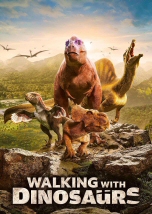
In a late Jurassic forest in what is now China, an Epidexipteryx escapes from a juvenile Sinraptor by climbing a tree. It finds a beetle grub in the tree bark, being shown to use its elongated fingers in a similar way to a modern day aye-aye. However, its prey is stolen by another, larger Epidexipteryx, and after a brief bout of posturing, the smaller individual goes to find more food. It drops a second grub to the forest floor, where the other Epidexipteryx retrieves it, only to be killed by the juvenile Sinraptor. The episode then cuts to a desert in late Cretaceous Mongolia, where a Saurornithoides is shown brooding a nest of eggs. When it leaves the nest, an Oviraptor raids it, fleeing when the troodontid returns. The Saurornithoides is suddenly attacked and eaten by a Gigantoraptor, which then heads to compete in a breeding ritual for mates. The males use their feathers for display, a brief fight between two erupting at one point, allowing the females to choose the best suitor. The episode finally cuts to an early Cretaceous forest in China, where a Xianglong is being hunted by a Microraptor, which uses its feathers to pursue the gliding lizard in the air. A Sinornithosaurus attacks it, and after a brief chase the Microraptor manages a lucky escape. The Sinornithosaurus, alongside two other members of its species is then shown hunting a Jeholosaurus and its three young. The group brings down the parent, the narrator explaining that their possibly venomous bite allowed them to tackle animals much larger than themselves. A montage is then shown of the feathered dinosaurs featured in the programme, with the narrator saying that Microraptor not only hints at how flight might have developed, but also that dinosaurs still live amongst us today, as birds.















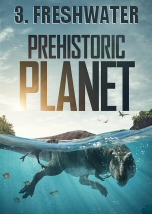



A female Quetzalcoatlus builds and guards her nest. A mother Masiakasaurus and her family hunt crabs. Elasmosaurs enter an estuary in search of fish.