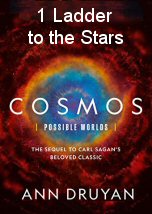
Following the wildly successful 'Cosmos: A Spacetime Odyssey,' Neil deGrasse Tyson returns as host to translate more revelations of science into a lavish transporting experience, taking audiences on a series of spiritual voyages of exploration. The show reveals previously uncharted realms, including lost worlds, worlds yet to come, and the worlds that humans may one day inhabit. Ann Druyan, original creative collaborator to Carl Sagan, whose iconic docuseries 'Cosmos' provided inspiration for this series, serves as executive producer alongside Seth MacFarlane. Episode 1 takes viewers on a wild ride with the Ship of Imagination in an adventure spanning billions of years into the evolution of life.
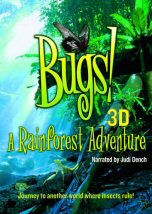
Explore the extraordinary hidden world of insects, where a leaf weighs more than a car, rain drops feel like exploding hand grenades and a blade of grass soars like a skyscraper. Shot on location in the Borneo rainforest, Bugs! brings the beautiful and dangerous universe of its tiny stars up close and personal with cutting-edge technology that magnifies them up to 250,000 times their normal size. Don't miss this unforgettable, stunning film that reveals the dramatic, savage and awe-inspiring lives of these fascinating creatures. Bugs! A Rainforest Adventure is an extraordinay Imax 3-D film featuring macro photography of exceedingly high quality. Narrated by Judi Dench
The constellation of the Pleiades provides a vehicle for us to explore a series of paradoxes and epochal discoveries for humanity. The untold story of the modern "sisters of the sun," the early 20th century female astronomers, led by two deaf women, at Harvard who catalogued the stars. It's also the story of the young British woman who joined forces with them, her defiance of the world's leading expert, and how she taught the world what the stars are really made of.
The episode begins with Tyson describing how pattern recognition manifested in early civilization as using astronomy and astrology to predict the passing of the seasons, including how the passage of a comet was often taken as an omen. Tyson continues to explain that the origin of comets only became known in the 20th century due to the work of Jan Oort and his hypothesis of the Oort cloud. Tyson then continues to relate the collaboration between Edmond Halley and Isaac Newton in the last part of the 17th century in Cambridge. The collaboration would result in the publication of Philosophiæ Naturalis Principia Mathematica, the first major work to describe the laws of physics in mathematical terms, despite objections and claims of plagiarism from Robert Hooke and financial difficulties of the Royal Society of London. Tyson explains how this work challenged the prevailing notion that God had planned out the heavens, but would end up influencing many factors of modern life, including space flight. Tyson further describes Halley's contributions including determining Earth's distance to the sun, the motion of stars and predicting the orbit of then-unnamed Halley's Comet using Newton's laws. Tyson contrasts these scientific approaches to understanding the galaxy compared to what earlier civilizations had done, and considers this advancement as mankind's first steps into exploring the universe. The episode ends with an animation of the Milky Way and Andromeda galaxies' merging based on the principles of Newton's laws.
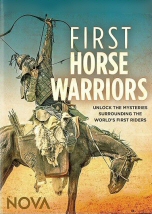
Horses. Powerful, graceful, and thunderously fast. No animal has made a greater impact on society or given humans more freedom and mobility. In a spectacular adventure, the film unlocks the mystery of the first horse warriors on the vast, grassy plains of Kazakhstan, where horses still roam free, and nomadic herders follow their traditional way of life. Investigating clues from archaeology and genetics, researchers reveal vivid evidence of the very first horsemen. They also discover warriors who swept across Europe and turn out to be the ancestors of millions today.
It's 3.5 million years ago and in East Africa a remarkable species of ape roams the land. Australopithecus afarensis has taken the first tentative steps towards humanity by standing and walking on two legs. The rift valley was forming, and the rain forests dying as Africa dried out - turning the landscape into a mosaic of scattered trees and grass. In this new environment afarensis found it more efficient to move about on two legs rather than four.






Episode 1 takes viewers on a wild ride with the Ship of Imagination in an adventure spanning billions of years into the evolution of life.