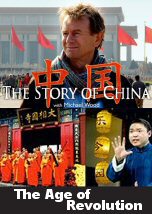
Between 1850 and 1950, three cataclysmic revolutions shook China to the core, but out of them, today's China emerged. The film begins in Canton with the meeting of a US missionary and a Chinese student. Inspired by the Christian story and calling himself God's second son, Hong unleashed the bloodiest war of the 19th century, the Taiping Rebellion. As imperial China weakened, foreign influence grew. Treaty ports expanded, bringing growth and wealth, trams, railways and western sensibilities. But this provoked another surge of violence, the Boxer Rebellion, an attack against the foreigners, which was crushed by those same foreigners, who extorted a huge indemnity - $60 billion in today's money. Then in 1912, the empire fell, and many groups contested China's future. In World War I, China sent 100,000 men to the western front, only to be humiliated at Versailles when German colonies in China were handed to Japan. Between the two world wars, the disparity between rich and poor, city and countryside increased. We visit Hong Kong's Peninsular Hotel in the jazz age and then follow Mao on the Long March to Yan'an, the heartland of revolution. World War II came to China two years earlier than it did in the west. Wood talks to a survivor of the Japanese massacre of Nanjing in 1937 and then charts the triumph of the communists, before ending the story with Mao's death and the boom time of the last 30 years. The series ends with the warmth of the Chinese family and, at Beijing's Altar of Heaven, a final haunting glimpse of eternal China.
The film takes viewers on an enchanting journey through the life and legendary career of one of cinema's greatest composers. Directed by John Williams' longtime friend Laurent Bouzereau, it delves deeply into the music that has defined iconic film franchises like “Star Wars”, “Jurassic Park”, and “Harry Potter”. Featuring interviews with esteemed artists and filmmakers profoundly influenced by Williams' timeless compositions, the film explores his extraordinary ability to bring emotion, depth, and grandeur to the screen through his symphonic genius. Archival footage and behind-the-scenes moments illustrate how his unforgettable scores became integral to the movies, revealing just how vital his contributions have been to modern cinema. This intimate tribute captures Williams’ journey from jazz pianist to cultural icon, showcasing the groundbreaking impact of his classical compositions in Hollywood and beyond. From his collaborative masterpieces with Steven Spielberg and George Lucas to his unique approach of composing by hand, "Music By John Williams" highlights the relentless passion and meticulous craft that have defined his career. Personal stories from colleagues, friends, and family, along with moments of Williams conducting before adoring fans, paint a vivid portrait of a man who has shaped our cinematic experiences for over half a century. For anyone captivated by the power of music in film, this documentary is an inspiring and nostalgic celebration of an unparalleled legacy.
Dylan Jones is in the driving seat for this authoritative four-part look back. No stone remains unturned, as he revisits the New Romantics, rap, modern dance music, hip-hop, indie jingle, synth-pop, house music and club culture. He makes the case that the 1980s was the most radical, innovative and creative decade in the history of pop because, unlike other decades, unleashed a myriad of new musical genres in just 10 years. In the first part, Dylan Jones explores how in this decade the world-conquering genres of rap, hip-hop and modern dance music were launched, while guitar-driven indie flourished in a constellation of scenes spread out across the world. And a technological revolution was changing how music was made, filling the charts with a starburst of innovative records. Meanwhile, the launch of MTV turned pop into a visual medium, allowing artists as varied as U2 and Eurythmics to take charge of how they presented themselves. Featuring interviews with Nile Rodgers, Bananarama, Primal Scream's Bobby Gillespie, Mark Ronson, Trevor Horn and Soul II Soul's Jazzie B.
Dave Grohl discusses New Orleans' unique music history with Dr. John, Allen Toussaint and Cyril Neville. The band records in Preservation Hall and also performs with the Preservation Hall Jazz Band. The song 'In the Clear' is recorded during this episode.












As imperial China weakened, foreign influence grew. Treaty ports expanded, bringing growth and wealth, trams, railways and western sensibilities. But this provoked another surge of violence, the Boxer Rebellion, an attack against the foreigners, which was crushed by those same foreigners, who extorted a huge indemnity - $60 billion in today's money.
Then in 1912, the empire fell, and many groups contested China's future. In World War I, China sent 100,000 men to the western front, only to be humiliated at Versailles when German colonies in China were handed to Japan. Between the two world wars, the disparity between rich and poor, city and countryside increased. We visit Hong Kong's Peninsular Hotel in the jazz age and then follow Mao on the Long March to Yan'an, the heartland of revolution.
World War II came to China two years earlier than it did in the west. Wood talks to a survivor of the Japanese massacre of Nanjing in 1937 and then charts the triumph of the communists, before ending the story with Mao's death and the boom time of the last 30 years. The series ends with the warmth of the Chinese family and, at Beijing's Altar of Heaven, a final haunting glimpse of eternal China.