






Last Watched

"Mexico"  Sort by

Montezuma

   2009    History
Montezuma Dan Snow journeys to the ancient heart of Mexico in search of the lost civilisation of the Aztecs and their last and greatest ruler, Montezuma II (1502-1520). Montezuma inherited an empire of five million people, stretching from present-day Mexico to Nicaragua, from his uncle. His rule was marked by incessant warfare. Enemy states were growing more powerful and conquered tribes were becoming more rebellious. Within months of taking the throne in 1502, he went changed a man of good reason into a pitiless autocrat who declared himself a god, believing that fear and ruthlessness were the only ways to stop the empire falling apart. Yet it was at the hands of Cortes and the Spanish conquistadors that Montezuma met his downfall. But what was his relationship with Cortes, and why did such a ruthless leader submit to his captors with such relative ease? As Dan Snow visits the ruins and picks through current excavations, he pieces together the evidence of a gripping story: a divine tragedy of errors, the clash of civilisations, the end of a world - and a very human God.
The Great Invisible

   2014    Technology
On April 20, 2010, the Deepwater Horizon oil rig exploded in the Gulf of Mexico. It killed 11 workers and caused the worst oil spill in American history. The explosion still haunts the lives of those most intimately affected, though the story has long ago faded from the front page.
At once a fascinating corporate thriller, a heartbreaking human drama and a peek inside the walls of the secretive oil industry, 'The Great Invisible' is the first documentary feature to go beyond the media coverage to examine the crisis in depth through the eyes of oil executives, survivors and Gulf Coast residents who experienced it first-hand and then were left to pick up the pieces while the world moved on.

Conquistadors: The Fall of the Aztecs

   2002    History
Hernan Cortes left Cuba in 1519 seeking riches in the island to the west. Instead he discovered, and ultimately destroyed, a hitherto unknown civilization. Join Micheal Wood as he retraces this fateful expedition. Read Spanish eyewitness accounts that describe the conquistadors' awe at the Aztec achievements and the lust for native treasure. Learn the Aztec' side of the story by scrolling trough pictographs that tell of the agonizing fall of the empire.
Series: Conquistadors

Ancient Apocalypse: The Americas

   2024    History
We offer the complete second series of “Ancient Apocalypse” in a single video. In this series, journalist Graham Hancock travels to the Americas to search for evidence supporting his hypothesis: that an advanced civilization was lost to history during the cataclysms that marked the apocalyptic end of the last Ice Age, between 12,800 and 11,600 years ago. Each episode investigates new discoveries being made in the American hemisphere, which until recently has been largely under-explored by archaeologists interested in humanity’s origins. Graham reveals new findings and speculates about how those findings might suggest the existence of a globe-traveling advanced civilization that left traces of itself in ancient cultures.
In episode one, evidence from New Mexico’s White Sands desert confirms the presence of people in the Americas long before it was possible to migrate across the Bering Straits that formed a land bridge during the lowered sea-levels of the Ice Age. The series takes us to multiple locations in the US, Mexico, Brazil, Peru and Easter Island to investigate when people first arrived in the “New World” and how they made the journey. The findings give Graham reason to question the accepted timeline of human history. During his journey, Graham interviews highly regarded archaeologists and historians as well as indigenous elders, who share their unique knowledge of the sites and their oral histories. Hollywood actor, Keanu Reeves, also joins Graham across the series, discussing, among other things, his insights into storytelling as an act of preserving culture. Experts in the series include American archaeologist Dr. Chris Davis, Brazilian palaeontologist Dr. Alceu Ranzi, and archaeo-botanist Dr. Sonia Cardinali of Rapa Nui, Easter Island, among others.
Series: Ancient Apocalypse

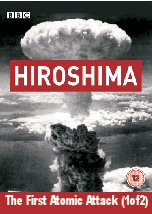
Hiroshima 1 of 2

   2005    History
It was the defining moment of the 20th Century - the scientific, technological, military, and political gamble of the world's first atomic attack. This drama-documentary attempts to do what no other film has done before - to show what it is like to live through a nuclear explosion, millisecond by millisecond. Set in the three weeks from the first test explosion in New Mexico to the eventual dropping of the bomb, the action takes viewers into the room where the crucial political decisions are made; on board the Enola Gay on her fateful voyage; inside the bomb as it explodes; and on the streets of Hiroshima when disaster strikes. Parallel storylines interweave, unfolding the action from both US and Japanese perspectives, and revealing the tensions and conflicts in the actions and minds of people who were making history. Special effects recreate the reality of the mission - even going inside the workings of the bomb - and archive film replays the horrific aftermath.
Series: Hiroshima

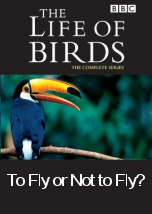
To Fly or Not to Fly

   1998    Nature
The first episode looks at how birds first took to the skies in the wake of the insects. It begins in Mexico, where Sir Attenborough observes bats being outmanoeuvred by a red-tailed hawk. Pterosaurs were the birds' forerunners, some 150 million years after dragonflies developed the means of flight, but eventually went extinct together with the dinosaurs. Birds had by then already evolved from early forms like archaeopteryx, the first creature to possess feathers. Its ancestry can be traced through reptiles, and some current species, such as the flying lizard, possibly show paths this evolution may have taken." One of the biggest birds to have ever existed was the terror bird, which proliferated after dinosaurs vanished and stood up to 2.5 metres tall. By comparison, the ostrich, while not closely related, is the largest and heaviest living bird. It was probably the evasion of predators that drove most birds into the air, so their flightless cousins evolved because they had few enemies. Accordingly, such species are more likely to be found on islands, and Sir Attenborough visits New Zealand to observe its great variety, most especially the kiwi. Also depicted is the moa, another huge creature that is now gone. The takahē is extremely rare, and high in the mountains of New Zealand, Sir Attenborough discovers one from a population of only 40 pairs. Finally, another example on the brink of extinction is the kakapo, which at one point numbered only 61 individuals. A male is heard calling — an immensely amplified deep note that can be heard at great distances from its nest.
Series: The Life of Birds
How Earth Made Us

How Earth Made Us

2010  Science
Arnold

Arnold

2023  History
The Planets

The Planets

2000  Science
Dirty Money

Dirty Money

2018  Culture
Vegan

Vegan

2020  Culture
Dark Net

Dark Net

2016  Technology
Secrets of the Dead

Secrets of the Dead

2017  History