Meet Perseverance, NASA's latest rover, as it heads to Mars to answer one question: did life exist on the red planet? On the way, it will lay the foundation for human exploration of our closest neighbour. Today, Mars is hostile to life. It's too cold for water to stay liquid on the surface, and the thin atmosphere lets through high levels of radiation, potentially sterilizing the upper part of the soil. But it wasn't always like this. Some 3.5 billion years ago or more, water was flowing on the surface. It carved channels still visible today and pooled in impact craters. A thicker carbon dioxide atmosphere would have blocked more of the harmful radiation. The Mars 2020/Perseverance rover is designed to better understand the geology of Mars and seek signs of ancient life. The mission will collect and store a set of rock and soil samples that could be returned to Earth in the future. It will also test new technology to benefit future robotic and human exploration of Mars, as the Ingenuity Helicopter.
Groundbreaking missions and the latest research are finally uncovering the long-hidden secrets of Mars. From ancient water flows to possible traces of life, scientists are piecing together the planet's dramatic past. As powerful new technology scans its surface and atmosphere, experts confront extraordinary questions: Did Mars once support life? And could humanity one day make the Red Planet its second home? A stunning exploration into the evolving mysteries of our nearest planetary neighbor.
In the concluding episode of the series, Jim encounters ever larger cosmic structures to reveal the latest breakthroughs in our understanding of the universe. For example, Jim comes face to face with our galactic home, the Milky Way, a monstrous structure sculpted by the gravitational forces of dark matter. Jim finds out from pioneering researcher Adrian Fabian about the black hole at its centre, whose strange behaviour includes emitting the lowest note that can be heard in the cosmos. At an even greater scale, Jim encounters huge structures such as the Laniakea Supercluster, of which the Milky Way is only a tiny part. Then there’s the 'Giant Arc', a collection of galaxies that account for more than three per cent of the observable universe. Jim learns from its discoverer, British PhD student Alexia Lopez, that this gargantuan structure is forcing scientists to reassess their theory of how the universe evolves and may overturn some of the most fundamental principles in physics.
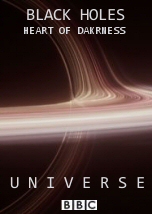
The centre of our galaxy is home to an invisible monster of unimaginable power – a supermassive black hole named Sagittarius A star, with four million times the mass of the Sun. Recent astronomical breakthroughs have confirmed not only that black holes like Sagittarius A star exist, but that these bizarre invisible objects may be the ultimate galactic protagonists. Stunning CGI takes us back to witness the fiery origins of our galaxy’s black hole 13.6 billion years ago, when the early universe was home to colossal blue stars, and when they ran out of fuel, they collapsed under their own enormous mass, crushing down into an object so small and so dense it punched a hole in the fabric of the universe. Over billions of years, Sagittarius A star feasted on nearby gas, stars, and through cataclysmic mergers with other black holes. A breakthrough discovery by Nasa’s Fermi gamma-ray telescope has shown that our black hole had the power to sculpt the entire galaxy, creating vast bubbles of gas above and below our galaxy and even protecting stars systems as ours. In a mind-bending conclusion, Brian Cox reveals how our modern understanding of black holes is challenging our concepts of reality to the breaking point. In trying to understand the fate of objects that fall into Sagittarius A star, scientists have come to a stunning conclusion: space and time, concepts so foundational to how we experience the world around us, are not as fundamental as we once thought.
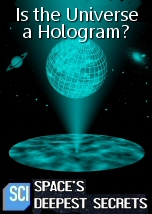
Shocking new evidence has convinced some of the world's greatest physicists that the universe is a hologram. Using cutting-edge technology, they investigate the secrets of black holes and space-time to build the case for this game-changing discovery. The holographic principle is a supposed property of quantum gravity that states that the description of a volume of space can be thought of as encoded on a lower-dimensional boundary to the region like a gravitational horizon. First proposed by Gerard 't Hooft, it was given a precise string-theory interpretation by Leonard Susskind. The holographic principle was inspired by black hole thermodynamics, which conjectures that the maximal entropy in any region scales with the radius squared, and not cubed as might be expected. In the case of a black hole, the insight was that the informational content of all the objects that have fallen into the hole might be entirely contained in surface fluctuations of the event horizon.
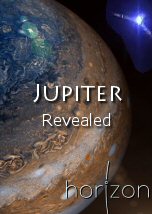
This documentary journeys with the scientists into the heart of a giant. Juno is the Nasa mission designed to peer through Jupiter's swirling clouds and reveal the wonders within. By projecting a 70-foot-wide, life-size Juno on a Houston rooftop, Scott Bolton, head of Juno, shows us how its fragile electronics are encased in 200kg of titanium. As Scott puts it, 'we had to build an armoured tank to go there.' Professor Andrew Ingersoll, Juno's space weatherman, reveals they have seen lightning inside Jupiter, perhaps a thousand times more powerful than Earth's lightning. This might be evidence for huge quantities of water inside Jupiter. Under the extreme conditions of Jupiter thousands of miles under the surface, hydrogen becomes a liquid metal. Juno is finding out how much liquid metallic hydrogen is inside Jupiter, and scientists hope to better understand how this flowing metal produces the most powerful aurora in the Solar System. But what is at Jupiter's heart? In Nice, Prof Tristan Guillot explains how Juno uses gravity to map the planet's centre. This can take scientists back to the earliest days of the solar system, because Jupiter is the oldest planet and it should contain clues to its own creation. By chalking out an outline of the Jupiter, Tristan reveals there is a huge rocky core - perhaps ten times the mass of Earth.




























Today, Mars is hostile to life. It's too cold for water to stay liquid on the surface, and the thin atmosphere lets through high levels of radiation, potentially sterilizing the upper part of the soil. But it wasn't always like this. Some 3.5 billion years ago or more, water was flowing on the surface. It carved channels still visible today and pooled in impact craters. A thicker carbon dioxide atmosphere would have blocked more of the harmful radiation. The Mars 2020/Perseverance rover is designed to better understand the geology of Mars and seek signs of ancient life. The mission will collect and store a set of rock and soil samples that could be returned to Earth in the future. It will also test new technology to benefit future robotic and human exploration of Mars, as the Ingenuity Helicopter.