This revealing film examines how human activity is setting off dangerous warming loops that are pushing the climate to a point of no return - and what we need to do to stop them. With captivating illustrations, stunning footage and interviews with leading climate scientists as well as support from Greta Thunberg and the Dalai Lama, 'Earth Emergency' adds the missing piece of the climate puzzle. Narrated by Richard Gere, the film examines four of the major warming feedback loops threatening our planet: Forests, Permafrost, Albedo and Atmosphere.
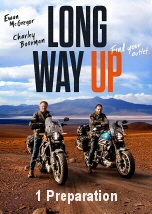
Ewan McGregor and Charley Boorman, after more than a decade since their last motorbike adventure around the world, will cover 13,000 miles over 100 days through 13 countries. Starting from the city of Ushuaia at the tip of South America, Ewan and Charley travel through the glorious and underexposed landscapes of South and Central America to Los Angeles in the United States in their most challenging expedition to date. In their journey they will use cutting-edge technology on the backs of their prototype electric Harley-Davidsons in order to contribute to the sustainability of the planet. In the first episode, Ewan McGregor reunites with his best friend Charley Boorman to evaluate what's important in their lives, following a life-threatening accident of Charley.
Global warming, and how to combat it, has provoked intense debate, changed the way we see the planet and created headlines around the world. But when and how did scientists first discover global warming, why has it led to such furious debate? In this three-part series geologist Dr Iain Stewart presents a definitive guide to the history of climate change. Battle Begins uncovers some of the great unsung heroes of climate change science, and introduces us to a secret organisation of American government scientists, known as Jason, who wrote the first official report on global warming as far back as 1979. By the late 1980s global warming had already become a serious political issue. It looked as if the world was uniting to take action. But it turned out to be a false dawn.
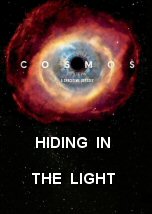
This episode explores the wave theory of light as studied by mankind, noting that light has played an important role in scientific progress, with such early experiments from over 2000 years ago involving the camera obscura by the Chinese philosopher Mozi. Tyson describes the work of the 11th century Arabic scientist Ibn al-Haytham, considered to be one of the first to postulate on the nature of light and optics leading to the concept of the telescope, as well as one of the first researchers to use the scientific method. Tyson proceeds to discuss the nature of light as discovered by mankind. Work by Isaac Newton using diffraction through prisms demonstrated that light was composed of the visible spectrum, while findings of William Herschel in the 19th century showed that light also consisted of infrared rays. Joseph von Fraunhofer would later come to discover that by magnifying the spectrum of visible light, gaps in the spectrum would be observed. These Fraunhofer lines would later be determined to be caused by the absorption of light by electrons in moving between atomic orbitals when it passed through atoms, with each atom having a characteristic signature due to the quantum nature of these orbitals. This since has led to the core of astronomical spectroscopy, allowing astronomers to make observations about the composition of stars, planets, and other stellar features through the spectral lines, as well as observing the motion and expansion of the universe, and the existence of dark matter.
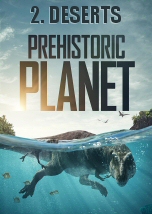
In the second episode, Dreadnoughtus males compete for the right to mate. Lizards are hunted by Velociraptor among a group of sleeping Tarbosaurus. A Mononykus forages for termites and investigates new food options after a brief rainstorm. Several types of dinosaurs congregate around a watering hole in Mongolia. Above the deserts of North Africa, aerial combat ensues as male Barbaridactylus pterosaurs fight for the attention of females below. A herd of Secernosaurus brave the harsh gypsum dunes in search of nourishment.
Our planet has amazing power, and yet that's rarely mentioned in our history books. This series tells the story of how the Earth has influenced human history, from the dawn of civilisation to the modern industrial age. It reveals how geology, geography and climate have been a far more powerful influence on the human story than has previously been acknowledged. A combination of epic story telling, visually stunning camerawork, extraordinary locations and passionate presenting combine to form a highly original version of human history" In the first episode professor Iain Stewart explores the relationship between the deep Earth and the development of human civilisation. He visits an extraordinary crystal cave in Mexico, drops down a hole in the Iranian desert and crawls through seven-thousand-year-old tunnels in Israel. His exploration reveals that throughout history, our ancestors were strangely drawn to fault lines, areas which connect the surface with the deep interior of the planet. These fault lines gave access to important resources, but also brought with them great danger.






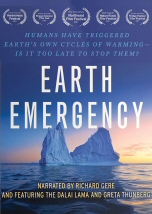



Narrated by Richard Gere, the film examines four of the major warming feedback loops threatening our planet: Forests, Permafrost, Albedo and Atmosphere.