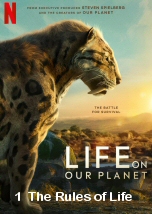
The series ‘Life on Our Planet’ brought to life by Steven Spielberg and narrated by Morgan Freeman, unfolds the remarkable and epic four-billion-year journey of life on Earth. Its captivating narrative explores the continuous battle of life to conquer and survive, delving into the history of the 20 million species that exist today. However, what we witness is merely a snapshot in time; 99% of Earth's inhabitants are buried in our deep past. This series weaves the tales of these dynasties, chronicling their rise and fall in a story that is as incredible as it is enlightening, sparking a profound interest in the history and resilience of life on Earth. The first episode traces the evolution of life on our planet and highlights the diversity of life, from ancient sharks to the reign of dinosaurs and the emergence of mammals. The episode showcases the constant struggle for survival and adaptation across different eras, illustrating the dynamic and often brutal nature of Earth's evolution.
The little known story of our quest to understand the origins of the Moon. Neil Armstrong's "giant leap for mankind" began a scientific journey of discovery that lead to one of the most startling conclusions in the history of astronomy. The Moon was born from Earth.
The metaverse is an environment where humans interact socially and economically through a software in cyberspace, which acts as a metaphor for the real world, but without its limitations. The metaverse is generally composed of multiple three-dimensional, shared and persistent virtual spaces linked to a perceived virtual universe. This virtual world is often facilitated by the use of virtual reality (VR) or augmented reality (AR) headsets and avatars. The Metaverse is the successor to the internet. It will change the lives of almost every human on the planet.
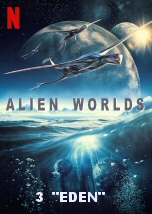
Planets beyond our solar system are known to astronomers as exoplanets. They are at trillions of miles from Earth and yet, it might be possible to detect a faint signature of life in them. From the light of the stars they orbit that passes through the atmosphere of an exoplanet, it is possible to capture the chemical fingerprint of the elements in that atmosphere. The fictional world Eden is orbiting not one star, but two. The light from its twin stars powers photosynthesis, pumping more oxygen into the atmosphere than in Earth, allowing life to thrive. Grazers are constantly alert to danger, because the canopy is home to predators perfectly evolved to live among the trees. In Episode 3, another topic are fungi and the role they could play on exoplanets. Ecologist Thomas Crowther talks about the role mycelial networks play in the Rothiemurchus forest in Scotland.
Nintendo was like an impossibly huge wall. But if Mario was the undisputed king, an underdog was about to declare war. For Japanese game maker Sega, mainly known for its arcade cabinets, the battle was about winning the home console market. Sega's Genesis console and its speedy character, Sonic, hit the market. In the early '80s, sports video games existed, but they didn't really look real. And one visionary entrepreneur had already started tackling the challenge of taking sports from the stadium onto the screen. Electronic Arts kicks off a partnership with football legend John Madden.
For all of human history, the Sun, our home star, has measured our days and our seasons while fueling all life on Earth. Yet it remains an enigma. NASA's Parker Probe Plus is on a mission to change that, flying through dangerous radiation to become the closest spaceship to orbit our Sun. It's a journey to the center of our solar system, a mission to gather information about the most critical celestial body in the sky, our star.



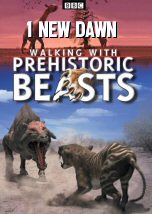
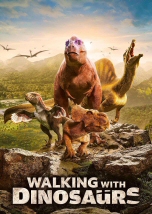

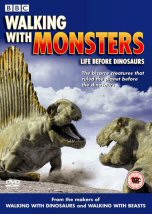





The first episode traces the evolution of life on our planet and highlights the diversity of life, from ancient sharks to the reign of dinosaurs and the emergence of mammals. The episode showcases the constant struggle for survival and adaptation across different eras, illustrating the dynamic and often brutal nature of Earth's evolution.