



Last Watched

"Ant "  Sort by

A Sky Full of Ghosts

   2014    Science
Tyson begins the episode by explaining the nature of the speed of light and how much of what is seen of the observable universe is from light emanated from billions of years in the past. Tyson further explains how modern astronomy has used such analyzes via deep time to identify the Big Bang event and the age of the universe. Tyson proceeds to describe how the work of Isaac Newton, William Herschel, and James Clerk Maxwell contributed to understanding the nature of electromagnetic waves and gravitational force, and how this work led towards Albert Einstein's Theory of Relativity, that the speed of light is a fundamental constant of the universe and gravity can be seen as distortion of the fabric of space-time. Tyson describes the concept of dark stars as postulated by John Michell which are not visible but detectable by tracking other stars trapped within their gravity wells, an idea Herschel used to discover binary stars. Tyson then describes the nature of black holes, their enormous gravitational forces that can even capture light, and their discovery via X-ray sources such as Cygnus X-1. Tyson uses the Ship of Imagination to provide a postulate of the warping of spacetime and time dilation as one enters the event horizon of the black hole, and the possibility that these may lead to other points within our universe or others, or even time travel. Tyson ends on noting that Herschel's son, John would be inspired by his father to continue to document the known stars as well as contributions towards photography that play on the same nature of deep time used by astronomers.
Series: Cosmos: A Spacetime Odyssey
A New Perspective

   2019    Nature    HD
Prepare yourself for a groundbreaking series that reveals a spectacular new space-based vision of our planet. Cameras in space will tell stories of life on our planet from a brand new perspective.
Satellites follow an elephant family struggling through drought, reveal previously unknown emperor penguin colonies from the colour of their poo, and discover mysterious ice rings that could put seal pups in danger. Using cameras on the ground, in the air and in space, Earth from Space follows nature’s greatest spectacles, weather events and dramatic seasonal changes. This is our home, as we’ve never seen it before.
Series: Earth from Space

15 Shocking Ancient Secrets

   2021    History
From a 2,400-year-old corpse in remarkable condition to how shrunken heads are made, these 15 ancient secrets will have you completely riveted. The Vesuvius eruption may have been a gradual process. It took a storm to lift the cover on this ancient Roman city. The people of Pompeii often resorted to vigilante justice. How the wealthy of Pompeii protected their valuables? Was this pre-Viking gathering a prelude to a massacre? The valuable commodity behind King Solomon's wealth. This valuable Viking grave is missing something important. Is this where humanity decided to settle down? This mysterious stone structure is older than Stonehenge. This 2,400 year old corpse is in remarkable condition. Here's exactly how shrunken heads are made. DNA analysis reveals troubling news about shrunken heads. This mass grave discovery could alter Roman history. Gladiator teeth reveal signs of infant malnourishment. Evidence suggests Stonehenge was an elite cemetery.

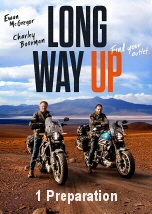
Preparation

   2020    Culture
Ewan McGregor and Charley Boorman, after more than a decade since their last motorbike adventure around the world, will cover 13,000 miles over 100 days through 13 countries. Starting from the city of Ushuaia at the tip of South America, Ewan and Charley travel through the glorious and underexposed landscapes of South and Central America to Los Angeles in the United States in their most challenging expedition to date. In their journey they will use cutting-edge technology on the backs of their prototype electric Harley-Davidsons in order to contribute to the sustainability of the planet.
In the first episode, Ewan McGregor reunites with his best friend Charley Boorman to evaluate what's important in their lives, following a life-threatening accident of Charley.
Series: Long Way Up

Hiding in the Light

   2014    Science
This episode explores the wave theory of light as studied by mankind, noting that light has played an important role in scientific progress, with such early experiments from over 2000 years ago involving the camera obscura by the Chinese philosopher Mozi. Tyson describes the work of the 11th century Arabic scientist Ibn al-Haytham, considered to be one of the first to postulate on the nature of light and optics leading to the concept of the telescope, as well as one of the first researchers to use the scientific method. Tyson proceeds to discuss the nature of light as discovered by mankind. Work by Isaac Newton using diffraction through prisms demonstrated that light was composed of the visible spectrum, while findings of William Herschel in the 19th century showed that light also consisted of infrared rays. Joseph von Fraunhofer would later come to discover that by magnifying the spectrum of visible light, gaps in the spectrum would be observed. These Fraunhofer lines would later be determined to be caused by the absorption of light by electrons in moving between atomic orbitals when it passed through atoms, with each atom having a characteristic signature due to the quantum nature of these orbitals. This since has led to the core of astronomical spectroscopy, allowing astronomers to make observations about the composition of stars, planets, and other stellar features through the spectral lines, as well as observing the motion and expansion of the universe, and the existence of dark matter.
Series: Cosmos: A Spacetime Odyssey
Deep Earth

   2010    Science
Our planet has amazing power, and yet that's rarely mentioned in our history books. This series tells the story of how the Earth has influenced human history, from the dawn of civilisation to the modern industrial age. It reveals how geology, geography and climate have been a far more powerful influence on the human story than has previously been acknowledged. A combination of epic story telling, visually stunning camerawork, extraordinary locations and passionate presenting combine to form a highly original version of human history" In the first episode professor Iain Stewart explores the relationship between the deep Earth and the development of human civilisation. He visits an extraordinary crystal cave in Mexico, drops down a hole in the Iranian desert and crawls through seven-thousand-year-old tunnels in Israel. His exploration reveals that throughout history, our ancestors were strangely drawn to fault lines, areas which connect the surface with the deep interior of the planet. These fault lines gave access to important resources, but also brought with them great danger.
Series: How Earth Made Us
The Story of Science

The Story of Science

2010  History
Leaving Neverland

Leaving Neverland

2019  Culture
Unknown

Unknown

2023  Science
Apocalypse: World War 1

Apocalypse: World War 1

2014  History
Dirty Money

Dirty Money

2018  Culture
Planet Earth

Planet Earth

2007  Nature