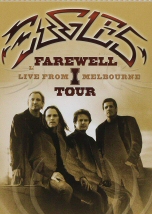
Without doubt, the Eagles are one of the all-time biggest acts in popular music since the dawn of the rock'n'roll era. The band's roots go back to their role as defining artists in the phenomenally popular Southern California rock scene of the '70s, a decade in which they delivered four consecutive #1 albums. Their momentous 2004 farewell tour filled stadiums around the world, and this series captures one of the most stellar events from that now-historic global sweep. It was filmed in Melbourne, Australia at the Rod Laver Arena on November 14, 15 and 17, 2004.
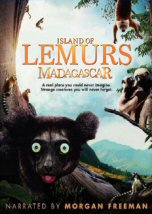
Morgan Freeman narrates Island of Lemurs: Madagascar, the incredible true story of nature's greatest explorers - lemurs. Scientist Patricia Wright has a passion for preserving the life of one particular creature: the lemur. These lively animals found in Madagascar face all sorts of threats, just like so many other animals in a world in which they are increasingly crowded out by humans. Her passion for the subject is compelling and plainly evident, but it's the silent testimony of the animals themselves that really makes the case. Countless hours of footage are trimmed down to create this tapestry depicting the lives of these creatures of remarkable intelligence and ingenuity. Their daily routines and extraordinary adventures are awesome to behold, as is the way that the community functions. A full immersion into the world of the lemurs means great insights on these unusual animals.
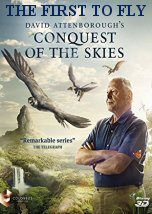
David Attenborough embarks on an extraordinary journey to unravel one of nature s most gripping stories the evolution of flying animals. The power of flight is one of the greatest miracles of nature. Over one hundred billion creatures soar through the air today - from nectar-drinking hummingbirds, to armoured airborne beetles; from bats hunting in the black of night, to bizarre winged lizards. The film travels back in time to unravel the astonishing 300-million-year story of how these animals first appeared, and then evolved into the huge variety of aeronauts that fill our skies today. Only now, using the latest scientific analysis, can he reveal the hidden mechanics behind their gravity-defying skills. Ground-breaking 3D cameras, high speed filming and stunning CGI bring the viewer closer than ever to this astounding aerial world.
We are the only species on earth that cooks its food - and we are also the cleverest species on the planet. The question is: do we cook because we're clever and imaginative, or are we clever and imaginative because our ancestors discovered cooking? Horizon examines the evidence that our ancestors' changing diet and their mastery of fire prompted anatomical and neurological changes that resulted in taking us out of the trees and into the kitchen.
We offer the complete second series of “Ancient Apocalypse” in a single video. In this series, journalist Graham Hancock travels to the Americas to search for evidence supporting his hypothesis: that an advanced civilization was lost to history during the cataclysms that marked the apocalyptic end of the last Ice Age, between 12,800 and 11,600 years ago. Each episode investigates new discoveries being made in the American hemisphere, which until recently has been largely under-explored by archaeologists interested in humanity’s origins. Graham reveals new findings and speculates about how those findings might suggest the existence of a globe-traveling advanced civilization that left traces of itself in ancient cultures. In episode one, evidence from New Mexico’s White Sands desert confirms the presence of people in the Americas long before it was possible to migrate across the Bering Straits that formed a land bridge during the lowered sea-levels of the Ice Age. The series takes us to multiple locations in the US, Mexico, Brazil, Peru and Easter Island to investigate when people first arrived in the “New World” and how they made the journey. The findings give Graham reason to question the accepted timeline of human history. During his journey, Graham interviews highly regarded archaeologists and historians as well as indigenous elders, who share their unique knowledge of the sites and their oral histories. Hollywood actor, Keanu Reeves, also joins Graham across the series, discussing, among other things, his insights into storytelling as an act of preserving culture. Experts in the series include American archaeologist Dr. Chris Davis, Brazilian palaeontologist Dr. Alceu Ranzi, and archaeo-botanist Dr. Sonia Cardinali of Rapa Nui, Easter Island, among others.
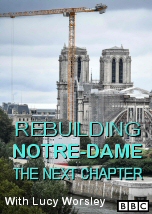
Three years after the devastating fire, Lucy Worsley has exclusive access to the Cathedral of Notre-Dame de Paris at a key turning point of the restoration. Work to rebuild and restore the monument is being ramped up in a bid to meet the ambitious deadline to reopen it to the public in 2024. Scaffolding now fills the interior of the cathedral, giving Lucy and the team unprecedented close-up access to every inch of the structure. Lucy meets scientists, historians and craftspeople working to return the 850-year-old Gothic masterpiece to its former glory. The fire coated Notre-Dame with tons of toxic lead dust, so specialists are now decontaminating the site. Unique access to the stunning rose windows allows Lucy and the stained-glass historians to uncover the mysteries of these enigmatic 13th-century works of art. An unforeseen legacy of the fire threatens to destroy the remaining vaulting, so the team must develop an ingenious solution to save the stonework. The loss of the roof during the fire reveals hundreds of large iron staples embedded in the stone along the top of the walls. And the incredible task of sourcing and cutting two-thousand perfect oaks gets underway to rebuild the world's most complex medieval timber structure - Notre-Dame's extraordinary roof and spire.











Their momentous 2004 farewell tour filled stadiums around the world, and this series captures one of the most stellar events from that now-historic global sweep. It was filmed in Melbourne, Australia at the Rod Laver Arena on November 14, 15 and 17, 2004.