Championed by both therapists and ravers, ecstasy stands out as the first psychedelic likely to become legalized, thanks to passionate advocates. The episode about 3,4-Methylenedioxymethamphetamine (MDMA), is focused on Multidisciplinary Association for Psychedelic Studies (MAPS) clinical trials treating Post-traumatic stress disorder (PTSD).
The last episode explores Mescaline, the psychoactive molecule in San Pedro and peyote cacti, a sacred medicine that Native Americans have had to fight for the right to use. At the Indigenous practices there's always an elder, someone who knows the territory very well, who's presiding. There's usually a group, a community is involved, There's always an intention, a purpose to what you're doing, and you're treating it as sacred, in order to achieve altered states of consciousness, which contribute to worship in various ways, or celebration or healing. But maybe all this is not so new to Western culture after all. In the old Greek histories of Eleusis, people who were initiated there got the drink, the kykeon, and then they had the illumination. The precise recipe is a mystery, but we know that the kykeon was a psychoactive brew that was used at the Eleusinian mysteries, a sacred annual ritual of enlightenment practiced by some of the world's greatest minds including Socrates, Plato, and Aristotle. So why did this ritual come to an end more than 1,000 years ago? Was the possibility of illumination or achieving a higher consciousness considered threatening to the powers that be? Have the drug wars been merely an extension of that fear? Psychedelics has a major part in how we can heal as a community, how we can heal as a city, and how we can heal as a country. The current renaissance of psychedelics could not come at a better time as the world confronts a crisis in mental health. But psychedelics have much to offer. The psychedelic experience changes the mind in ways that will help scientists better understand how it works. All these altered states allow us to probe what is the greatest mystery in all of nature. The emergence from mere matter of something as miraculous as consciousness. But an even bigger question is whether psychedelics might help us address the environmental crisis of how we think about our place in nature. One of the greatest gifts of psychedelics is how they reanimate the natural world, allowing us to perceive the subject, the spirit of all species, not just our own. And to feel a deeper sense of interconnectedness with nature.
Recent archaeological sites in England offer a whole new perspective on the life and death of the seafarers and marines who built the British Empire in the 18th and 19th centuries. The bones of sailors reveal surprising and shocking facts. Apparently not only seasoned men but also half children did their service in the Royal Navy; according to the investigations, the youngest were no older than 13 years. A forensic archaeologist studies the injuries on bones discovered at the site of an battle and suggests how these people may have died. Three-hundred-and-fifty skeletons, exhumed from Royal Navy graveyards from the age of Nelson's Navy, are throwing an extraordinary new light on how these sailors lived, fought, outwitted their enemy, and, from the oldest to youngest, suffered for victory. These men were the beating heart of the most victorious fleet in history and never have so many of these sailors' remains been available for forensic investigation. Six remarkable stories stand out: the child sailor, the top man, the American gunner, the freed slave, the marine and the victim of the sailor's most dreaded disease: syphilis. Broken bones, amputations, injuries from blows with a saber or cutlass, sexually transmitted diseases, but also malnutrition - the list of causes of death is long. There is definitely no tale of seafaring romance. These fighters and sailors sailed the globe as cannon fodder, conquered an empire for the crown, and were themselves forgotten. No longer just bones in a box, the men of Nelson's Navy are back from the dead.
Nathan decides to practice his own assertiveness in relationships by challenging Angela over their son's religious upbringing. Angela, a fervent Christian, refuses to allow Adam to be raised in Nathan's Jewish faith, so Nathan secretly brings his son to lessons with a tutor in Judaism under the pretense of swimming lessons. Seeking solace outside the house, Nathan opens his replica Alligator Lounge to the public under the name Nate's Lizard Lounge. The co-parents argue over a comedy skit featuring six-year-old Adam as 'Dr. Fart' and a joke about eating faeces, which Angela claims is a Satanic practice. Nathan rehearses the confrontations with a fake Angela, and in one scenario, she harshly criticizes Nathan's emotional detachment and questions the ethics of the entire production. However, in their real final confrontation, Angela simply decides to quit the rehearsal. Nathan continues to raise Adam, now as a single parent.
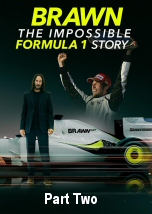
The second part of the series describes how Honda withdrew from Formula 1 and how Ross Brawn and Nick Fry took control to form Brawn GP. It explains the team's financial struggles, their ingenious interpretation of the rules to develop an innovative double diffuser, and the subsequent controversies and legal battles with other teams over the legality of this innovation. The rivalry between Jenson Button, the team's lead driver, and his teammate Rubens Barrichello is emphasized. The climax of the film is Button's victory in Monaco, highlighting both the driver's triumph and the team's success under extreme pressure. As the season progresses, other teams begin to catch up to Brawn GP, increasing the pressure on Button to maintain his championship lead. The documentary concludes with Brawn GP, pressured by financial needs, signing an agreement with Ecclestone, apparently betraying FOTA (Formula One Teams Association) and creating significant internal conflict. This twist highlights the complex power dynamics and ethical challenges within the world of F1.
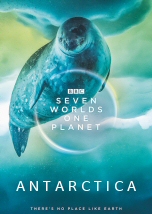
Millions of years ago incredible forces ripped apart the Earth's crust creating our seven continents - each with its own distinct climate, its own distinct terrain and its own unique animal life. From the colourful paradise of South America to the scorching heat of Africa, ‘Seven Worlds, One Planet’ showcases the true character of each continent in turn and reveals just how it has shaped all life there. Be surprised by unexpected stories. Marvel at iconic landscapes. And be awestruck by spectacular wildlife. This series is an eye-opening journey around a world you thought you knew. The snowy shores and icy waters of Antarctica are home to some of the most amazing and unusual wildlife in the world. However, even here, many species face extinction due to rapid climate change and overhunting.










The episode about 3,4-Methylenedioxymethamphetamine (MDMA), is focused on Multidisciplinary Association for Psychedelic Studies (MAPS) clinical trials treating Post-traumatic stress disorder (PTSD).