Cicero is finally undone by his duplicity in the form of Titus Pullo, acting upon Octavian's request to assassinate all supporters of Brutus in Rome. Pullo and Vorenus enjoy a happy if counterfeit outing with their families in the countryside to hide their assassin mission. Vorena the Elder's dangerous dalliance with one of Mimeo's men continues, and the torrid affair between Octavia and Agrippa escalates. Atia's casual cruelty to ask for the assassination of people she doesn't like results in complete disaster for Octavia's friend Jocasta.
The defeated Cato and Scipio fall back on the African city of Utica after the Battle of Thapsus where they decide to end it all. Caesar, after two years of fighting in Greece and Egypt, returns to Rome and receives a hero's welcome. Meanwhile, Servilia's cold rage against the Julii clan makes Brutus's submission to Caesar even more painful. Octavian returns home from military school and Caesar, impressed with his nephew's incisive political acumen, appoints him a pontiff despite his youth.
In space travel there is a saying that the first 50 miles and the last 50 miles are the most dangerous. Explore the controlled explosion of launch, the fiery crucible of re-entry and everything in between. See how a single spark inside a spacecraft or a micrometeoroid less than an inch wide hitting a space station can turn a routine mission into a lethal nightmare. As the missions become longer, venturing to Mars and beyond, the potential disasters will only become bigger. What would happen if a spacecraft ventured too close to a black hole or was hit by a gamma ray burst?
For most of our history, we humans considered ourselves unique. But now, a new, artificial species might challenge our superiority. Mechanical beings have the potential to change everything. How we got them is a story of astonishing twists and amazing turns to achieve us the machine that may turn out to be the most revolutionary technology ever conceived--the robot. Learn how robots were first conceptualized in ancient Rome and see how their use has evolved over the centuries, from the calculator to the Mars Lander. Then, take a sneak peek at what future robots will be able to do. Narrated by Patrick Stewart.
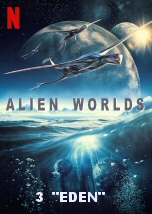
Planets beyond our solar system are known to astronomers as exoplanets. They are at trillions of miles from Earth and yet, it might be possible to detect a faint signature of life in them. From the light of the stars they orbit that passes through the atmosphere of an exoplanet, it is possible to capture the chemical fingerprint of the elements in that atmosphere. The fictional world Eden is orbiting not one star, but two. The light from its twin stars powers photosynthesis, pumping more oxygen into the atmosphere than in Earth, allowing life to thrive. Grazers are constantly alert to danger, because the canopy is home to predators perfectly evolved to live among the trees. In Episode 3, another topic are fungi and the role they could play on exoplanets. Ecologist Thomas Crowther talks about the role mycelial networks play in the Rothiemurchus forest in Scotland.
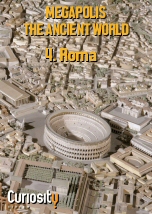
Thanks to stunning reconstitutions with computer-generated images, this documentary retraces the manufacturing secrets of the largest and most exceptional city of Antiquity: Rome, the capital of the Mediterranean world. Three of its most emblematic monuments come to life. The Pantheon and its majestic dome, the sumptuous palace of Nero which covered a quarter of the city, and finally the legendary Colosseum, the largest Roman amphitheater ever built.





Vorena the Elder's dangerous dalliance with one of Mimeo's men continues, and the torrid affair between Octavia and Agrippa escalates. Atia's casual cruelty to ask for the assassination of people she doesn't like results in complete disaster for Octavia's friend Jocasta.