


Last Watched

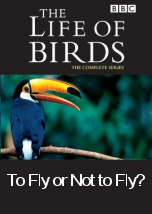
To Fly or Not to Fly

   1998    Nature
The first episode looks at how birds first took to the skies in the wake of the insects. It begins in Mexico, where Sir Attenborough observes bats being outmanoeuvred by a red-tailed hawk. Pterosaurs were the birds' forerunners, some 150 million years after dragonflies developed the means of flight, but eventually went extinct together with the dinosaurs. Birds had by then already evolved from early forms like archaeopteryx, the first creature to possess feathers. Its ancestry can be traced through reptiles, and some current species, such as the flying lizard, possibly show paths this evolution may have taken." One of the biggest birds to have ever existed was the terror bird, which proliferated after dinosaurs vanished and stood up to 2.5 metres tall. By comparison, the ostrich, while not closely related, is the largest and heaviest living bird. It was probably the evasion of predators that drove most birds into the air, so their flightless cousins evolved because they had few enemies. Accordingly, such species are more likely to be found on islands, and Sir Attenborough visits New Zealand to observe its great variety, most especially the kiwi. Also depicted is the moa, another huge creature that is now gone. The takahē is extremely rare, and high in the mountains of New Zealand, Sir Attenborough discovers one from a population of only 40 pairs. Finally, another example on the brink of extinction is the kakapo, which at one point numbered only 61 individuals. A male is heard calling — an immensely amplified deep note that can be heard at great distances from its nest.
Series: The Life of Birds
Archimedes Secret

       History
This is the story of a book that could have changed the history of the World. To the untrained eye, it is nothing more than a small and unassuming Byzantine prayer book. For faintly visible beneath the prayers on its pages are other, unique, writings - words that have been lost for nearly two thousand years. The text is the only record of work by one of the world's greatest minds - the ancient Greek, Archimedes - a mathematical genius centuries ahead of his time. Hidden for a millennium in a middle eastern library, it has been written over, broken up, painted on, cut up and re-glued. But in the nick of time scientists have saved the precious, fragile document, and for the first time it is revealing just how revolutionary Archimedes' ideas were. If it had been available to scholars during the Renaissance, we might have reached the Moon over a hundred years ago.

Rare Earth

   2007    Nature
It has taken 4.6 billion years for the Earth to evolve from a barren rock into the world we know today. Explore the forces beyond our planet that have determined Earth’s destiny -- forces of destruction and regeneration in the solar system that created the planet and still protect it. And now the remarkable planet is facing a new challenge: humankind. The question is, how will it survive?
Series: Earth, The Power of the Planet

Putin Forever

   2020    History
Putin returns to power under a storm after a four-year absence, but his attempts to improve his popularity are hobbled by accusations of corruption. The final part of this sinister history doesn’t quite come up to date with Vladimir Putin’s recent moves to 'reset' the Russian constitution so he can rule, theoretically, until at least 2036 – longer than Stalin. But it does walk us through some of his other moves to entrench power, including vote-rigging in parliamentary elections that was so brazen, his approval ratings fell amid mass street protests. Leading the protests was opposition leader Boris Nemtsov, who was then simply gunned down on a street near the Kremlin.
These days, we are told, the world stage interests Putin more than the Russian one, and with various 'mini-Putins' installed around the world, his legacy looks safe.
Series: Putin: A Russian Spy Story

Webb Telescope: The Story So Far

   2024    Science    HD
In July 2022, the James Webb Space Telescope (JWST) unveiled its first breathtaking images, offering an unprecedented level of detail of stars, galaxies, and planets. But for scientists, these images were just the start of an exciting journey to uncover the universe's secrets. This documentary follows Chris Lintott as he embarks on a road trip to meet the researchers who have been eagerly analyzing JWST's data, revealing groundbreaking discoveries about exoplanet atmospheres, the outer planets of our solar system, and the earliest galaxies in the cosmos.
To mark the second anniversary of JWST's first images, Chris, along with presenters Maggie Aderin-Pocock and George Dransfield, revisits these scientists to explore the telescope's successes and challenges. From new jet streams on Jupiter to quirks on Uranus and Neptune, and insights into the ancient universe, the documentary showcases the remarkable findings made possible by JWST. Additionally, resident astronomer Pete Lawrence guides viewers on how to observe the night sky's wonders, aligning their stargazing with the telescope's targets. This captivating journey into space science promises to inspire and intrigue.
Series: The Sky at Night

Green Seas

   2017    Nature
This episode includes footage of wildlife inhabiting underwater kelp forests, thousands of giant cuttlefish spawning along a restricted area of rocky reef off the south coast of Australia. Males outnumber females 11 to one, which leads to fierce competition. Larger males use brute force to drive off competition, while their smaller rivals use deception by mimicking the appearance of females. The programme also features tiger sharks hunting for green turtles in fields of seagrass and spider crabs trying to avoid predators while they shed their shells.
Series: Blue Planet II