It's known as the Alamo of the ancient world, the story of a band of Jewish rebels and their final stand against the Roman Army. The siege of Masada, recorded nearly 2,000 years ago by Jewish military leader Flavius Josephus, is more than a tale of resistance against impossible odds. It's part of the founding narrative of Israel. But how much of it is true? We take a look at the events that inspired the CBS television miniseries 'The Dovekeepers' and go to the site of the mountain fortress itself, uncovering new truths about this epic conflict.
The Codex Gigas, or Devil's Bible, is the world's largest and most enigmatic medieval manuscript, said to be crafted from 160 donkey skins and weighing a staggering 165 pounds. Its chilling full-page portrait of the Devil, believed to be the result of a monk's desperate pact with dark forces, is just the beginning of its mysteries. Written in the Kingdom of Bohemia, this legendary text blends biblical scripture with forbidden demonic spells, making it both sacred and cursed. Filled with mystical medical formulas and cryptic incantations, the Codex Gigas holds mysteries that have fascinated historians for centuries. The haunting contrast between a Heavenly City and the devil's image adds to its mystique. This documentary dives deep into one of history's most mysterious artifacts, uncovering secrets that have captivated the world for generations.
The word Anunnaki means "princely seed" or "princely blood". The idea is that the Anunnaki were direct creations of Anu, who was regarded as the father and king of the gods. Ancient Aliens: "In the ancient texts of Sumeria we have descriptions of these being descending from the sky called the Anunnaki. The term Anunnaki means 'those who from the heavens came."
The open arenas of grassland and desert make up half of all land on our planet. In these exposed habitats, predators like cheetahs, bald eagles and lions can usually see their prey. But it works both ways: their prey can see them too. With nothing but open vistas, the element of surprise is hard-won, and predators must make their own opportunities.
Professor Jim Al-Khalili investigates the most accurate and yet perplexing scientific theory ever - quantum physics. At the beginning of the 20th century scientists were led into the hidden workings of matter, into the sub-atomic building blocks of the world around us. They discovered phenomena unlike any encountered before - a realm where things can be in many places at once, where chance and probability call the shots and where reality appears to only truly exist when we observe it. Albert Einstein hated the idea that nature, at its most fundamental level, is governed by chance. Jim reveals how, in the 1930s, Einstein thought he'd found a fatal flaw in quantum physics because it implies that sub-atomic particles can communicate faster than light in defiance of the theory of relativity. In the 1960s the scientist John Bell showed there was a way to test if Einstein was right and quantum mechanics was actually mistaken. Jim repeats this critical experiment - with shocking results.
The ultimate adventure in scientific inquiry, this fascinating program follows the exploits of a small group of pioneering mathematicians who discovered a whole area of study that is revolutionizing all branches of understanding in the world: fractal geometry. Fractals are most recognized as a series of circular shapes with a border surrounded by jagged "tail-like" objects. The program, aimed at the average viewer does a fine job of explaining the background of fractals, first by beginning with the story of Pixar co-founder, Loren Carpenter's work at Boeing, developing 3D terrain from scratch using fractals. From there the program starts at the beginning with an introduction to Benoit Mandelbrot and his revolutionary work. The explanations are full of solid factual information but never talk above the level of a viewer who has some understanding of basic mathematical principles. Once the concept is presented the program spends the rest of the time showing how prevalent the fractal is in life. For a program about a mathematical concept, "Fractals" is very engaging, showing how the process was applied to special effects as far back as the Genesis planet from "Star Trek II" all the way to the spectacular finale on Mustafar in "Star Wars: Episode III." I found myself astonished at how fractals were the source of the lava in constant motion and action during the Obi-Wan/Anakin fight. What is more amazing is when the program delves into practical applications such as cell phone antennas, and eventually the human body. For the average person who enjoys watching science related programs, even on a sporadic basis, "Fractals" will prove to be a very worthwhile experience. The program is well produced, integrating talking head interviews (including some with Mandelbrot himself) with standard "in the field" footage. The structure of the program is very logical and never finds itself jumping around without direction. In simplest terms, this is a program as elegant as the designs it focuses on.













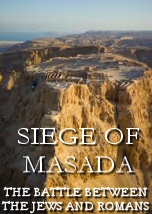




We take a look at the events that inspired the CBS television miniseries 'The Dovekeepers' and go to the site of the mountain fortress itself, uncovering new truths about this epic conflict.