The magnificent ringed planet Saturn, along with its more than 80 moons, forms the most dynamic planetary system in our neighborhood. With underground oceans and protective magnetic fields, experts are exploring how this collective of satellites has the potential to rewrite the rules of the Solar System. The closer that we look, the more we see these extraordinary moons like worlds of their own -- so dynamic, so Earth-like. Almost a billion miles from the Sun, these icy worlds could be home for Life 2.0. The moons of Saturn offer possibly the best chance of finding extraterrestrial life in our solar system. With each new mission, we get closer to unraveling the mysteries of Saturn's moons.
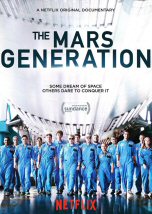
This history of NASA includes a look at a group of youths attending a space camp, whose enthusiasm could be the key to launching an expedition to Mars. 'Ever since we first began exploring space, every generation has had a craft to transport their dreams into space. We have seen the Apollo Era, the Shuttle Era, and now we are ready to see the Orion Era. My generation, the Mars Generation, will make it happen. It's our time, we are ready.' - Astronaut Abby.
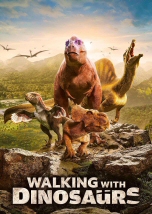
An entire world long vanished, reborn in breathtaking detail. Through the lens of cutting-edge science, each episode uncovers the untold story of a single dinosaur — its fears, its fights, its desperate struggle to survive in a brutal prehistoric landscape. With state-of-the-art visual effects and the latest fossil discoveries, this groundbreaking series offers an unprecedented, intimate look at the daily lives of Earth’s most legendary creatures. More than just science — this is raw drama, real survival, and nature at its most spectacular. We offer the complete 6-episode collection of this magnificent series, presented as a nearly 5-hour long documentary experience.
This remarkable series profiles on the major defendants of the Nuremberg war crimes trials. In the first episode, Nathaniel Parker plays the most inscrutable Nazi on trial at Nuremberg, Hitler's architect and armaments minister Albert Speer. He was the only defendant who unreservedly accepted responsibility for the Nazis' crimes. But was Speer's remorse genuine or just a clever defense strategy to get off the hook? The film tells the intriguing behind-the scenes-story of Speer's trial and his showdown with unrepentant rival, Hermann Goering.
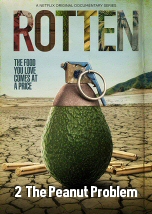
Around the world, food allergies are surging to near-epidemic levels. Medicine is just beginning to understand why some people react to seemingly harmless foods. Scientists race to understand what's changed in our bodies, while farmers and chefs contend with new challenges.
At 11 o'clock on New Year's Eve of the Cosmic Calendar, Homo erectus stood up for the first time, freeing its hands and earning the species its name. They began to move around, to explore, daring to risk everything to get to unknown places. Our Neanderthal relatives lived much as we did and did many of the things we consider to be 'human.' More restless than their cousins the Neanderthals and Denisovans, our Homo sapiens ancestors crossed seas and unforgiving landscapes, changing the land, ocean and atmosphere, leading to mass extinction. The scientific community gave our age a new name, 'Anthropocene.' Since the first civilizations we've wondered if there's something about human nature that contains the seeds of our destruction. Syukuro Manabe was born in rural Japan and took an intense interest in Earth's average global temperature. In the 1960's, he would assemble the evidence he needed to predict the increase of Earth's temperature due to greenhouse gases until it becomes an uninhabitable and toxic environment, leading to our extinction. 'This doesn't have to be,' says Neil deGrasse Tyson, 'it's not too late. There's another hallway, another future we can still have; we'll find a way.'














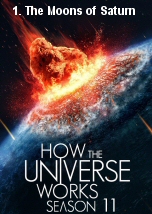







The closer that we look, the more we see these extraordinary moons like worlds of their own -- so dynamic, so Earth-like. Almost a billion miles from the Sun, these icy worlds could be home for Life 2.0. The moons of Saturn offer possibly the best chance of finding extraterrestrial life in our solar system. With each new mission, we get closer to unraveling the mysteries of Saturn's moons.