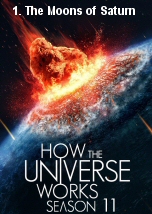
The magnificent ringed planet Saturn, along with its more than 80 moons, forms the most dynamic planetary system in our neighborhood. With underground oceans and protective magnetic fields, experts are exploring how this collective of satellites has the potential to rewrite the rules of the Solar System. The closer that we look, the more we see these extraordinary moons like worlds of their own -- so dynamic, so Earth-like. Almost a billion miles from the Sun, these icy worlds could be home for Life 2.0. The moons of Saturn offer possibly the best chance of finding extraterrestrial life in our solar system. With each new mission, we get closer to unraveling the mysteries of Saturn's moons.
Around the world, food allergies are surging to near-epidemic levels. Medicine is just beginning to understand why some people react to seemingly harmless foods. Scientists race to understand what's changed in our bodies, while farmers and chefs contend with new challenges.
A majestic presence, towering over Paris for more than 130 years, the Eiffel Tower is an iconic symbol of 19th-century progress and grandeur. When it was built for the 1889 Paris world’s fair, its creator, Gustave Eiffel, was at the height of his fame and ready to take on the dream of every engineer and architect - to build the world’s tallest man-made structure. He had just two years, two months and five days to erect his 300-metre iron colossus. Drawing on three decades of civil engineering innovation and works across the globe, Eiffel, a magician of iron building, was perfectly poised for this extraordinary feat.
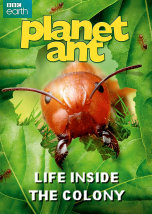
Ant colonies are one of the wonders of nature - complex, organised and mysterious. This programme reveals the secret, underground world of the ant colony in a way that's never been seen before. At its heart is a massive, full-scale ant nest, specially designed and built to allow cameras to see its inner workings. The nest is a new home for a million-strong colony of leafcutter ants from Trinidad. For a month, entomologist Dr George McGavin and leafcutter expert Professor Adam Hart capture every aspect of the life of the colony, using time-lapse cameras, microscopes, microphones and radio tracking technology.
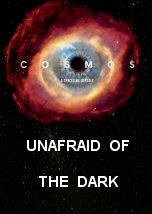
Tyson describes the discovery of cosmic rays by Victor Hess through high-altitude balloon trips. Swiss Astronomer Fritz Zwicky, in studying supernovae, postulated that these cosmic rays originated from these events instead of electromagnetic radiation. Also tells how Vera Rubin observed that the rotation of stars at the edges of observable galaxies did not follow expected rotational behavior leading to consider the existence of dark matter. This further led to the discovery of dark energy to account for the increasing rate of expansion of the universe. Tyson then describes the interstellar travel of the two Voyager probes. Tyson tells the Carl Sagan's role in the Voyager program, including creating the Voyager Golden Record to encapsulate humanity and Earth's position in the universe. Tyson concludes the series by emphasizing Sagan's message on the human condition in the vastness of the cosmos, and to encourage viewers to continue to explore and discover what else the universe has to offer.
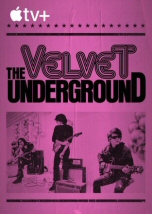
A kaleidoscopic immersion into the underground art and music scene of 1960s New York, this documentary eschews conventional rock biographies in favor of a sensory-rich, cinematic experience. Through a vibrant mosaic of avant-garde films, rare archival footage, and personal testimonies, it paints the Velvet Underground not just as a band—but as the beating heart of a creative explosion. By interweaving interviews with John Cale and Maureen Tucker alongside voices from their cultural milieu, the film evokes the fraught, fragile energy of a time when music intersected with performance, queerness, and counterculture. More than a story about a band, it is a journey into a cultural explosion that still resonates today.
















The closer that we look, the more we see these extraordinary moons like worlds of their own -- so dynamic, so Earth-like. Almost a billion miles from the Sun, these icy worlds could be home for Life 2.0. The moons of Saturn offer possibly the best chance of finding extraterrestrial life in our solar system. With each new mission, we get closer to unraveling the mysteries of Saturn's moons.