We inhabit a cosmos of undiscovered dimensions and paradoxical realities. We live on one level of perception, but there are others. Every once in a while, a searcher happens upon the doorway to one of these other levels. One of them discovered a paradox about reality that proved to be so profound, we have yet to understand how it could be possible. The universe, or perhaps we should say, universes have never been the same. In the counterintuitive realm of quantum mechanics, light can be two contradictory things, and somehow - no one knows how - an unseen observer can alter the nature of reality. The man who stumbled on this hole in reality and the still- unfolding technological revolution that it made possible.
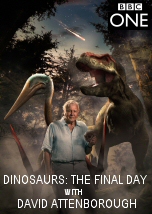
In the last episode, Austroposeidon level trees in search of fresh foliage. A herd of Triceratops journey through a cave to find an underground clay lick. A male Carnotaurus sets the stage for an extravagant display. A female Qianzhousaurus uses an autumn storm to her advantage while hunting Corythoraptor. A family of Edmontosaurus evade a forest fire, while an Atrociraptor and Ankylosaur reap its rewards. Juvenile Therizinosaurus attempt to climb up to a bee nest. Hatzegopteryx hunts Zalmoxes, and patrols the dense undergrowth and seaspray-battered coastline.
On a dusty highway between Australia's most isolated city and its largest gold pit lies Coolgardie - where the arrival every three months of a new pair of foreign backpackers to work the only bar in town is a keenly anticipated event. Fresh off the plane and lured by the promise of an authentic outback experience, Finnish travellers Lina and Steph find themselves en route to a dot on the map - to pour beers, replenish depleted travel funds, and live amongst the locals. But their working holiday quickly deteriorates into a baptism of fire. Harangued by their new boss, relentlessly pursued by booze-addled patrons, and prey to the madness and malaise of an environment as claustrophobic as it is isolated - the girls soon realise that to meet expectations out here, they'll need to do more than just serve drinks.
David Attenborough embarks on an extraordinary journey to unravel one of nature s most gripping stories the evolution of flying animals. The power of flight is one of the greatest miracles of nature. Over one hundred billion creatures soar through the air today - from nectar-drinking hummingbirds, to armoured airborne beetles; from bats hunting in the black of night, to bizarre winged lizards. The film travels back in time to unravel the astonishing 300-million-year story of how these animals first appeared, and then evolved into the huge variety of aeronauts that fill our skies today. Only now, using the latest scientific analysis, can he reveal the hidden mechanics behind their gravity-defying skills. Ground-breaking 3D cameras, high speed filming and stunning CGI bring the viewer closer than ever to this astounding aerial world.
Episode 7 focuses specifically on first contact and the search for intelligent life in the vastness of the cosmos. Are humans ready to make first contact with other intelligent beings? Is our technology even sophisticated enough to detect communication signals from another world? Who are we to search for alien intelligence when we can't even recognize or respect the consciousness all around us, or even beneath our feet. Neil deGrasse Tyson reveals the hidden underground network that is a collaboration of four kingdoms of life, and a true first contact story between humans and beings who communicate in a symbolic language and have maintained a representative democracy for many tens of millions of years.
This episode explores the nature of the greenhouse effect (discovered by Joseph Fourier and Svante Arrhenius), and the evidence demonstrating the existence of global warming from humanity's influence. Tyson begins by describing the long-term history of the planet Venus; based on readings from the Venera series of probes to the planet, the planet had once had an ocean and an atmosphere, but due to the release of carbon dioxide from volcanic eruptions, the runaway greenhouse effect on Venus caused the surface temperatures to increase and boiled away the oceans. Tyson then notes the delicate nature of the amount of carbon dioxide in the atmosphere can influence Earth's climate due to the greenhouse effect, and that levels of carbon dioxide have been increasing since the start of the 20th century. Evidence has shown this to be from mankind's consumption of oil, coal, and gas instead of from volcanic eruptions due to the isotopic signature of the carbon dioxide. The increase in carbon dioxide has led to an increase in temperatures, in turn leading to positive feedback loops of the melting polar ice caps and dethawing of the permafrost to increase carbon dioxide levels. Tyson then notes that humans have discovered means of harvesting solar power, such as Augustin Mouchot's solar-driven motor in the 19th century, and Frank Shuman's solar-based steam generator in the 1910's. Tyson points out that in both cases, the economics and ease of using cheap coal and oil caused these inventions to be overlooked at the time. Today, solar and wind-power systems would be able to collect enough solar energy from the sun easily. Tyson then compares the motivation for switching to these cleaner forms of energy to the efforts of the Space race and emphasizes that it is not too late for humanity to correct its course.

















In the counterintuitive realm of quantum mechanics, light can be two contradictory things, and somehow - no one knows how - an unseen observer can alter the nature of reality. The man who stumbled on this hole in reality and the still- unfolding technological revolution that it made possible.