












Last Watched

"City"  Sort by

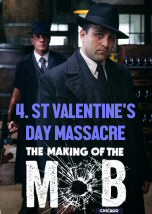
St Valentine Day Massacre

   2016    History
Al Capone moves back to Chicago and takes over two floors of the city's finest hotel, the Lexington. With a thriving business and Chicago politicians in his back pocket, Capone soon reaches a level of celebrity normally reserved for athletes and entertainers. As Capone's profile grows, he begins to indulge in all that the Roaring '20s have to offer, including cocaine. While Capone enjoys his reign at the top of the Chicago underworld, Irish gangster Bugs Moran seeks to take him down as revenge for the deaths of his partners Dean O'Banion and Hymie Weiss. On March 7, 1928, Moran orders a hit on one of Capone's top associates, Jack McGurn, the man who took out Hymie Weiss. McGurn survives but Capone decides to retaliate by taking out Moran and as many of his men as possible - all at once. On February 14, 1929, Capone's men dress as law enforcement and raid the liquor buy. They order Moran's men to face the wall for handcuffing, but while their backs are turned, Capone's men shoot all of them. Firing 70 rounds of ammunition in less than 10 seconds, the assassins carry out the biggest gangland hit in American history that will come to be known as the St. Valentine's Day Massacre. Through a stroke of luck, Moran avoids the massacre, but knows he's been defeated.
Series: The Making of the Mob


Rise of the Drones

   2013    Technology
These unmanned flying robots–some as large as jumbo jets, others as small as birds–do things straight out of science fiction. Much of what it takes to get these robotic airplanes to fly, sense, and kill has remained secret. But now, with rare access to drone engineers and those who fly them for the U.S. military, we reveal the amazing technologies that make drones so powerful". From cameras that can capture every detail of an entire city at a glance to swarming robots that can make decisions on their own to giant air frames that can stay aloft for days on end, drones are changing our relationship to war, surveillance, and each other. And it's just the beginning. Discover the cutting edge technologies that are propelling us toward a new chapter in aviation history

The Age of Invention

   2014    Science
Just under 200 years ago scientists discovered something profound, that electricity is connected to another of nature's most fundamental forces - magnetism. In the second episode, Jim discovers how harnessing the link between magnetism and electricity would completely transform the world, allowing us to generate a seemingly limitless amount of electric power which we could utilise to drive machines, communicate across continents and light our homes. This is the story of how scientists and engineers unlocked the nature of electricity in an extraordinary century of innovation and invention.
Series: Shock and Awe: The Story of Electricity

What is the Secret of Life

   2010    Science
The story of how the secret of life has been examined through the prism of the most complex organism known - the human body. It begins with attempts to save the lives of gladiators in Ancient Rome, unfolds with the macabre work and near-perfect drawings of Leonardo in the Renaissance, through the idea of the 'life force' of electricity, to the microscopic world of the cell. It reveals how a moral crisis unleashed by work on the nuclear bomb helped trigger a great breakthrough in biology - understanding the structure and workings of DNA.
Series: The Story of Science

To the Bitter End

   2007    History
The determination of the German forces to keep on fighting in the face of defeat had disastrous consequences. After the Allied landings in the summer of 1944, the Wehrmacht was on the defensive on all fronts. It was clear to the German generals interned at Trent Park that Germany would soon lose the war. In mid-1944, Gerhard Graf von Schwerin chose to use common sense instead of blindly obeying Hitler's orders. He decided to surrender the city of Aachen to the US army to avoid bloodshed. Other commanders such as Field Marshal Ferdinand Schorner kept on pushing their soldiers to give their all. Despite being outnumbered by the Soviet forces, Schorner forced his soldiers to hold out in Sworbe, a 200 square kilometre peninsula on the coast of Estonia. Thousands of soldiers died. Yet Schorner's attitude and the urging by Hitler and Goebbels to hold out were accepted by a large number of young soldiers. By April 1944, the Ruhr pocket was completely surrounded, yet Field Marshal Model refused to surrender, so that 1.2 million German soldiers and a large number of Allied soldiers died between January and May 1945.
Series: The Wehrmacht

Blood Filled Streets

   2016    History
After the murder of his brother Frank, Al Capone is out for revenge against William Dever and the Chicago police. He plots to kill every undercover cop that was in Cicero on the day of Frank’s death. Before he can set his plan in motion, however, Johnny Torrio returns from Italy and reclaims his control of their criminal empire. Torrio forbids Capone from killing cops, fearing it would spark an all-out war. Despite Capone’s personal loss, Torrio returns to a booming business that’s raking in $10 million a month. However, as Torrio and Capone’s empire grows, it becomes harder to keep smaller factions under control. After a small group of Italian mobsters attacks one of Dean O’Banion’s distilleries, O’Banion blames Torrio and decides to end their business partnership. He announces his retirement to Torrio and offers Torrio an opportunity to buy him out. Torrio meets O’Banion at the Seine Brewery on May 19, 1924, with the buyout money. Chicago police raid the brewery and arrest Torrio while letting O’Banion walk free: O’Banion had set the whole thing up. With prior convictions, Torrio serves a mandatory prison sentence but is first released on bail. He vows to kill O’Banion as payback and gives Capone his blessing to kill O’Banion. Capone spends months planning the hit. Capone knows that catching O’Banion off guard is nearly impossible, so he places an order with O’Banion’s flower shop for nearly $20,000 worth of flowers, knowing that O’Banion personally oversees his biggest arrangements. On November 10, 1924, O’Banion works in his shop preparing the flower delivery. Two of Capone’s men enter the shop and fatally gun O’Banion down. Four days later, Chicago’s most powerful Irish gangster is laid to rest in one of the most lavish funerals Chicago has ever seen. More than two dozen cars are required to transport floral arrangements as a crowd of 10,000 mourns the death of the infamous gangster. Torrio and Capone attend the funeral, infuriating O’Banion’s top lieutenants, Hymie Weiss and Bugs Moran. Chaos breaks out as smaller gangs through the city begin a turf war. It’s the beginning of an era of bloodshed in Chicago known as the Beer Wars. Over 300 people are murdered at a rate of 75 to 100 murders a year.
Series: The Making of the Mob