In a world where the pursuit of health pushes us towards organic aisles and fresh produce, this film uncovers a chilling revelation: the very foods promoted for wellness might be our greatest peril. As we navigate grocery store aisles, seemingly benign items like romaine lettuce, cut fruit, and even infant formula hide tales of contamination and legal battles. This gripping exposé dives deep into the unsettling truth about our food, revealing risks where we least expect them. With every bite, we make choices about our health. But what if those choices, even the most well-intentioned ones, are not as safe as we believe? Poisoned: The Dirty Truth About Your Food challenges our perceptions and urges viewers to question: In the modern food landscape, is anything truly safe? The film is a truly call to action for the officials who have the power to mitigate the danger caused by foodborne pathogens that kill thousands of people every year.
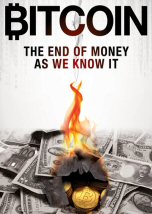
The concept of a digital, decentralized currency is questioning things and the answers being spilled out are deep-seated, long-standing propositions that place a magnifying glass onto the seemingly untouchable financial institutions at the base of modern commerce. What may be uncovered in the philosophical, political, and economic questions could have radical implications for the rest of the 21st century". The documenteray ushers us in, not to explore simply Bitcoin, but to hint at the basis of trade, commerce, and civil society. Director Torsten's story of money is one filled with promise like a sunrise over a landscape of human spirit.
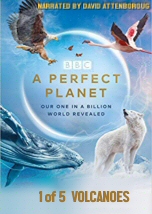
Our planet is one in a billion. How incredible, awe-inspiring life is driven by its natural forces - and how we can ensure humans become a force for good. David Attenborough narrates a series revealing how the forces of nature drive, shape and support the Earth's great diversity of life. The first edition examines volcanoes, which responsible for both for the planet's breathable atmosphere and the oceans, but are also the architects of the planet, with over 80% of the Earth's surface being the result of magma bursting up from the molten interior - providing a platform for life.
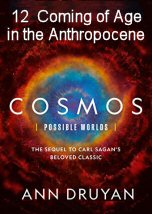
At 11 o'clock on New Year's Eve of the Cosmic Calendar, Homo erectus stood up for the first time, freeing its hands and earning the species its name. They began to move around, to explore, daring to risk everything to get to unknown places. Our Neanderthal relatives lived much as we did and did many of the things we consider to be 'human.' More restless than their cousins the Neanderthals and Denisovans, our Homo sapiens ancestors crossed seas and unforgiving landscapes, changing the land, ocean and atmosphere, leading to mass extinction. The scientific community gave our age a new name, 'Anthropocene.' Since the first civilizations we've wondered if there's something about human nature that contains the seeds of our destruction. Syukuro Manabe was born in rural Japan and took an intense interest in Earth's average global temperature. In the 1960's, he would assemble the evidence he needed to predict the increase of Earth's temperature due to greenhouse gases until it becomes an uninhabitable and toxic environment, leading to our extinction. 'This doesn't have to be,' says Neil deGrasse Tyson, 'it's not too late. There's another hallway, another future we can still have; we'll find a way.'
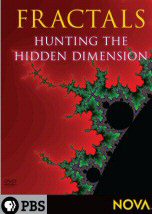
The ultimate adventure in scientific inquiry, this fascinating program follows the exploits of a small group of pioneering mathematicians who discovered a whole area of study that is revolutionizing all branches of understanding in the world: fractal geometry. Fractals are most recognized as a series of circular shapes with a border surrounded by jagged "tail-like" objects. The program, aimed at the average viewer does a fine job of explaining the background of fractals, first by beginning with the story of Pixar co-founder, Loren Carpenter's work at Boeing, developing 3D terrain from scratch using fractals. From there the program starts at the beginning with an introduction to Benoit Mandelbrot and his revolutionary work. The explanations are full of solid factual information but never talk above the level of a viewer who has some understanding of basic mathematical principles. Once the concept is presented the program spends the rest of the time showing how prevalent the fractal is in life. For a program about a mathematical concept, "Fractals" is very engaging, showing how the process was applied to special effects as far back as the Genesis planet from "Star Trek II" all the way to the spectacular finale on Mustafar in "Star Wars: Episode III." I found myself astonished at how fractals were the source of the lava in constant motion and action during the Obi-Wan/Anakin fight. What is more amazing is when the program delves into practical applications such as cell phone antennas, and eventually the human body. For the average person who enjoys watching science related programs, even on a sporadic basis, "Fractals" will prove to be a very worthwhile experience. The program is well produced, integrating talking head interviews (including some with Mandelbrot himself) with standard "in the field" footage. The structure of the program is very logical and never finds itself jumping around without direction. In simplest terms, this is a program as elegant as the designs it focuses on.
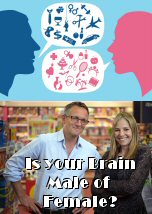
Dr Michael Mosley and Professor Alice Roberts investigate if male and female brains really are wired differently. New research suggests that the connections in men and women's brains follow different patterns, patterns which may explain typical forms of male and female behaviour. But are these patterns innate, or are they shaped by the world around us?" Using a team of human lab rats and a troop of barbary monkeys, Michael and Alice test the science and challenge old stereotypes. They ask whether this new scientific research will benefit both men and women - or whether it could drive the sexes even further apart.



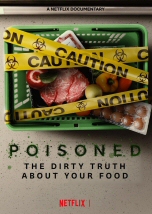


With every bite, we make choices about our health. But what if those choices, even the most well-intentioned ones, are not as safe as we believe? Poisoned: The Dirty Truth About Your Food challenges our perceptions and urges viewers to question: In the modern food landscape, is anything truly safe? The film is a truly call to action for the officials who have the power to mitigate the danger caused by foodborne pathogens that kill thousands of people every year.