


Last Watched

"Arrow"  Sort by

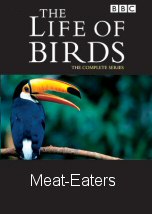
Meat-Eaters

   1998    Nature
This episode examines those birds whose sustenance comes from flesh and their methods of hunting. In New Zealand, Sir Attenborough observes Keas, parrots that do not eat meat exclusively, raiding a shearwater's burrow for a chick. However, it is the dedicated birds of prey, such as owls, buzzards, eagles, falcons and vultures, to which much of the programme is devoted. In order to spot and pursue their victims, senses of sight and hearing are very acute. Vultures are the exception, in that they eat what others have left, and once a carcass is found, so many birds descend on it that the carrion seems submerged beneath them. The Turkey Vulture is an anomaly within its group, as it also has a keen sense of smell. Eagles defend their territory vigorously, and a pair of sea eagles are shown engaging in an aerial battle. The Galápagos Hawk hunts Marine Iguanas, but can only do so when its quarry is vulnerable, during the breeding season. The African Harrier Hawk has adapted to extracting burrowing animals by virtue of an especially long, double-jointed pair of legs. By contrast, a shrike is not equipped with the requisite sharp beak and talons needed for butchery, and so dismembers its kill by impaling it on the thorns of acacias. The Lammergeier eats bones, and will drop them on to rocks from a great height in order to break them down to a digestible size. Also featured are the Eurasian Sparrowhawk, Goshawk and Peregrine Falcon.
Series: The Life of Birds
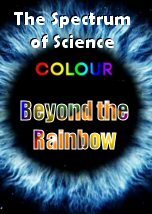

Beyond the Rainbow

   2015    Science
Helen Czerski ventures beyond the visible spectrum in the final (and best) episode in this vibrant series, showing how electromagnetic radiation is so much broader than the narrow slice of reality we see with our eyes. Before delving into the details of UV, infrared and x-rays, Dr Czerski explores colour subjectivity by trying on a dress that recently divided the internet — to some it appeared blue and black, to others white and gold. It's a perfect fit. It's also a neat analogy of how people can have opposing views but both swear blind that their perspective is correct. The series ends with some amazing imaging techniques that show our bodies in a whole new light.
Series: Colour The Spectrum of Science

Music for Montserrat

       Art
The event was organised by George Martin, former producer for The Beatles, to raise funds for the Caribbean island of Montserrat after a major volcanic eruption earlier that year. This unrepeatable event starred many iconic British and American rock musicians such as Phil Collins, Ray Cooper, Carl Perkins, Jimmy Buffett, Mark Knopfler, Sting, Elton John, Eric Clapton, Paul McCartney, Midge Ure, Arrow and many more. This concert was held on 15 September 1997 at the Royal Albert Hall.

Judgment Day

   2016    History
In 1927, Prohibition agent Eliot Ness narrowly escapes a hit ordered by Al Capone. Determined to prove to Capone that he's not intimidated, Ness and his team of Untouchables execute a series of high-profile raids on Capone's breweries. Over the course of a few months, they destroy more than 200,000 gallons of beer, worth a modern-day equivalent of $134 million - and the newspapers cover it all. Capone lashes out against Ness in the press. What Capone doesn't realize is that Ness and the Prohibition agents aren't the only ones trying to take him down. For the past four years, another government agency with more manpower and resources than Ness has been going after the infamous kingpin: the Internal Revenue Service.
Series: The Making of the Mob

Out of Sight

   2012    Science
The human eye is a remarkable piece of precision engineering, but it is also extremely limited. Beyond the narrow range of light that makes up the familiar colours of the rainbow is a vast spectrum of light, entirely unseen. Richard Hammond does just that, using ground-breaking new imaging technologies to take the viewer on a breath-taking journey of discovery beyond the visible spectrum, seeing the world, quite literally, in a whole new light. From death-defying aerial repairmen in the United States using ultraviolet cameras to seek out an invisible force that lurks unseen on power lines, to German scientists unlocking the secrets of animal locomotion with the world's most powerful moving x-ray camera, to infrared cameras that can finally reveal the secrets within a humble beehive, he shows how new technologies are letting us see our world anew.
Series: Invisible Worlds

Take Care of Maya

   2023    Culture
When nine-year-old Maya Kowalski was admitted to Johns Hopkins All Children's Hospital in 2016, nothing could have prepared her or her family for what they were about to go through. As the medical team tried to understand her rare illness, they began to question the basic truths that bound the Kowalskis together. Suddenly, Maya was in state custody despite two parents who were desperate to bring their daughter home. The story of the Kowalski family as told in their own words will change the way you look at children's healthcare forever.
'Take Care of Maya' delves into the harrowing narrative of a family navigating the treacherous waters of the U.S. parental rights. The storyline underscores the agonizing journey of parents who find themselves battling against seemingly insurmountable odds to reclaim their child. As the story unfolds, it becomes evident that the issues they face are deeply entrenched in the ethical and moral dilemmas of the U.S. system. The narrative hints at potential flaws in the healthcare or judicial sectors that further complicate their fight for justice. Throughout, the audience is exposed to raw emotions, moments of despair, confrontation, and an unwavering spirit of resilience.