Witness the secret powers of extraordinary animals, experience the world as they do and see the SUPER/NATURAL side of nature as never before. Executive produced by James Cameron and narrated by Benedict Cumberbatch, this series uses the scientific innovations and leading-edge filmmaking technology to reveal the secret powers and super-senses of the world’s extraordinary animals. See flowers in bee-vision to eavesdropping on conversations between elephant seals to soaring the length of a football field with glow-in-the-dark squirrels. They say in nature that only the strongest survive. But when cooperation and communication bring animals and plants together and superpowers combine even the most vulnerable can become unstoppable. If you think you know nature, think again.
Frequent security expos feature companies like Megvii and its facial- recognition technology. They show off cameras with A.I. that can track cars, and identify individuals by face, or just by the way they walk. In China it's been projected that over 600 million cameras will be deployed by 2020. Here, they may be used to discourage jaywalking, but they also serve to remind people that the state is watching. Matching with the most advanced artificial intelligence algorithm, they can actually use this data, real-time data, to pick up a face or pick up a action. A.I. is a technology that can be used for good and for evil. So, how do governments limit themselves in, on the one hand, using this A.I. technology and the database to maintain a safe environment for its citizens, but not to encroach on a individual's rights and privacies?
The fiercest, strangest, and wildest creatures in the animal kingdom face off in a countdown of the most incredible animal moments ever recorded. Across arid deserts, through dense rainforests, and into the deepest of oceans, witness remarkable scenes of animal activity, from deadly showdowns to wild romances.
In early 2003, a team of Italian thieves orchestrated one of the boldest robberies in modern history: The disappearance of hundreds of millions in diamonds from the heavily guarded vaults of Antwerp. Through unprecedented access to archival footage, police records, and newly recorded interviews, the film reconstructs the intricate planning that allowed the so-called School of Turin to bypass what was believed to be impenetrable security. Told with a balance of suspense and reflection, it confronts investigators with the alleged mastermind, weaving a story of ambition, betrayal, and the mystery of gems never recovered. Beyond the spectacular details of the heist, it examines the toll on jewelers, insurers, and investigators, while questioning how ingenuity, greed, and betrayal blur the lines between admiration and crime.
Professor Brian Cox fulfils a childhood dream by going behind the scenes at Nasa’s Jet Propulsion Laboratory (JPL), mission control for Mars 2020 – one of the most ambitious missions ever launched that may finally reveal if life ever existed on the red planet. In 1980, a young Brian Cox wrote to JPL asking for photos from some of their missions to the planets. The pictures they sent him from Voyager and the Viking mission to Mars were a source of inspiration that set him on the path to becoming a physicist. Now, over 40 years later, he has been granted privileged access to JPL, including key mission areas that are usually off-limits to film crews. Brian spends a week following the team who guide the Perseverance rover and the Ingenuity helicopter - the first powered aircraft ever sent to another planet - across the surface of Mars during a critical stage of the mission. Perseverance’s goal is to search for signs of long extinct life on the surface of Mars in an area called Jezero Crater, which, 3.8 billion years ago, was filled by a vast lake. If it finds evidence of that life, it could change everything we know about life in the universe - and even transform our understanding of our own origins.
The fifth programme explores the alliances formed between the animal and plant worlds. Attenborough dives into Australia's Great Barrier Reef and contrasts the nocturnal feeding of coral, on microscopic creatures, with its daytime diet of algae. Some acacias are protected by ants, which will defend their refuge from any predator. Besides accommodation, the guards are rewarded with nectar and, from certain species, protein for their larvae as well. Fungi feed on plants but can also provide essential nutriment to saplings (Mycorrhiza). The connection is never broken throughout a tree's life and a quarter of the sugars and starches produced in its leaves is channelled back to its fungal partners. Meanwhile, fungi that feed on dead wood leave a hollow trunk, which also benefits the tree. Orchids enjoy a similar affiliation. Lichens are the product of a relationship between fungi and a photosynthetic associate, usually algae. They are extremely slow-growing, and a graveyard is the perfect location to discover their exact longevity. Mistletoe is a hemiparasite that obtains its moisture from a host tree, while using own leaves to manufacture food. Its seeds are deposited on another by the mistletoe tyrannulet, following digestion of the fruit. The dodder (Cuscuta) is also parasitic, generally favouring nettles, and siphons its nourishment through periodic 'plugs' along its stem. The rafflesia has no stem or leaves and only emerges from its host in order to bloom — and it produces the largest single flower: one metre across.







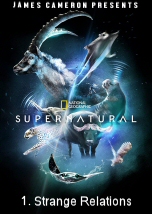



They say in nature that only the strongest survive. But when cooperation and communication bring animals and plants together and superpowers combine even the most vulnerable can become unstoppable. If you think you know nature, think again.