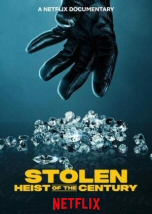
In early 2003, a team of Italian thieves orchestrated one of the boldest robberies in modern history: The disappearance of hundreds of millions in diamonds from the heavily guarded vaults of Antwerp. Through unprecedented access to archival footage, police records, and newly recorded interviews, the film reconstructs the intricate planning that allowed the so-called School of Turin to bypass what was believed to be impenetrable security. Told with a balance of suspense and reflection, it confronts investigators with the alleged mastermind, weaving a story of ambition, betrayal, and the mystery of gems never recovered. Beyond the spectacular details of the heist, it examines the toll on jewelers, insurers, and investigators, while questioning how ingenuity, greed, and betrayal blur the lines between admiration and crime.
Everyone from the most simple-minded to the deepest thinking has pondered a question that strikes at the core of our existence: Is there life after death? What happens to the soul after we die? People who have had near-death experiences claim to have visited the other side before getting yanked back into consciousness. Now, some of the brightest minds in science are trying to understand how life can persist beyond the physical and what will it look like. It might be a quantum state based on the fundamental laws of the universe. Ultimately, it is a journey that struggles to decode the most complicated instrument in the universe: the human brain.
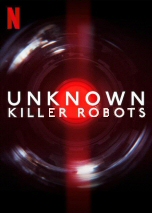
Frequent security expos feature companies like Megvii and its facial- recognition technology. They show off cameras with A.I. that can track cars, and identify individuals by face, or just by the way they walk. In China it's been projected that over 600 million cameras will be deployed by 2020. Here, they may be used to discourage jaywalking, but they also serve to remind people that the state is watching. Matching with the most advanced artificial intelligence algorithm, they can actually use this data, real-time data, to pick up a face or pick up a action. A.I. is a technology that can be used for good and for evil. So, how do governments limit themselves in, on the one hand, using this A.I. technology and the database to maintain a safe environment for its citizens, but not to encroach on a individual's rights and privacies?
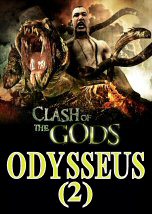
In part 2, we take a look at Odysseus, whom Homer made famous in "The Odyssey," including his adventures in light of astronomical and geographical evidence which bases the story on accurate real events.
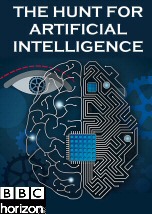
Marcus Du Sautoy wants to find out how close we are to creating machines that can think like us: robots or computers that have artificial intelligence. His journey takes him to a strange and bizarre world where AI is now taking shape. Marcus meets two robots who are developing their own private language, and attempts to communicate to them. He discovers how a super computer beat humans at one of the toughest quiz shows on the planet, Jeopardy". And finds out if machines can have creativity and intuition like us. Marcus is worried that if machines can think like us, then he will be out of business. But his conclusion is that AI machines may surprise us with their own distinct way of thinking.
Ideas about time and space are explored in the changes that constellations undergo over time, the redshift and blue shift measured in interstellar objects, time dilation in Albert Einstein's theory of relativity, the designs of both Leonardo da Vinci and spacecraft that could travel near light speed, time travel and its hypothetical effects on human history, the origins of the Solar System, the history of life, and the immensity of space. In Cosmos Update, the idea of faster-than-light travel by wormholes (researched by Kip Thorne and shown in Sagan’s novel Contact) is discussed.

















Told with a balance of suspense and reflection, it confronts investigators with the alleged mastermind, weaving a story of ambition, betrayal, and the mystery of gems never recovered. Beyond the spectacular details of the heist, it examines the toll on jewelers, insurers, and investigators, while questioning how ingenuity, greed, and betrayal blur the lines between admiration and crime.