











Last Watched

"Planet"  Sort by

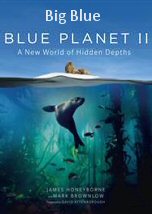
Big Blue

   2017    Nature
The big blue is the world's greatest wilderness, far from shore and many kilometres deep. It's a vast marine desert where there is little to eat and nowhere to hide. Yet it's home to some of the biggest and most spectacular creatures on earth. This episode reveals what it takes to survive in this savage and forbidding world. We witness feats of incredible endurance, moments of high drama and extraordinary acts of heart-wrenching self-sacrifice. Every animal in the big blue must find their own unique way to survive. Sperm whales have the largest brains in the world. They live for 80 years, and we are only now beginning to learn the extraordinary complexity of their language of clicks - thought to coordinate the whole family in everything from childcare to hunting. With special pressure-proof cameras, we witness record-breaking feats of endurance as they hunt for squid a kilometre down into the abyss. Only recently have we begun to solve the mystery of where baby turtles disappear to in their early years. They leave the crowded waters of the coast and head to the open ocean, where they use floating debris like logs as life rafts. Here they remain until adulthood, adrift on the high seas in relative safety away from coastal predators. Over half of all animals in the open ocean drift in currents. Jellyfish cross entire oceans feeding on whatever happens to tangle with their tentacles. The jelly-like Portuguese man-of-war can harness sail power to fish with its deadly tentacles. Sometimes there is a brief explosion of food in this marine desert, but ocean hunters must be fast to make the best of this bonanza. We witness super pods of up to 5,000 spinner dolphins racing to herd vast shoals of lanternfish, briefly caught at the surface where it is thought they spawn. New aerial footage reveals, for the first time, the truth to a centuries-old sailors' legend of the 'boiling seas' - the spectacular feeding frenzy of 90kg tuna and dolphins smashing through the lantern fish shoals turning the sea white with foam.
Series: Blue Planet II
Alien Worlds

   2016    Science
We are the generation of human beings that are going to know whether or not we're alone in the universe. This episode explores the search of exoplanets, from ancient Greek philosophers to the discoveries made possible with the Kepler Telescope. Unbelievable new worlds, planets made of diamond, planets of raining glass, worlds in collision, some plunging into stars, and others that just might harbor life.
Thanks to today's planet hunters, our views of the universe and of our place in it are undergoing one of the greatest revolutions in scientific history.
Series: The Universe Season 8

Caves

   2007    Nature
The Cave of Swallows in Mexico is a 400m vertical shaft, deep enough to engulf the Empire State Building. The Lechuguilla cave system in the USA is 193km long and 500m deep with astonishing crystal formations hanging from its chambers. Although often overlooked, caves are remarkable habitats with equally bizarre wildlife. Cave angel fish cling to the walls behind cave waterfalls with microscopic hooks on their flattened fins. Cave swiftlets navigate by echo-location and build nests out of saliva. The Texas cave salamander has neither eyes nor pigment. Unique access to a hidden world of stalactites, stalagmites, snotites and troglodytes brings a wealth of surprises.
Series: Planet Earth

Nowhere to Hide

   2015    Nature
The open arenas of grassland and desert make up half of all land on our planet. In these exposed habitats, predators like cheetahs, bald eagles and lions can usually see their prey. But it works both ways: their prey can see them too. With nothing but open vistas, the element of surprise is hard-won, and predators must make their own opportunities.
Series: The Hunt

Pluto: Back From the Dead

   2020    Science
The incredible story of how Pluto has been propelled from an unremarkable ball of ice on the edge of the solar system to a world of unimaginable complexity - where some form of alien life might exist.
New discoveries from the edge of the solar system are transforming what is known about Pluto, thanks to the New Horizons space probe that took the first-ever close up images of the planet. Pluto was once thought to be geologically dead, but the pictures revealed it to be an active world of stunning complexity, with mountains carved from ice, a nitrogen glacier that appeared to be moving and a recently active volcano, with data sent back lead some scientists to speculate that there may even be life on Pluto today.
Series: Space Deepest Secrets

Strangest Alien Worlds

       Science    HD
Discoveries of new planets have revealed countless worlds much stranger than Earth. Some of these strange worlds don’t have stars; others are made out of diamonds. Will we ever find a planet like Earth, or are these distant worlds stranger than fiction?
The Crusades

The Crusades

2012  History
Shine a Light

Shine a Light

2008  Art
Reel Rock

Reel Rock

2014  Culture
The Last Dance

The Last Dance

2020  Culture
The Sky at Night

The Sky at Night

2025  Science