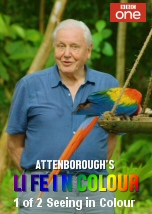
The natural world is full of colours. For us, they are a source of beauty, but for animals they are a tool for survival. David Attenborough reveals the extraordinary ways in which animals use colour: to win a mate, to fight off rivals and to warn enemies. New camera technologies - some developed especially for this series – also allow us to see colours and patterns usually invisible to human eyes. Ultraviolet cameras reveal bright signals on a butterfly’s wings and facial markings on yellow damselfish that are used as secret communication channels. Some animals can also detect polarized light, and specialist cameras can now show us how fiddler crabs see the world, and how mantis shrimp have strange polarization patterns on their bodies to signal to a mate or rival.
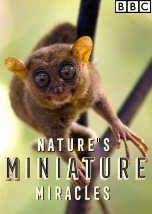
It really is a big bad world out there. So what happens if you are the little guy? This film tells the epic survival stories of the world's smallest animals. To make a living, these tiny heroes have evolved extraordinary skills and achieved mind-boggling feats. From the animal kingdom's greatest artist to the tiny creatures that provide us with so much of the air we breathe, we discover what it takes to be a miniature miracle.
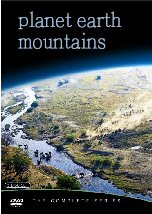
Welcome to an extreme landscape of rock, ice and snow. We tour the mightiest mountain ranges, starting with the birth of a mountain at one of the lowest places on Earth and ending at the summit of Everest. Find out how some of the most secretive animals rise to the challenge of mountain life. Share one of Earth's rarest phenomena, a lava lake that has been erupting for over 100 years. The same forces built the Simian Mountains where we find troops of gelada baboons nearly a thousand strong. In the Rockies, grizzlies build winter dens inside avalanche-prone slopes and climb the peaks to devour abundant summer moths. In another world first, the programme brings us astounding images of a snow leopard hunting on the Pakistan peaks.
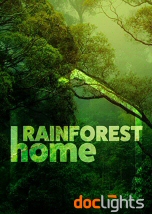
Rainforests face more threats than ever before, but remain the last stronghold for some truly astonishing animal families. Today we know rainforests are some of the most wondrous and important habitats on Earth. It is the richest habitat on earth, teeming with millions of dramatic plants and animals. From giant landscape gardeners to a whole family supported by a single leaf, there are surprises at every turn.
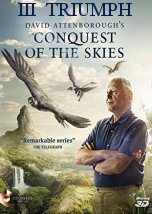
David Attenborough concludes his epic history of the evolution of flight with an exploration of the highly advanced fliers that dominate our skies today – the extraordinarily diverse skills of the birds, and the sonar-guided precision of the bats. He encounters some of our planet’s most remarkable fliers – from peregrine falcons dive-bombing starlings over Rome, to hummingbirds hovering in the cloud forests of Ecuador. In a spectacular finale, he visits Gomantong cave in Borneo to witness the mass exodus of a million bats.
In the fourth episode of the series, legendary nature and cultural photographer Art Wolfe captures the great brown bear with the stunning backdrop of Alaska’s mountains and glaciers, immigrating wildebeests in the plains East Africa, and the hard-to-find gorillas of Uganda.













Ultraviolet cameras reveal bright signals on a butterfly’s wings and facial markings on yellow damselfish that are used as secret communication channels. Some animals can also detect polarized light, and specialist cameras can now show us how fiddler crabs see the world, and how mantis shrimp have strange polarization patterns on their bodies to signal to a mate or rival.