









Last Watched

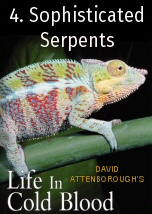
Sophisticated Serpents

   2008    Nature
David Attenborough reveals the fascinating lives of snakes, the most misunderstood group of reptiles. A CCTV stakeout of wild rattlesnakes hunting shows, for the first time, what sophisticated predators they truly are. Attenborough is also on the receiving end of a spitting cobra's chemical weapons system, while the surprisingly beautiful and tender side of snakes is displayed in the sinuous courtship of kingsnakes, and the water birth of 15 beautiful yellow anaconda babies.
Series: Life In Cold Blood
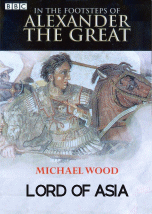
Lord of Asia

   1997    History
Michael crosses Iran towards the Caspian Sea. He meets nomads who tell of Alexander's tryst with an Amazon queen, and the living descendants of Alexander's Persian enemies, who have their own tales of `Alexander the Accursed'.
Series: In the Footsteps of Alexander the Great

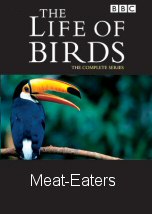
Meat-Eaters

   1998    Nature
This episode examines those birds whose sustenance comes from flesh and their methods of hunting. In New Zealand, Sir Attenborough observes Keas, parrots that do not eat meat exclusively, raiding a shearwater's burrow for a chick. However, it is the dedicated birds of prey, such as owls, buzzards, eagles, falcons and vultures, to which much of the programme is devoted. In order to spot and pursue their victims, senses of sight and hearing are very acute. Vultures are the exception, in that they eat what others have left, and once a carcass is found, so many birds descend on it that the carrion seems submerged beneath them. The Turkey Vulture is an anomaly within its group, as it also has a keen sense of smell. Eagles defend their territory vigorously, and a pair of sea eagles are shown engaging in an aerial battle. The Galápagos Hawk hunts Marine Iguanas, but can only do so when its quarry is vulnerable, during the breeding season. The African Harrier Hawk has adapted to extracting burrowing animals by virtue of an especially long, double-jointed pair of legs. By contrast, a shrike is not equipped with the requisite sharp beak and talons needed for butchery, and so dismembers its kill by impaling it on the thorns of acacias. The Lammergeier eats bones, and will drop them on to rocks from a great height in order to break them down to a digestible size. Also featured are the Eurasian Sparrowhawk, Goshawk and Peregrine Falcon.
Series: The Life of Birds

Woody Allen A Documentary 2

   2011    History
The film chronicles Allen's career - from teen writer to Sid Caesar's TV scribe, from stand-up comedian to award-winning writer-director averaging one film-per-year for more than 40 years. Exploring Allen's writing habits, casting, directing, and relationship with his actors first-hand, new interviews with A-listers, writing partners, family and friends provide insight and backstory to the usually inscrutable filmmaker.
Series: Woody Allen A Documentary

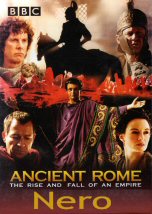
Ancient Rome: Nero

   2006    History
This programme focuses on Nero, charting his obsession with becoming a god, how his plans to turn Rome into a glorious city bankrupted the Empire, how he married his slaveboy and killed his beloved wife in a frenzy, and how he was finally overthrown.
Series: Ancient Rome

AlphaGo

   2017    Technology
With more board configurations than there are atoms in the observable universe, the ancient Chinese game of 'Go' has long been considered a grand challenge for artificial intelligence. On March 9, 2016, the worlds of Go and AI collided in South Korea for an extraordinary best-of-five-game competition, coined the Google DeepMind Challenge Match. Hundreds of millions of people around the world watched as a legendary Go master took on an unproven AI challenger for the first time in history.
AlphaGo chronicles a journey from the halls of Cambridge, through the backstreets of Bordeaux, past the coding terminals of DeepMind in London, and, ultimately, to the seven-day tournament in Seoul. As the drama unfolds, more questions emerge: What can artificial intelligence reveal about a 3000-year-old game? What can it teach us about human mind?