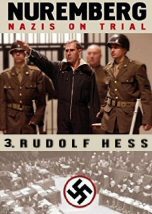
Episode three explores the mind of one of the most fanatical of all Nazis and the insight that gives into the psychology of dictatorship. Hess is brought to Nuremberg from the UK where he had flown 4 years earlier much to the bemusement of the British. Overy explains that they must have quickly realised he was not normal. In the intervening time Hess’s mental state has further deteriorated and when interviewed by Chief Interrogator Colonel John Amen proclaims amnesia. Chief Interpreter Richard Sonnenfeldt explains that they brought in Göring to confront Hess but that he too failed to make an impression. Psychopathologist Prof. Edgar Jones proposes Hess’s behaviour patterns may be his way of escaping reality as he is forced to face the extent of the atrocities and choose between accepting his part of the blame or forsaking his Führer. However, as history Professor Robert Gellatel explains it is difficult to construct a case against Hess as he was imprisoned in England when the worst of the atrocities were carried out so British Prosecutor Mervyn Griffith-Jones must argue a conspiracy charge linking the pre-1939 persecutions to the post-1939 atrocities and a crimes against peace charge proving the flight to Scotland was merely a ruse.
Wonder Woman is the most popular female comic-book superhero of all time. Aside from Superman and Batman, no other comic-book character has lasted as long. Like every other superhero, Wonder Woman has a secret identity. Unlike every other superhero, she also has a secret history. The history of her creation seven decades ago has been hidden away—until now. A riveting work of historical detection revealing that the origins of one of the world's most iconic superheroes hides within it a fascinating family story-and a crucial history of twentieth-century feminism. Take a look at the very unconventional lives of the man and women who created this iconic pop culture figure.
Episode 3 continues to show the obstacles faced with charging electric bikes in remote places, but Ewan McGregor and Charley Boorman start to learn and evolve their process. The risk of cold temperatures is high but they bravely do it anyway. The duo is having a hard time of it out there but, thankfully, the scenery is absolutely stunning. Heading through Patagonia, Ewan and Charley stay at an eco-lodge in one of the world’s remotest areas with people that live off the grid.
Dawkins opines that the moral framework of religions is warped, and argues against the religious indoctrination of children. He discusses specifically the idea of religion seen as a virus in the sense of a meme. He begins by explaining how a child is genetically programmed to believe without questioning the word of authority figures, especially parents – the evolutionary imperative being that no child would survive by adopting a sceptical attitude towards everything their elders said. But this same imperative, he claims, leaves children open to infection by religion.
It is the greatest technological challenge ever undertaken by humankind. The quest to produce the ultimate energy solution, Fusion, a reliable source of clean power. What if we could create here on earth, our very own version of a star, a machine that makes power from nuclear fuel? But so immense are the challenges, the goal of a power-producing fusion reactor has so far remained elusive and out of reach... until now.
Dr Janina Ramirez embarks on a journey through six decades of the BBC archives to create a television history of one of the most celebrated figures in art - Leonardo Da Vinci. Ramirez shows how experts and art presenters have turned to television to bring Leonardo's artwork out of galleries and into our living rooms. Through television they have explored the origins of Leonardo's boundless curiosity, his pioneering use of light and shade, and his remarkable scientific exploration. Along the way Dr Ramirez discovers Britain's little-known version of The Last Supper, the gruesome ways Leonardo acquired his anatomical knowledge - and even what lies beneath the Mona Lisa.



























Psychopathologist Prof. Edgar Jones proposes Hess’s behaviour patterns may be his way of escaping reality as he is forced to face the extent of the atrocities and choose between accepting his part of the blame or forsaking his Führer. However, as history Professor Robert Gellatel explains it is difficult to construct a case against Hess as he was imprisoned in England when the worst of the atrocities were carried out so British Prosecutor Mervyn Griffith-Jones must argue a conspiracy charge linking the pre-1939 persecutions to the post-1939 atrocities and a crimes against peace charge proving the flight to Scotland was merely a ruse.