Most planets we know of are so hellish, it seems impossible that anything could live. But it's amazing where life can take hold in the Earth. Astrobiologists look for simple single-celled microbes known as extremophiles in places as Danakil Depression, known in Ethiopia as 'The Gateway to Hell.' In Episode 2, the fictional world is Janus, a planet in such a close orbit than its rotation is locked by the star's gravity and it always shows the same face to its sun. On one side of the planet, it's always daytime, a searing desert. On the other side, it's forever night, a frozen shadowland. Squeezed between the two, a sliver of perpetual twilight. Freezing meltwater flows from the cold side, carving canyons through the landscape. Deep in these canyons lives an extraordinary five-legged creature.
Beneath Yellowstone National Park, lies the biggest volcano on Earth. An eruption in the past was so big it plunged the earth into a volcanic winter that lasted years. A super-eruption would be more than millions of Hiroshima bombs going off all at once. It would be even worse than an asteroid impact: Entire cities lost beneath ash, people and animals crushed alive, power networks destroyed, sun dimmed across the globe, harvests failed, widespread famine.
Could this nightmare really happen? We will use the latest scientific data to uncover the danger beneath us, as we see our planet like never before.
More than a film, it was conceived as a gift to the public and has been a major event all over the globe. Since World Environment Day, June 5, 2009, when it was released worldwide across all media platforms more than 400 million people have watched the film. Home is truly an astounding cinematic experience - a soulful voyage, a feast for the eyes, a thought-provoking and unforgettable journey. Directed by Yann Arthus-Bertrand
Zachary Quinto explores the unpredictable and terrifying phenomenon of sinkholes to determine just what causes them. He visits a Florida man whose brother was killed when their family home was literally swallowed whole by the Earth as well as a series of sinkholes that are forming a series of caves right below the houses of a quaint suburban neighbourhood. Whether they be a part of some biblical prophecy or further evidence of mankind's effect on our planet, he's alarmed to discover that all the same, they can strike anywhere in the world, at any time.
As tides rise and fall twice a day, vast amounts of water swirl around the earth. This is a huge energy source that's currently largely untapped. An estimated 3000 gigawatts are available to be harvested globally, enough to power a third of the earth's homes. Yet compared to wind and solar, the technology needed to harness tidal power is still in its infancy. The power of the ocean’s tides is the last great untapped energy source on Earth. From sub-sea kites to floating platforms, teams of engineers are racing to perfect the technology to harness the vast flows of water.
The Blue Marble is an image of Earth taken on 1972, from a distance of about 18,000 miles from the planet's surface. It was taken by the crew of the Apollo 17 spacecraft on its way to the Moon. Before it was photographed from space, our perspective of Earth was fragmented and disconnected. Recent discoveries have revealed a dynamic and rapidly changing planet, above the crust and below.











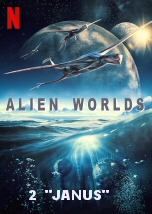


In Episode 2, the fictional world is Janus, a planet in such a close orbit than its rotation is locked by the star's gravity and it always shows the same face to its sun. On one side of the planet, it's always daytime, a searing desert. On the other side, it's forever night, a frozen shadowland. Squeezed between the two, a sliver of perpetual twilight. Freezing meltwater flows from the cold side, carving canyons through the landscape. Deep in these canyons lives an extraordinary five-legged creature.