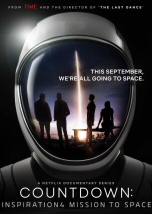
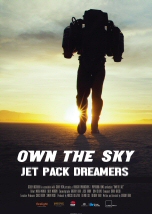
How what began as a passion for the tantalising possibilities of jetpacks became an obsession. Shot over ten years, this documentary chronicles Australian David Mayman's seemingly impossible quest to fulfil his childhood dream to build and fly the world’s first jetpack. His ambition, which nearly cost him his life and family, culminates in an attempt to make the world's first jetpack flight around the Statue of Liberty.
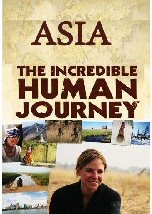
The journey continues into Asia, the world's greatest land mass, in a quest to discover how early hunter-gatherers managed to survive in one of the most inhospitable places on earth - the Arctic region of Northern Siberia. Alice also explores what may have occurred during human migration to produce Chinese physical characteristics, and considers a controversial claim about Chinese evolution: that the Chinese do not share the same African ancestry as other peoples.
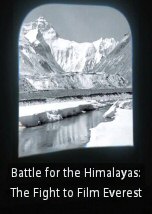
Between the 1920s and the 1960s the world's great powers sent vast military-style expeditions to conquer the peaks of the Himalayas, with Everest at their head. This was a great game played - camera in hand - by Imperial Britain, Nazi Germany and superpower America. As a result, Himalayan mountaineering's most iconic, epic and tragic moments didn't just go down in history, but were caught on film - from the deaths of Mallory and Irvine on Everest in 1924, to Everest's final conquest in 1953 by Hillary and Tensing. Using footage never before seen on British television, this is the story how of how film-makers turned the great peaks into great propaganda.
Discover our extraordinary world through a stunning cinematic experience -following the journeys of acclaimed photographers pursuing their personal projects. Their aim: changing people's perceptions through art. From the art of sacred nature, to the demons of the deep and the juxtaposition of life and death. Over the years Eric Cheng has dived with the planet's most magnificent creatures. Now he is determined to use his photography to tell the true story of the most misrepresented and demonised species.
Writing itself is 5,000 years old, and for most of that time words were written by hand using a variety of tools. The Romans were able to run an empire thanks to documents written on papyrus. Scroll books could be made quite cheaply and, as a result, ancient Rome had a thriving written culture. With the fall of the Roman Empire, papyrus became more difficult to obtain. Europeans were forced to turn to a much more expensive surface on which to write: Parchment. Medieval handwritten books could cost as much as a house, they also represent a limitation on literacy and scholarship. No such limitations were felt in China, where paper had been invented in the second century. Paper was the foundation of Chinese culture and power, and for centuries how to make it was kept secret. When the secret was out, paper mills soon sprang up across central Asia. The result was an intellectual flourishing known as the Islamic Golden Age. Muslim scholars made discoveries in biology, geology, astronomy and mathematics. By contrast, Europe was an intellectual backwater. That changed with Gutenberg’s development of movable type printing. The letters of the Latin alphabet have very simple block-like shapes, which made it relatively simple to turn them into type pieces. When printers tried to use movable type to print Arabic texts, they found themselves hampered by the cursive nature of Arabic writing. The success of movable type printing in Europe led to a thousand-fold increase in the availability of information, which produced an explosion of ideas that led directly to the European Scientific Revolution and the Industrial Revolution that followed.
The Apollo equipment has sat abandoned on the lunar surface for over 40 years. Now there is a renewed excitement and drive to return to the moon. This time, not to just plant a flag, but to colonize. How would we accomplish this? And why would we do it? The race is on to colonize the Moon, to uncover its hidden riches and discover if humanity can really survive on another world. The Moon is our gateway to our solar system, it's the stepping stone we have to become a multi-planetary species.












His ambition, which nearly cost him his life and family, culminates in an attempt to make the world's first jetpack flight around the Statue of Liberty.